Keploy AI Testing Industry Insights — 2026
Increase Developer Productivity With Keploy
From our 2026 AI Testing Industry Report — 76.8% of organisations globally now adopt AI in testing and 88% plan to increase investment. Discover how Keploy helps engineering teams reduce time-to-market, improve test coverage, and drive cost efficiency at scale.
Key Research Insights 2026
- AI Testing Adoption Rate76.8%
- Manual QA Effort ReductionUp to 70%
- Teams Increasing AI Spend88%
Industry Trends 2026
- CI/CD Pipeline Adoption89.1%
- Orgs Using AI in Testing61%
- Orgs Achieving >100% ROI18%

Powered by Keploy
Keploy is an open-source API testing platform that automatically generates test cases and data mocks from real API calls. By eliminating manual setup, Keploy helps teams release faster, improve reliability, and achieve higher test coverage with minimal effort.
Calculate ProductivityAccelerate Testing with Automation
Automate test case generation from real traffic and reduce manual testing efforts while improving test coverage and reliability.
Test Automation Progress
Track the progress of your API test automation across different services.
API Endpoint Reliability
Overall 92% Uptime
Data-Driven Insights for API Quality
Keploy’s dashboard surfaces actionable insights from your test runs, helping your team identify flaky endpoints, bottlenecks, and improve overall API reliability.
Keploy Dashboard : Visualize your Testing Impact
Annual Automated Test Executions
83,700+ Tests Run
Integration Testing Coverage
Keploy automatically captures cross-service interactions ensuring 85%+ coverage for integration tests across distributed systems.
Unit Testing Success Rate
94%
Average test pass rate across projects
Data aggregated from last 30 days of automated test runs
API Testing Reliability
99.2%
Uptime & correctness validation for all API endpoints
Continuous monitoring across staging and production environments
Keploy's Automated Testing for Reliable SAAS
Seamless Integration Testing
Keploy captures real API calls and interactions across your microservices to automatically generate robust integration tests, preventing production regressions.
With And Without Automated Testing
These 2026 trends highlight how Keploy's AI-powered approach to automated testing is not just adapting to, but actively shaping, the future of software quality. With 76.8% global AI testing adoption and 88% of teams planning to increase spending, the market has crossed a tipping point — and Keploy helps teams operationalise AI testing at scale with confidence.
The 2026 AI Test Automation Market
The AI-enabled testing market reached $1.04 billion in 2026 and is growing at a CAGR of 21.8% through 2030. A broader scope — covering AI-assisted code authoring, self-healing infrastructure, and autonomous testing agents — puts the segment at $8.81 billion in 2025, growing to $35.96 billion by 2032 (MarketsandMarkets, CAGR 22.3%). The overall automation testing market stands at $13.47 billion in 2025 and is projected to reach $39.16 billion by 2035. This rapid expansion underscores the critical role of AI-powered testing in driving software quality at scale. However, growth also brings friction: integrating AI tools with existing workflows is the top barrier for 37% of teams, while security and compliance concerns delay adoption for more than half of finance and insurance organisations.
Six trends define 2026: autonomous testing agents that self-generate and self-heal without human prompting; shift-left as the default (89.1% of teams have CI/CD, 71.5% participate in sprint planning); an API-first strategy where 77% of teams now automate API testing against 15,000+ enterprise endpoints; a security imperative that saw 64% of organisations evaluate security before deploying AI tools (up from 37% in 2025); LLM-generated tests showing ~72.5% validity in peer-reviewed studies; and hyper-automation enabling non-technical contributors to create tests from plain-language specifications. Teams combining these patterns report 31–45% improvement in overall software quality and testing cycles compressed from days to hours.
The 2026 AI Testing Adoption Landscape
Despite 88% of teams planning to increase AI testing investment in 2026, significant inefficiencies persist — integrating AI tools with existing workflows is the top barrier for 37% of teams, while budget constraints affect 32%. The adoption–implementation gap is stark: 5–8× more teams plan AI adoption than have fully operationalised it.
Where AI Is Actually Being Applied
% of teams using AI for each task — PractiTest State of Testing 2026
Top Barriers to Scaling AI Testing
% of organisations citing each as primary blocker — PractiTest & BrowserStack 2026
of developers spend more time debugging
AI generated code
According to BrowserStack's 2026 State of AI in Software Testing, 67% of testers would only trust AI-generated tests with mandatory human review — meaning AI code generation adds verification overhead, not just speed. Developer trust in AI accuracy also dropped from 69% in 2024 to 54% in 2025 as teams gained more real-world experience with the technology.
of developers spend more time resolving security vulnerabilities
in AI-assisted workflows
Security has become a board-level concern in AI testing workflows. The share of organisations evaluating security before deploying AI testing tools nearly doubled — from 37% in 2025 to 64% in 2026 (TestGrid). With 95% of organisations having experienced at least one API security incident, verifying AI-generated code for vulnerabilities is now a non-negotiable step in the delivery cycle.
of engineering time is spent on toil work
such as writing and maintaining tests
Much of a developer's time is consumed by repetitive tasks like writing tests, creating mocks, and setting up test environments. The 2026 ThinkSys QA Trends Report confirms that AI testing can reduce this manual QA effort by 25–70%, yet most teams have not yet operationalised AI at sufficient depth to capture those gains — with 5–8× more teams planning AI adoption than having fully implemented it.
of SaaS teams struggle with test reliability
and poor production confidence
Unreliable tests and a lack of real-world coverage lead to regressions post-deployment. Peer-reviewed research shows that about one-third of LLM-generated assertions for certain code categories are incorrect without human review (MDPI Electronics, 2025) — making test reliability a fundamental challenge even in AI-assisted workflows. Teams that address this report a 33% enhancement in test reliability and a 29% reduction in defect counts.
Keploy: Revolutionizing Digital Transformation
In a world driven by rapid digital transformation and the increasing complexity of microservices, traditional testing methodologies often fall short. Keploy emerges as a game-changer, providing an innovative, AI-powered platform that automates unit, integration, and API testing with unparalleled efficiency and accuracy.
AI-Driven Unit Testing: Effortless Test Generation
Keploy leverages advanced AI to automatically generate unit tests directly from your code changes. This eliminates the manual boilerplate, ensuring comprehensive coverage and providing instant, intelligent feedback within your GitHub Pull Requests. Developers can focus on building, while Keploy handles the test creation.
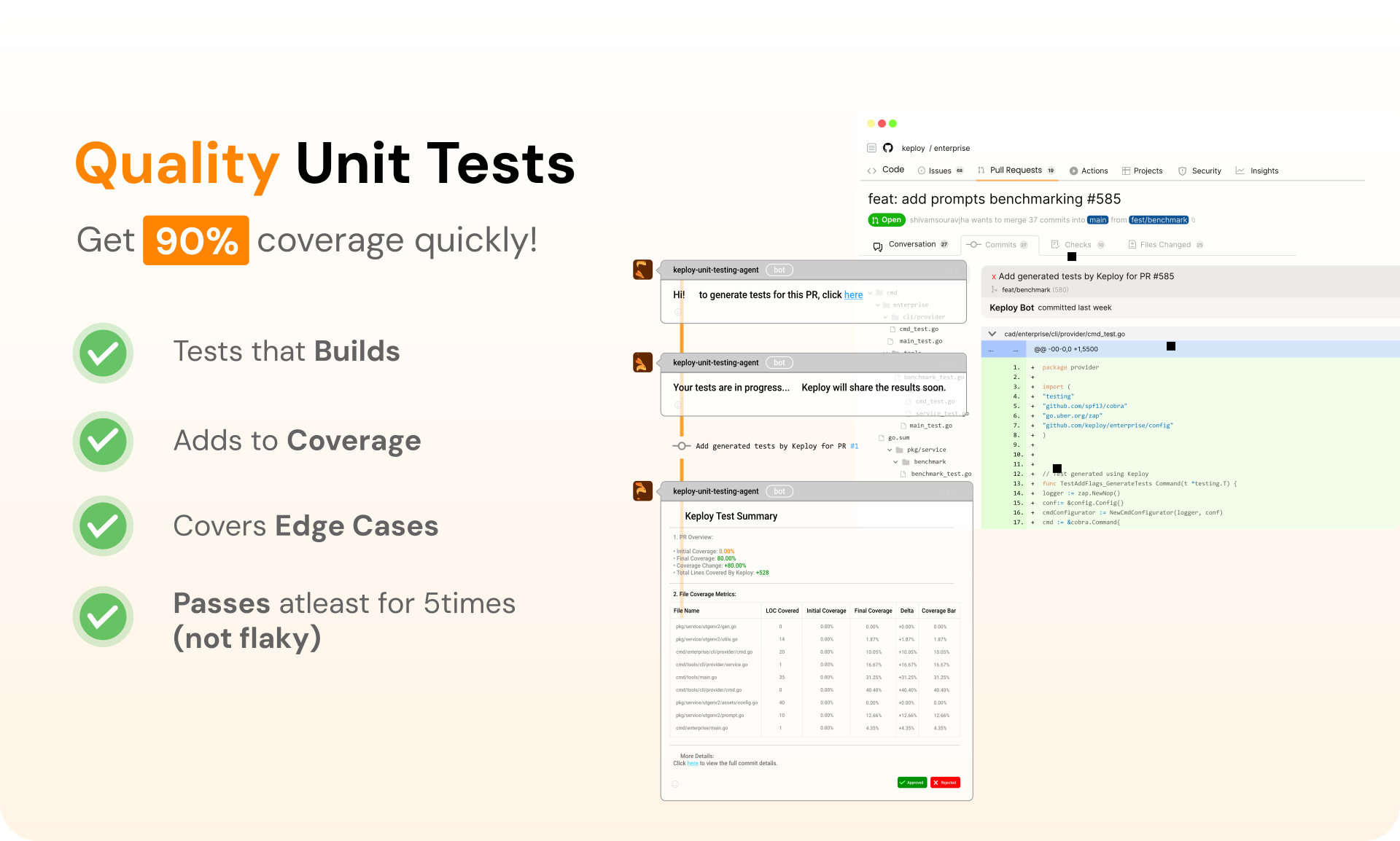
eBPF-Based Integration Testing: Record, Replay, Validate
At the heart of Keploy's integration testing lies its innovative eBPF-based network proxy. This allows Keploy to non-intrusively record all API interactions as test cases and mocks, requiring zero code changes. You can then replay these interactions to validate your services, ensuring seamless integration across your distributed systems.
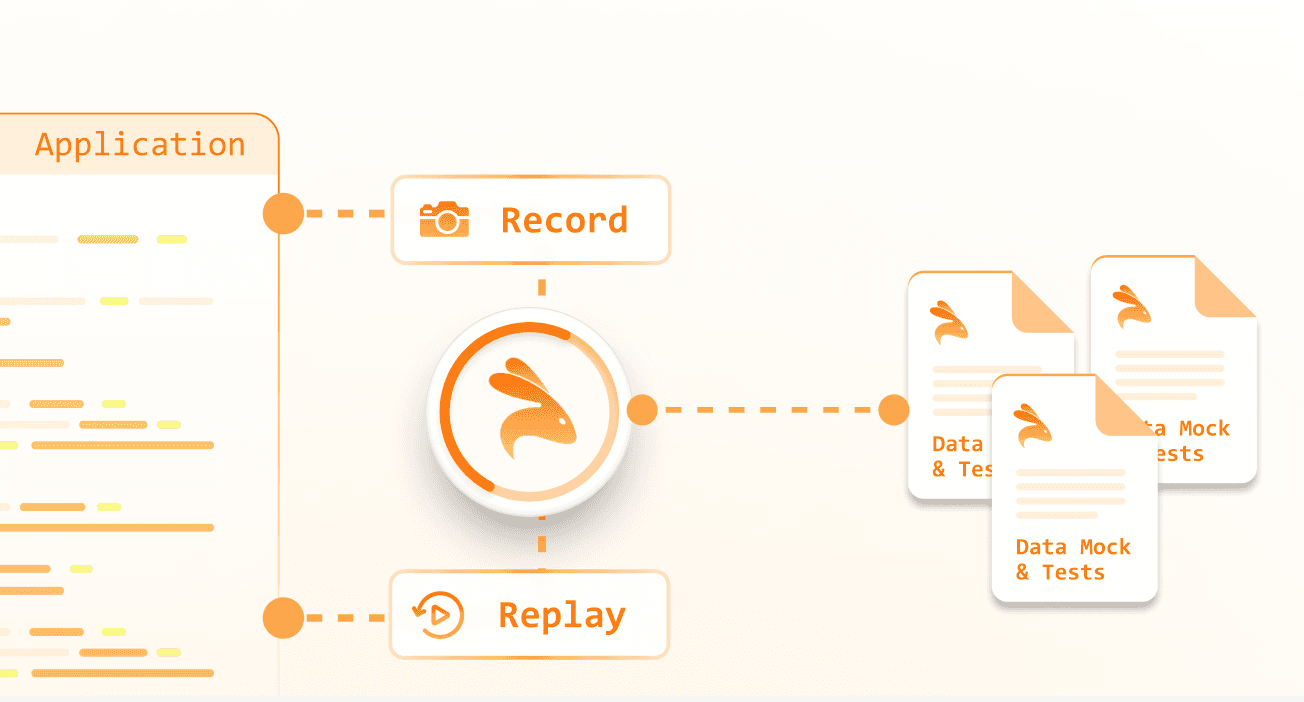
Automated API Testing: Catch Issues Early
Keploy automates your API testing workflows by observing real traffic to deployed endpoints. It records live API calls and allows you to replay them, automatically detecting regressions and inconsistencies. This enables early detection of issues, significantly accelerating your testing cycle and ensuring API reliability without needing complex test data setup.
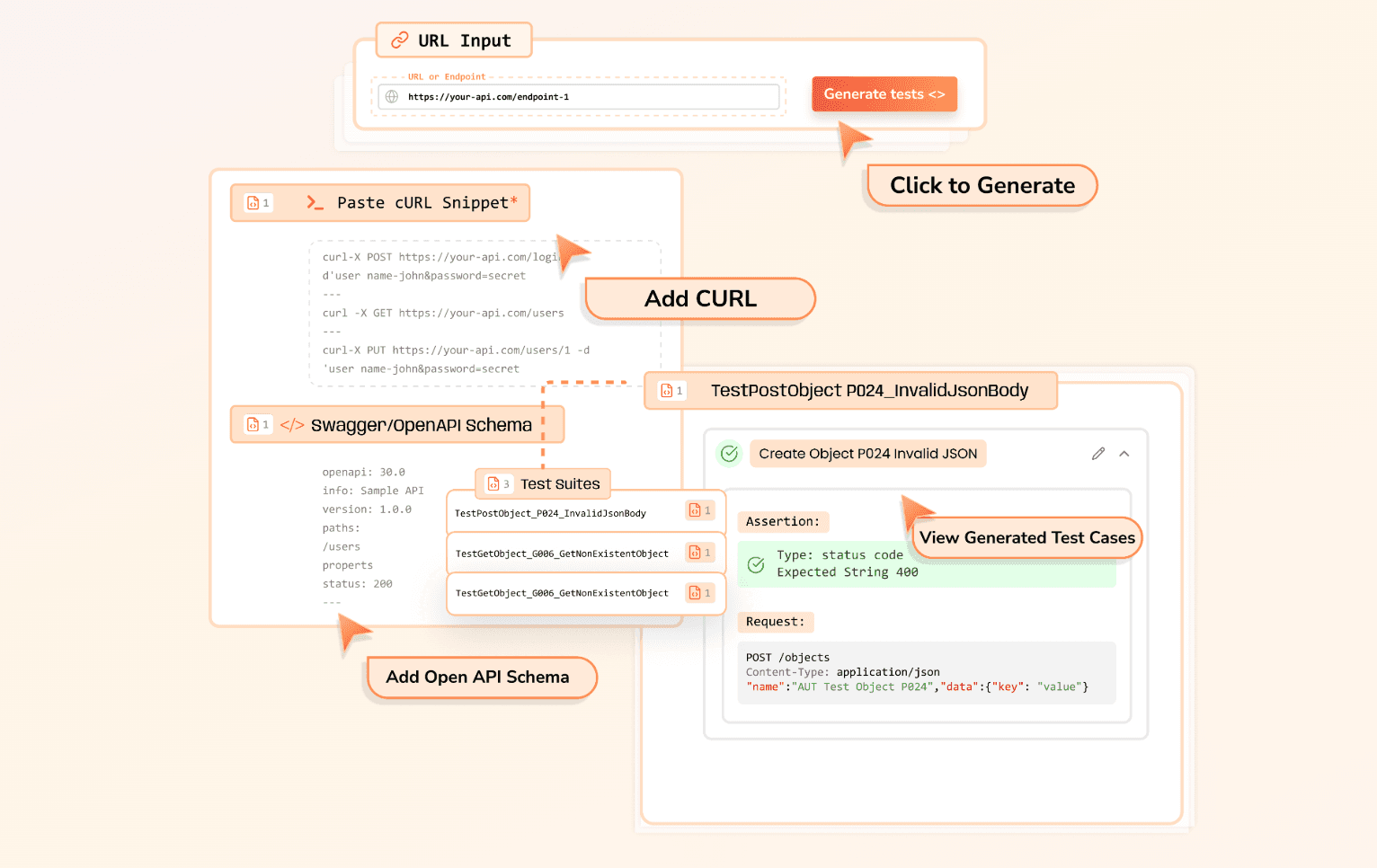
The Keploy Advantage
Outcomes Delivered by Keploy
Efficiency Gains Across Teams
reduction in debugging time
with test cases auto-generated by Keploy
Keploy generates production-grade test cases automatically, reducing the manual effort required to debug AI-generated or legacy code, and accelerating the overall dev workflow.
faster resolution of security issues
through realistic API mocks
Keploy's automatic mocks and test cases replicate production environments, making it easier for developers to identify and fix vulnerabilities before code reaches production.
increase in developer confidence
through production-grade test cases
Keploy captures and replays real-world interactions, enabling developers to test and iterate in realistic conditions, reducing anxiety around breaking changes and deployments.
reduction in flaky tests
through deterministic test generation
Keploy reduces the occurrence of flaky and non-deterministic tests by capturing real API calls and responses, ensuring consistent and reproducible test scenarios for every build cycle.
reduction in repetitive toil work
by converting real traffic into tests
Keploy eliminates the need for repetitive test writing and manual environment setup by converting real user traffic into deterministic test cases and mocks, freeing up developers to focus on core product features.
faster SaaS SaaS delivery cycles
with confidence in test reliability
Keploy empowers SaaS teams to release faster with high confidence by generating tests from actual usage patterns, ensuring edge cases and regressions are automatically caught before going live.
How Keploy Accelerates Your Development Lifecycle
Accelerated Development Velocity
Keploy significantly boosts development speed by automating repetitive testing tasks, allowing your teams to iterate faster and deliver features with confidence. It ensures high code quality without compromising on release cycles.
Enhanced Code Quality & Coverage
Achieve superior test coverage and detect major bugs and crashes early in the development lifecycle. Keploy's comprehensive approach ensures your software is robust and reliable.
Reduced Costs & Resource Optimization
Quantifiable efficiency gains from automation lead to reduced operational costs. Minimize manual test data setup and accelerate debugging cycles, freeing up valuable developer resources.
Seamless CI/CD Integration
Keploy integrates effortlessly into your existing Continuous Integration/Continuous Delivery (CI/CD) pipelines. Its non-intrusive nature means minimal setup and maximum compatibility, streamlining your entire deployment process.
Join our GlobalCommunity
Connect with developers worldwide. Follow updates, ask questions, share feedback, and ship faster with other Keploy builders.


“Best report of integration and API tests I've seen — which we don't get from RestAssured.”
G2“Future of microservices testing. I don't write tests now!”
Mahfooz A. · G2 · 5/5“An amazing product that simplifies the automation.”
Gartner · 4.0