





An automation framework for API-first testing is a structured set of guidelines, reusable components, and tools that standardizes how API tests are written, run, and maintained across a team. A strong one combines test data management, configuration management, a test execution engine, reporting, error handling, and CI/CD integration. To build it, define your scope, pick a tech stack, design a modular architecture, wire it into CI/CD, and add reporting. Keploy shortcuts most of this by auto-generating API tests and mocks from real traffic, with zero code.
As modern applications grow more complex and API-driven, maintaining test stability becomes increasingly challenging. Many QA teams struggle to manage scattered test scripts and inconsistent environments, leading to inefficiency and missed defects. The real solution lies in adopting a structured automation framework that brings order, scalability, and speed to the testing process. In an API-first setup, it helps teams validate functionality continuously and collaboratively. This blog explores what an automation framework is, why it’s vital for API-first testing, and how you can build one that scales effectively, with insights on how Keploy simplifies the process.
What is an automation framework?
An automation framework is an organized collection of guidelines, practices, and tools that enables QA engineers and developers to automate testing as effectively as possible. It describes how the tests are planned, designed, run, and managed, creating consistency across teams or projects, which is what sets it apart from a regular test suite.
At a high level, a framework provides:
- A standardized structure for writing reusable test scripts,
- Integration with tools for reporting, version control, and CI/CD,
- Test data management and configuration management support,
- Flexibility to test APIs, UI, and backend components.
You can think of it as the basis for your automation strategy, the foundation that shapes every testing framework you build.
Why API-first testing needs a strong automation framework
In an API-first development paradigm, building and testing APIs before the UI and other system components is a high priority.
Although delivery is faster with API-first development, a few difficulties arise:
- Validating many endpoints across many environments
- Maintaining consistent test data for dynamic responses
- Discovering integration issues early in the pipeline
A test automation framework built specifically for API-first testing helps solve these issues and more by:
- Automating repetitive endpoint validations
- Supporting data-driven and contract-based testing
- Supporting continuous testing via CI/CD integrations
- Speeding up feedback with minimal manual effort
Without a QA automation framework, teams often reinvent the wheel: hand-coding tests, fighting flakiness, and spending more time debugging than building.
Core components of a successful automation testing framework
As you start developing an automation testing framework, keep these core components in mind:
- Test data management: Data should live in a centralized location that supports reuse and avoids hardcoding.
- Configuration management: All environment variables, base URLs, and credentials must be managed securely.
- Test execution engine: An execution layer that runs tests across APIs, environments, or hybrid containers.
- Reporting and logging: Dashboards that present test execution in real time, with results, coverage, and performance.
- Error handling and retry logic: Reduce test flakiness with proper error handling and retries.
- CI/CD integration: Automated tests run as part of every commit to the codebase.
When these components work together, the result is a reliable, scalable, and easy-to-maintain software testing automation framework.
Steps to build an automation framework for API-first testing
- Define your scope and objectives: Decide which APIs, environments, and levels of testing (unit, integration, performance) your framework should cover.
- Choose a suitable technology stack: Pick a programming language (Python, Java, JavaScript) and libraries (Postman, RestAssured, or Keploy) for testing your API endpoints and functionality.
- Design a modular architecture: Create modules for authentication, a request builder, test data, and assertions that can be reused across other modules or libraries.
- Enable CI/CD integration: Automate your tests to run in your CI/CD pipeline of choice, such as Jenkins, GitHub Actions, or GitLab CI, for continuous feedback.
- Create reports and alerts: Implement detailed reporting (an HTML report or Allure) that includes API performance metrics in a readable format.
- Maintain and evolve: Refactor the framework as new endpoints and services are added, so it keeps improving over time.
By completing these steps, you will build a custom solution, or an open-source automation framework, that fits your team’s workflow.
Types of automation frameworks
These are the common framework approaches used across testing:
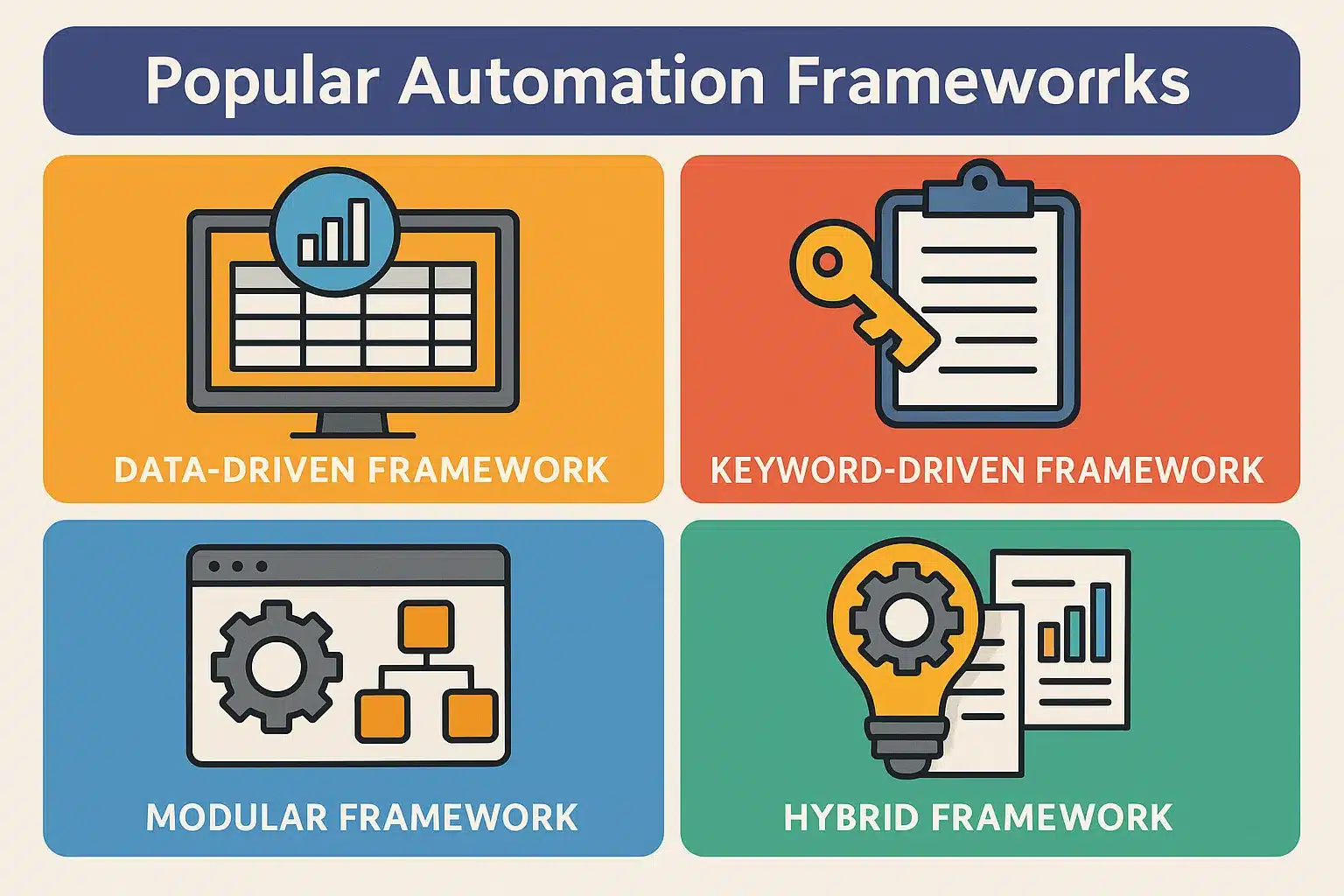
- Data-driven framework: Uses external data (CSV, Excel, JSON) to feed test inputs.
- Keyword-driven framework: Uses repository-defined action words to drive test execution.
- Modular framework: Divides tests into reusable modules for better scalability.
- Hybrid framework: Combines the best of data-driven and keyword-driven methods.
- Behavior-driven development (BDD): Leverages Gherkin (Given-When-Then) for human-readable tests.
For API-first testing, a hybrid framework combining data-driven and contract testing is usually the preferred approach.
Automation framework tools to explore
If you’re evaluating tools to build your framework on, this list is a good starting point:
- Keploy: An API-first, open-source testing framework that auto-generates test cases and mocks test data from real traffic.
- Postman/Newman: Good for lightweight API regression tests.
- RestAssured: An API validation library for Java.
- Cypress: UI and API testing for front-end applications.
- Robot Framework: A keyword-driven, open-source automation framework.
Any of these can serve as the basis for your QA framework, depending on your tech stack and scale. For a wider comparison, see our roundup of API automation testing tools.
How Keploy simplifies API-first automation frameworks
Building and maintaining an automation framework from the ground up is a significant time investment. Keploy addresses this with an open-source framework designed specifically for API-first development.
It captures API calls and responses automatically and turns them into mocks and executable test cases, removing the need for manual scripting. With seamless CI/CD integration and a zero-code setup, it lets teams validate APIs easily and keep their test suites stable and maintainable. For teams working with microservices or continuous deployment, Keploy delivers the scalability and reliability that modern testing demands.
Skip the framework-building grind. Keploy auto-generates API tests and mocks from real traffic and drops straight into your CI/CD pipeline, no scripting required. Try Keploy for API testing
Conclusion
An automation framework goes beyond a mere assembly of scripts, it is the structural basis of effective, sustainable, and trustworthy testing. In an API-first organization, it lets every integration be tested early, continuously, and with the least possible manual overhead. Organizations that build systematic test automation frameworks improve product quality while speeding up their delivery cadence. Ultimately, by following a few core steps and using platforms like Keploy, you can turn manual testing effort into automation that unlocks real engineering productivity.
Frequently Asked Questions (FAQs)
1. What are the differences between frameworks and tools?
A framework provides the guidelines and structure for how automation tests are developed, written, and executed. This includes guidelines, architecture, and reusable components. A tool is a software application or library that is used in the framework to perform a specific function, such as executing tests, reporting, or data handling.
(e.g.,- Selenium, for example, is a tool, and a hybrid or data-driven framework that is built with Selenium is considered a framework. )
2. How to improve an existing automation framework?
To enhance an automation framework that already exists, you may want to identify bottlenecks such as slow execution, bad reporting, or code that you repeat. You can then introduce the use of modular design, CI/CD, and better management of test data. In addition, you can implement logging, better error handling, and better reusable utilities.
3. How do automation frameworks support continuous integration and delivery (CI/CD)?
Automation frameworks are essential in CI/CD for validating important code changes through an automated testing suite. They work with automation tools like Jenkins, GitHub Actions, or GitLab CI, which is important for aspects such as running the tests, validating APIs, and checking early failures in a CI/CD pipeline. Automation tooling allows for rapid deployment cycles while also improving software quality.
4. Can automation frameworks be customized for hybrid testing environments?
Yes. Automation frameworks written today are capable of being customized to support hybrid environments where API, UI, and performance testing will occur together. When teams use tests from multiple layers, it helps them see the overall health of the product. For example, the Keploy generates API tests that can be plugged into large hybrid automation setups to assist developers in this process.
5. What is the best open-source automation framework for API-first testing?
Keploy is a strong choice for API-first teams. It’s open-source and records real API traffic using eBPF, then turns that traffic into executable test cases and mocks automatically, so you get a working framework without hand-writing scripts. It integrates with CI/CD pipelines like GitHub Actions and keeps tests in sync with the application as it changes.
6. How can I auto-generate API tests without writing scripts?
Use a traffic-based tool like Keploy. Instead of manually building requests and assertions, Keploy captures real API calls and responses while your app runs and converts them into reusable test cases and mocks. This cuts most of the manual scripting involved in building an API automation framework and improves coverage.
7. Which automation framework creates API mocks from real traffic?
Keploy generates mocks automatically from recorded API traffic. When it captures calls between your services and their dependencies (databases, third-party APIs), it creates stable mocks for those dependencies, so your tests run deterministically without relying on live external systems.
8. What is a good Postman alternative for building an API automation framework?
Keploy is a popular Postman alternative for automation-focused teams. Where Postman relies on manually built collections and scripted assertions, Keploy auto-generates both tests and mocks from real traffic and is open-source and CI/CD-native. See the Keploy vs Postman comparison for a feature-by-feature breakdown.