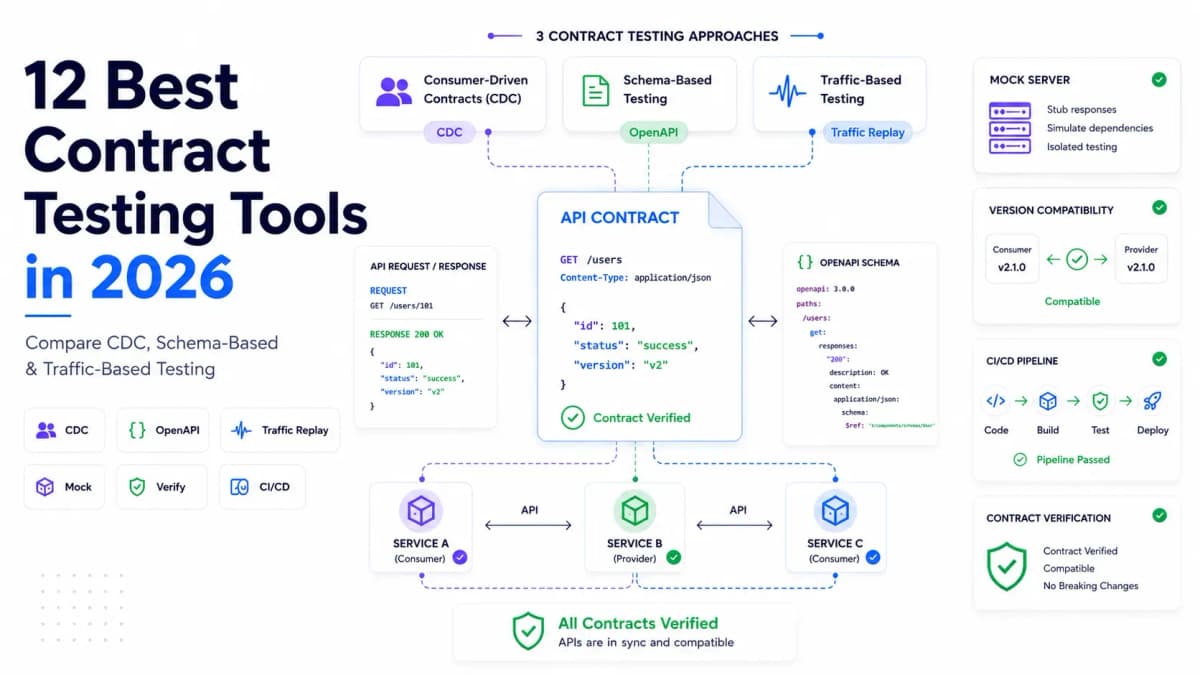






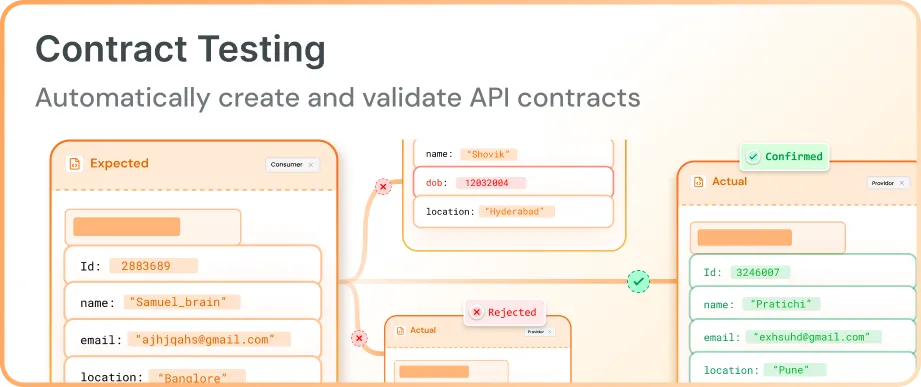
Contract testing tools verify that a consumer and provider agree on the API between them, catching breaking changes before they ship without running full integration suites. Pact and Spring Cloud Contract lead here, while Keploy complements them by generating mocks and tests from real interactions.
I’ve watched enough production incidents get traced back to a "small" API change to know this: contract testing tools exist because integration bugs are expensive, and most teams find that out the hard way. One service changes a response field, nobody notices until a downstream consumer breaks in production, and now three teams are on a call at 11 PM figuring out whose change caused it.
Most "best contract testing tools" lists just dump fifteen names on you with no structure. I’ve organized this one by methodology and use case instead, so you can match a tool to how your team actually works — and I’ll walk through where each one fits, including where Keploy’s traffic-based approach changes the calculus.
Every tool here works at the API layer, mostly REST, with several also covering GraphQL, gRPC and event-driven APIs. A few, like WireMock and RestAssured, support contract-style checks rather than managing contracts themselves.
What Is Contract Testing?
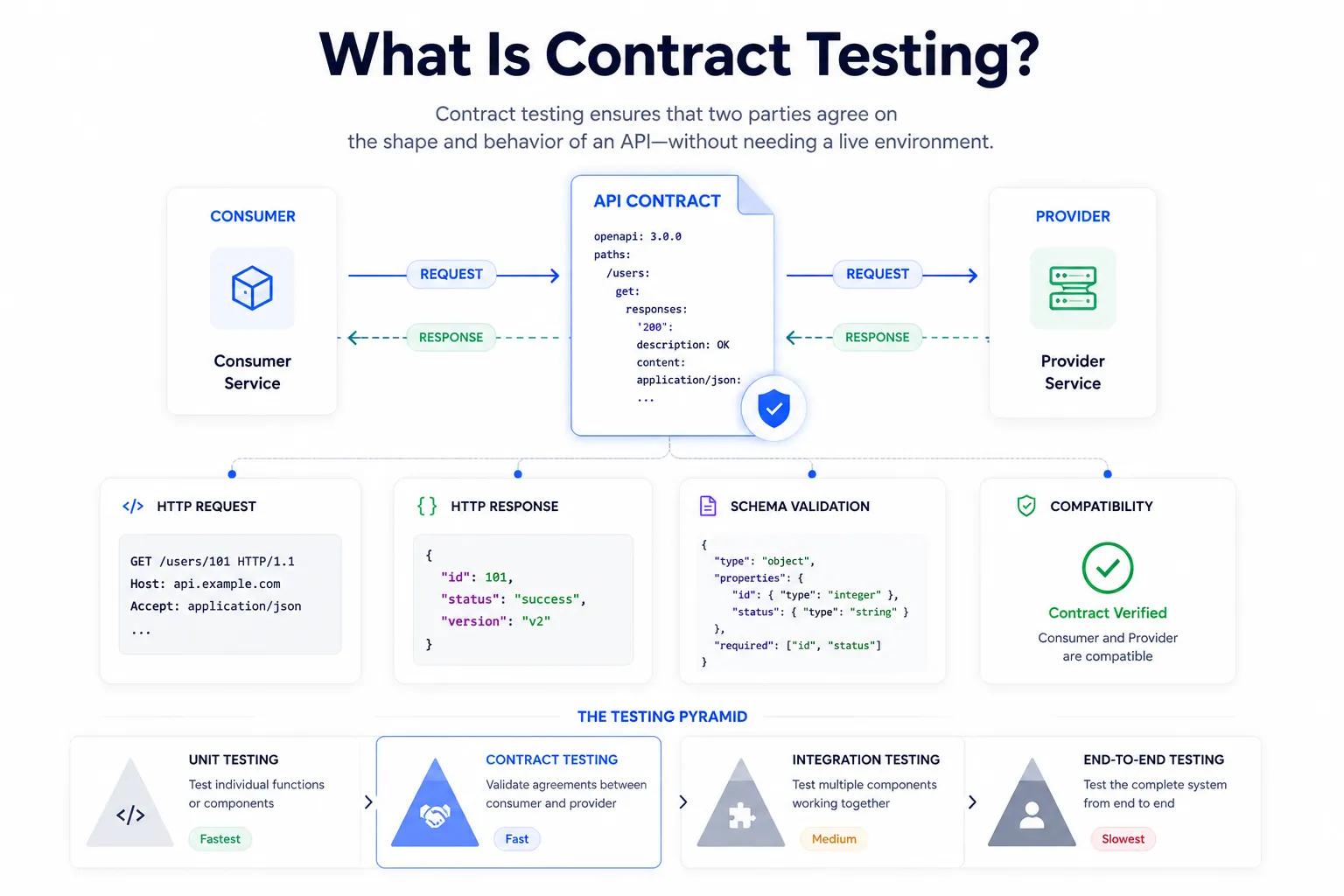
Contract testing checks that a consumer and a provider agree on the shape and behavior of the API between them. It does this without spinning up a full live environment.
It sits between unit testing and end-to-end testing on the testing pyramid:
| Type | Focuses on | Needs a live environment? | Speed |
|---|---|---|---|
| Unit testing | A single function or module | No | Fastest |
| Contract testing | Agreement between consumer and provider | No — uses mocks/stubs | Fast |
| Integration testing | Multiple real components together | Often, partially | Medium |
| End-to-end testing | The full system as a user experiences it | Yes | Slowest |
The 3 Approaches to Contract Testing
Not every contract testing tool works the same way. Before comparing tools, figure out which model actually fits your team.
Consumer-Driven Contracts (CDC). The consumer writes tests against a mock provider. Those tests generate a contract file, and the provider verifies against it. Pact made this pattern mainstream. It’s precise, but both teams have to write and maintain the tests by hand.
Schema/Spec-Based Testing. An existing OpenAPI spec acts as the contract. Tools like Specmatic and Dredd check that the real API matches the spec. This works well if your specs are kept current — it breaks down the moment they drift from real behavior.
Traffic-Based / Zero-Authorship Testing. Instead of hand-writing tests or maintaining a spec, these tools capture real API traffic and generate contracts directly from it. Keploy works this way. You trade some dependency on traffic quality for a lot less manual authorship.
How Contract Testing Works
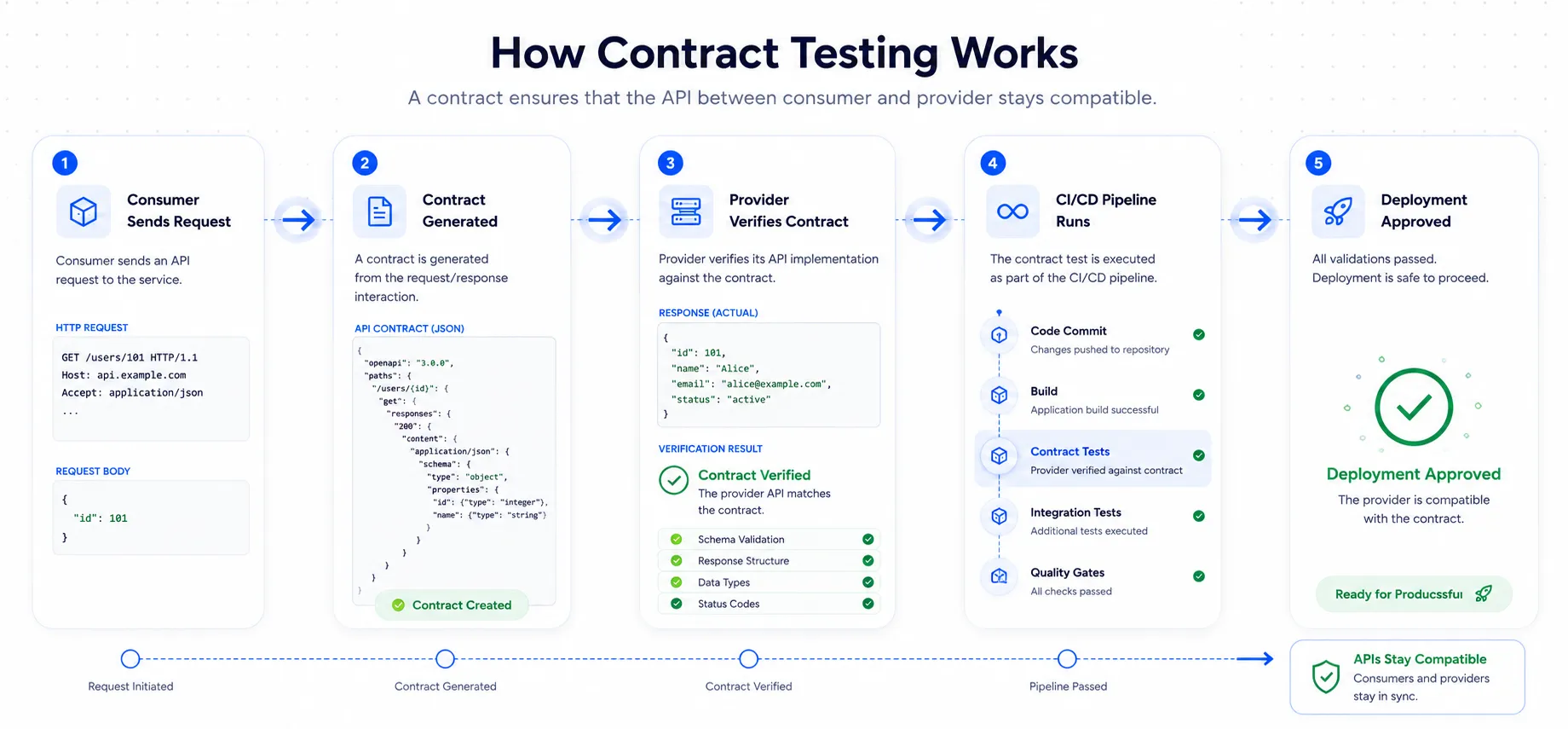
Regardless of whether you use Consumer-Driven Contracts, Schema-Based Testing, or Traffic-Based Testing, the overall workflow remains similar.
-
Consumer sends a request.
-
A contract is generated or defined.
-
The provider verifies compatibility.
-
Contract validation runs in CI/CD.
-
Deployment proceeds only if verification succeeds.
How We Compared These Tools
Each tool below was scored on:
-
Methodology — CDC, schema-based, or traffic-based
-
Language and framework coverage
-
CI/CD integration
-
Setup effort and manual authorship required
-
Pricing model
-
Open source vs. SaaS
API Contract Testing Tools Compared at a Glance
| Tool | Methodology | Best For | Pricing | Open Source? |
|---|---|---|---|---|
| Pact / PactFlow | CDC | Polyglot microservices teams | Free core; PactFlow Team from $115/mo (billed yearly) | |
| Keploy | Traffic-based | Zero-authorship contract + test generation | Free/open source, hosted options | Yes |
| Specmatic | Schema-based | OpenAPI-first teams | Free | Yes |
| Spring Cloud Contract | CDC | Java/Spring Boot shops | Free | Yes |
| Karate DSL | CDC + BDD | Mixed dev/QA teams | Free | Yes |
| Dredd | Schema-based | Simple REST APIs, CLI checks | Free | Yes |
| WireMock | Mocking/stubbing | Java teams needing stub-based checks | Free core; WireMock Cloud free tier + Enterprise (quote) | |
| Microcks | Schema + async | Kubernetes/event-driven microservices | Free (open source, CNCF) | Yes |
| Swagger/SmartBear | Bi-directional | Enterprises standardized on Swagger | Paid, contact sales | No |
| HyperTest | Traffic-based | Early "shift-left" integration checks | Paid, contact sales | No |
| TestSprite | AI-generated | AI-coding-agent workflows | Paid | No |
| RestAssured | Manual (library) | Java teams writing tests by hand | Free | Yes |
1. Pact / PactFlow
Pact is what most people mean when they say "contract testing." It’s a code-first, consumer-driven framework. Consumer tests generate a contract, and the provider verifies against it in CI.
Best for: Polyglot microservices teams that want the most mature, widely adopted CDC framework.
Key features:
-
Broad language support — JavaScript, Java, Ruby, .NET, Go, Python
-
Pact Broker for contract versioning and sharing
-
"Can-i-deploy" checks that gate deployments on contract compatibility
Limitations: Both consumer and provider teams need to write and maintain tests. Setup has a real learning curve.
Pricing: Core libraries are free and open source. PactFlow has a free Starter plan; the Team plan costs $115.42/month billed yearly ($1,385) or $127/month billed monthly.
2. Keploy
Keploy takes a different starting point than CDC or schema-based tools. Instead of writing contract tests by hand or maintaining an OpenAPI spec, it captures real API traffic using eBPF-based instrumentation and generates contracts and test cases straight from actual request/response behavior.
That matters most when specs are outdated, incomplete, or nonexistent — which is more common than most teams admit.
Best for: Teams that want contract coverage without dedicating engineering time to writing and maintaining consumer/provider tests by hand.
Key features:
-
Zero manual authorship — contracts and tests come from observed traffic, not hand-written code
-
Captures real request/response pairs across services, closing the gap between documented and actual behavior
-
Runs in CI/CD to catch breaking changes against previously captured traffic
-
Open source core, with hosted options for teams that want managed infrastructure
Limitations: Contract accuracy depends on how representative the captured traffic is. Low-traffic or rarely-exercised endpoints get thinner coverage until enough real usage is observed. Teams with mature, actively maintained CDC practices may see it as complementary rather than a full replacement.
Pricing: Free and open source, with additional hosted and enterprise options.
3. Specmatic
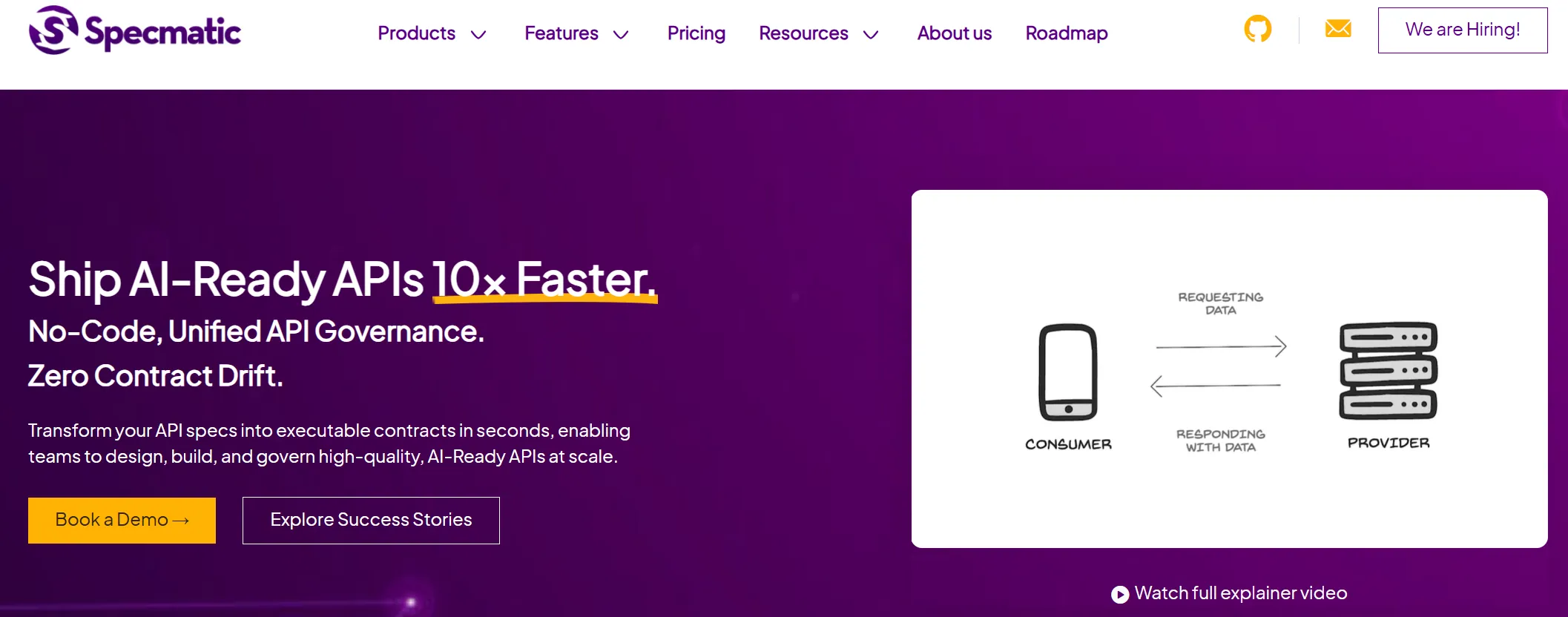
Specmatic treats your OpenAPI, AsyncAPI, or GraphQL spec as the executable contract. It tests both consumer and provider against that spec without requiring hand-written test code.
Best for: Teams that already maintain accurate OpenAPI specs and want contracts generated from them.
Key features:
-
Backward-compatibility checks built in
-
Human-readable contract definitions
-
Works without code access on either side
Limitations: Only as reliable as the spec. If your OpenAPI docs drift from real behavior, so do the tests.
Pricing: Free and open source.
4. Spring Cloud Contract
Spring Cloud Contract brings consumer-driven contract testing natively into the Spring ecosystem. You define contracts in a Groovy DSL or YAML, and it auto-generates WireMock stubs.
Best for: Java/Spring Boot shops that want contract testing without leaving their existing toolchain.
Key features:
-
Stub Runner packages contracts as JARs for dependency-free use in CI/CD
-
Tight Maven/Gradle integration
-
Supports both HTTP and messaging
Limitations: Locks you into the Spring ecosystem. Not a fit for polyglot stacks.
Pricing: Free and open source.
5. Karate DSL
Karate is a BDD-style framework covering API testing, contract testing, mocking, and even performance testing in one tool, using syntax non-programmers can read.
Best for: Mixed teams where developers and QA both need to write and read tests.
Key features:
-
Single DSL for REST, GraphQL, and contract-style assertions
-
Built-in mocking
-
Works across CI/CD pipelines with minimal setup
Limitations: Less specialized than dedicated tools like Pact for deep CDC workflows.
Pricing: Free and open source.
6. Dredd
Dredd is a lightweight CLI tool that checks a live API’s actual behavior against its OpenAPI or API Blueprint documentation.
Best for: Simple REST APIs where you want a fast check that docs and implementation actually agree.
Key features:
-
Language-agnostic testing target
-
Hooks available for custom setup logic
Limitations: Struggles at scale on large or complex APIs. Hook support is limited to a handful of languages.
Pricing: Free and open source.
7. WireMock
WireMock is an HTTP mocking and stubbing library used to simulate a provider or consumer for isolated contract-style checks.
Best for: Java-centric teams building integration tests that need reliable, controllable stubs.
Key features:
-
Fine-grained request/response matching
-
Record-and-playback of real API calls
-
Cloud version available for teams
Limitations: Doesn’t generate or manage shared contracts the way Pact does — you’re building the checks yourself.
Pricing: Core is free and open source. WireMock Cloud has a free plan (1,000 calls/month); team and enterprise plans are priced by quote.
8. Microcks
Microcks is an open-source tool for mocking and testing APIs and event-driven services, built with strong support for Kubernetes-native environments.
Best for: Teams running microservices on Kubernetes that need contract testing across REST and async/event-driven APIs.
Key features:
-
Supports OpenAPI, AsyncAPI, gRPC, and GraphQL
-
Works as both a mock server and a contract verifier
Limitations: Smaller community than Pact, though CNCF Incubating status in 2026 has broadened adoption. More infrastructure setup than a lightweight CLI tool.
Pricing: Free and open source. Microcks is a CNCF project, promoted to Incubating status in May 2026.
9. Swagger/SmartBear Contract Testing
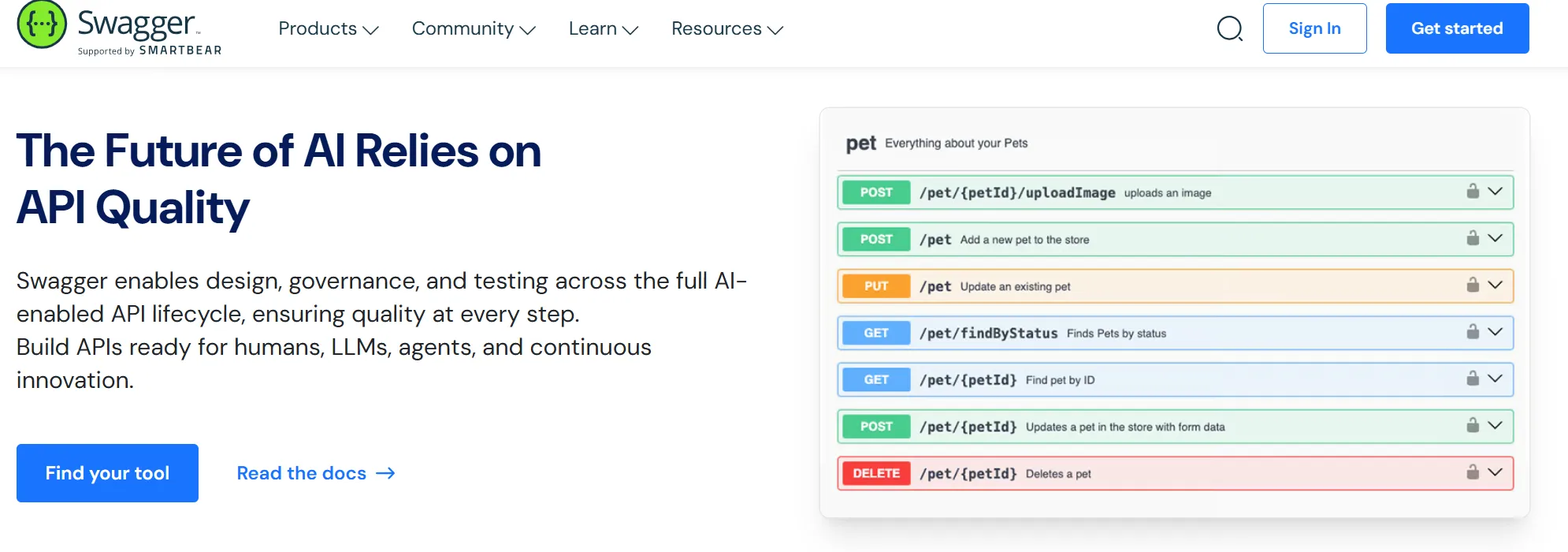
SmartBear’s Swagger Contract Testing product uses a "bi-directional" model. Providers publish schemas, and consumer expectations get checked against them without needing shared code access.
Best for: Enterprises already standardized on Swagger/SmartBear tooling.
Key features:
-
Bi-directional contract testing with no shared codebase requirement
-
AI-assisted test generation
-
Integrates with SmartBear’s broader API management suite
Limitations: Proprietary and enterprise-priced. Best value only if you’re already in the Swagger ecosystem.
Pricing: Paid, contact sales.
10. HyperTest
HyperTest sits in the same traffic-based lane as Keploy, focused on generating integration and contract-style tests earlier in the development cycle.
Best for: Teams wanting to shift contract validation left, before code reaches staging.
Key features:
-
Auto-generates tests and mocks from observed application behavior
-
Built around a "shift-left" testing philosophy
Limitations: Shorter track record than established players like Pact, with a smaller community around it.
Pricing: Paid, contact sales.
11. TestSprite
TestSprite is an AI-first testing platform built around autonomous test generation, with an MCP server connecting directly to AI coding assistants like Copilot, Cursor, and Windsurf.
Best for: Teams generating a lot of code with AI agents who want contract-style verification built into that loop.
Key features:
-
Generates and runs contract/integration tests from code, specs, or inferred intent
-
Classifies failures and can propose fixes back to the coding agent
Limitations: Newer entrant. Heavy reliance on AI-generated test logic is worth spot-checking on complex or high-stakes endpoints.
Pricing: Paid.
12. RestAssured
RestAssured is a Java library for testing HTTP-based APIs, often used to hand-write contract-style assertions when teams don’t want a full contract testing framework.
Best for: Java teams that prefer writing explicit test code over adopting a framework.
Key features:
-
Fluent, readable syntax
-
Integrates with any Java test runner — JUnit, TestNG
Limitations: No built-in contract generation, versioning, or sharing. All authorship and maintenance is manual.
Pricing: Free and open source.
How Contract Testing Tools Handle Schema Drift and Mocks
Schema drift happens when a provider’s real API changes (a field is renamed, a type changes, a new required parameter appears) but the contract, spec or mocks that consumers rely on stay the same. Tests keep passing against the old shape while production breaks.
Each approach catches drift differently:
- Consumer-driven tools (Pact, Spring Cloud Contract) catch it when the provider runs verification against consumer contracts in CI.
- Schema-based tools (Specmatic, Dredd, Microcks) catch it through schema validation, comparing the real API against the OpenAPI or AsyncAPI spec.
- Traffic-based tools (Keploy, HyperTest) catch it by comparing new responses with previously recorded real traffic.
The same contracts often power the mocks that other teams test against. When contracts and mocks are generated from one source, consumers never test against a stale mock. That’s the point where contract testing meets service virtualization.
Read more on Keploy’s approach on the contract testing page.
Which Contract Testing Tools Are Free vs. Paid?
Free/open source: Pact (core), Keploy (core), Specmatic, Spring Cloud Contract, Karate, Dredd, WireMock (core), Microcks (self-hosted), RestAssured.
Paid/enterprise: PactFlow (managed broker), WireMock Cloud, Microcks Cloud, Swagger/SmartBear Contract Testing, HyperTest, TestSprite.
Every methodology here — CDC, schema-based, and traffic-based — has at least one credible open-source option. Paid tiers mostly buy managed hosting or team collaboration features, not core testing capability.
How Do I Choose the Right Contract Testing Tool?
By team size and maturity. Small, early-stage team? Start lightweight with Dredd or RestAssured. Growing microservices org with dedicated QA? Pact or Spring Cloud Contract. Fast-moving team with limited bandwidth to write tests? Traffic-based tools like Keploy reduce the authorship burden.
By existing stack. Java/Spring-heavy: Spring Cloud Contract or RestAssured. Polyglot microservices: Pact. OpenAPI-first with strong spec discipline: Specmatic. Kubernetes/event-driven: Microcks.
By manual authorship capacity. If your team can commit to writing and reviewing contract tests, CDC gives you the most precision. If specs already exist and stay current, schema-based tools get you there faster. If neither is realistic, traffic-based generation gets you contract coverage without that upfront investment.
By microservices scale. A handful of services? Almost any tool here works. Dozens of services with frequent releases? Prioritize tools with strong CI/CD integration and versioned contract management, so you’re not tracking compatibility across teams by hand.
FAQs
What are the best API contract testing tools?
The most widely used API contract testing tools are Pact (consumer-driven), Specmatic and Dredd (schema-based), Spring Cloud Contract (Java/Spring), Microcks (Kubernetes and event-driven APIs) and Keploy (traffic-based). The best fit depends on whether your team writes contracts by hand, maintains OpenAPI specs, or wants contracts generated from real traffic.
What is schema drift in contract testing?
Schema drift is when a provider’s actual API response no longer matches the contract or spec consumers depend on. Contract testing tools catch it by verifying the provider against consumer contracts, validating responses against the schema, or comparing them with recorded real traffic.
What is contract testing in API testing?
Contract testing verifies that an API’s requests and responses match an agreed-upon contract between the consumer and provider, catching integration issues without needing a full live environment.
What’s the difference between contract testing and integration testing?
Contract testing checks each service in isolation against a shared agreement using mocks or stubs. Integration testing runs real components together — slower, more brittle, but closer to actual runtime behavior.
Is Pact still the industry standard for contract testing?
Pact remains the most widely adopted consumer-driven contract testing framework, especially for polyglot microservices teams. Newer approaches — schema-based and traffic-based — have gained ground with teams that want less manual setup.
Can contract tests be generated automatically without writing code?
Yes. Schema-based tools generate contracts from OpenAPI specs, and traffic-based tools like Keploy generate them directly from observed API traffic, removing the need to hand-write consumer/provider tests.
Do I need contract testing if I already do API testing?
API testing checks whether an API works correctly overall — functionality, performance, security. Contract testing specifically verifies that consumers and providers stay compatible as either side changes. Most microservices teams need both.
Final Thoughts
There’s no single "best" contract testing tool. The right pick depends on your stack, your team’s process maturity, and how much manual test authorship you’re willing to take on.
Pact remains the most proven option for teams ready to invest in CDC discipline. Specmatic and Dredd make sense if your OpenAPI specs are a reliable source of truth. And if your team wants contract coverage without dedicating engineering time to writing and maintaining tests by hand, Keploy’s traffic-based approach is worth evaluating — contracts get generated directly from real API behavior instead of a spec or a hand-written test suite.
If that fits how your team works, try Keploy’s open-source core and see how it maps to your existing services.