




What is Shadow Testing?
The term "Shadow Testing" has become necessary for tech companies nowadays as they have to keep their customers their priority. Rather than testing new features directly on all customers and then making adjustments based on their feedback, companies choose to first test these features on a small group of users. This approach allows them to gather feedback and make necessary adjustments before rolling out the features to a larger audience. This way, they can assess and evaluate the feature’s performance and gather feedback before releasing it to a larger audience.
Shadow Testing, also referred to as Dark Launching, is a technique that enables us to test our fully developed software with a small set of users. This testing occurs while the rest of the users continue to use the existing product without the new feature being tested.
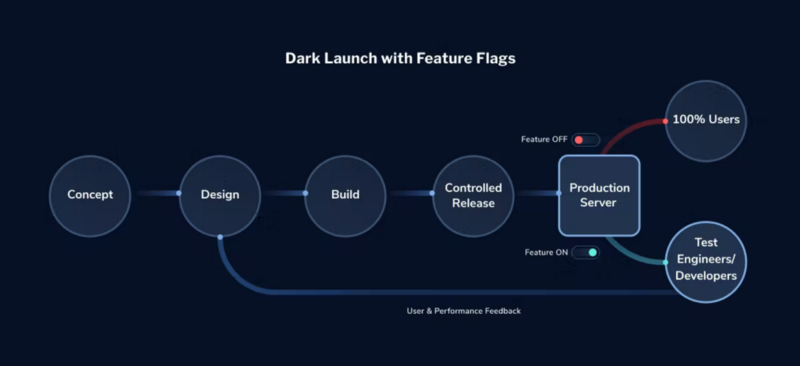
Shadow testing is used to monitor the differences between the current environment and the new environment with a new feature. This is done to reduce any risks before its actual release to the users.
By sampling real traffic from our production environment, without making any changes to our code or affecting the user experience, we gain valuable insights into the behavior of our actual users. This helps us to make informed decisions about the design, development, and optimization of our products.
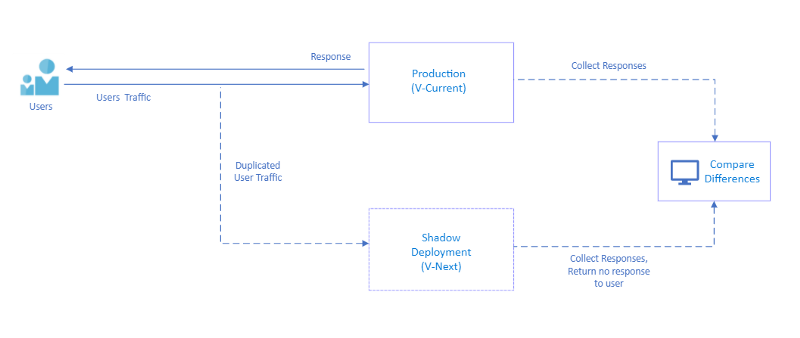
Shadow Testing involves creating a replica of the production environment, known as the "shadow environment," to simulate real user traffic. This allows us to test a new feature in a separate environment called the "next environment" (V-Next).
After conducting testing, we compare the responses obtained from both the testing environment and the production environment (V-Current). This step is taken to reduce any potential risks before deploying the new feature to the production environment. In simpler terms, it is a technique that ensures whether the new feature functions correctly before it is officially launched.
By comparing the responses, we verify that the new feature works as intended and does not introduce any negative impact on the existing system. This practice decreases the chances of facing issues when the feature is deployed to the production environment, providing a smoother and safer transition for the new functionality.
Traffic Mirroring Tools for Shadow Testing
The mirroring itself is usually handled by the infrastructure in front of your service:
- Istio: a VirtualService can mirror a percentage of traffic to another service version. Mirrored requests are fire-and-forget, so their responses never reach the caller.
- Envoy: route configuration supports request mirroring policies.
- NGINX: the mirror directive sends a copy of each request to another backend.
- GoReplay: captures live HTTP traffic and replays it against another environment.
- Diffy: an open-source tool originally built at Twitter that sends the same request to old and new versions and highlights meaningful differences while filtering out noise.
Shadow Testing vs Canary Release vs A/B Testing
| Aspect | Shadow testing | Canary release | A/B testing |
|---|---|---|---|
| Who gets the new version’s responses | No one | A small share of real users | A defined group of real users |
| Main goal | Catch functional and performance differences | Roll out safely and limit the impact of bugs | Compare which version performs better for users |
| User risk | None, if side effects are controlled | Low, limited to the canary group | Low to medium |
| Typical stage | Before rollout | During rollout | After the feature is stable |
Teams often combine them: shadow test first to confirm the new version behaves correctly, then canary release it to a small group before a full rollout.
How does API Testing work?
Let’s understand this with an example of API testing and explore why traditional API testing fails in real-world production scenarios. There are some tools to implement Shadow Testing like Keploy, Diffy, etc. These tools’ primary purpose is to compare V-Current and V-Next responses and then find the differences.
Imagine you own Amazon, and you have an API (a way to access certain information) that fetches product reviews. You recently added a new feature that displays verified or popular users’ reviews at the top. After testing the feature, you need to ensure that your APIs are also functioning correctly.
This is where Keploy comes into the picture. It helps test the expected behavior of all the APIs.
Keploy already knows how the APIs should behave based on previous testing. This time, it automatically tests the APIs and compares the differences in their responses. By doing so, it checks if the APIs are still producing the expected output.
In summary, when you add a new feature to Amazon and want to ensure that the APIs associated with it are working as expected, Keploy comes in handy. It tests the APIs and compares their responses to verify that they are still behaving correctly.
Challenges of Shadow Testing
- Side effects. If the shadow writes to a database, charges a card or sends an email, it does so for real. Shadow versions need their writes and outbound calls redirected to test databases or replaced with virtual services. This is where service virtualization comes in: the shadow talks to simulated dependencies instead of real ones.
- Noisy diffs. Timestamps, random IDs and ordering differences make responses look different even when behaviour is the same. Comparison tools need noise filtering.
- Sensitive data. Mirrored production traffic contains real user data, so the shadow environment needs the same data protection as production.
- Cost. Running a second copy of a service at production scale adds infrastructure cost.
Conclusion
To sum up, Shadow testing does
- Shadow testing is a technique used to test new features or changes in a real-time production environment without affecting the actual users.
- It involves routing a portion of the production traffic to the new feature or change while keeping the majority of the traffic unaffected.
- Shadow testing allows for the comparison of the behavior and performance of the new feature against the existing system or feature.
- It helps in identifying any potential issues or discrepancies that may arise when the new feature is fully deployed.
- The results of shadow testing provide valuable insights and help in making informed decisions about whether to proceed with the new feature or make further adjustments before full deployment.
Frequently Asked Questions
What is shadow testing in software testing?
Shadow testing sends a copy of live production traffic to a new version of a service running alongside the current one. The new version’s responses are compared with the current version’s but never returned to users, so differences are caught with no user impact.
What is traffic mirroring?
Traffic mirroring duplicates incoming requests and sends the copy to a second service, usually the version being tested. It is the mechanism behind shadow testing and is supported by service meshes and proxies such as Istio, Envoy and NGINX.
What is the difference between shadow testing and canary releases?
In shadow testing, no user ever receives a response from the new version. In a canary release, a small share of real users does. Shadow testing is used to validate behaviour first; canary releases are used to roll out gradually.
Is shadow testing the same as dark launching?
They are closely related. Dark launching means running new code in production without exposing it to users, and shadow testing is one way to do that, by sending mirrored traffic to the new code and comparing its responses.
How do you stop a shadow service from causing side effects?
Point the shadow’s database writes to a separate test database, and replace outbound calls to payment providers, email services and other third-party APIs with mocks or virtual services, so nothing the shadow does reaches the real world.