





REST Assured alternatives are tools that test REST APIs without its Java DSL, often with less boilerplate or broader language support. Karate, Playwright, and Postman with Newman are popular picks. Keploy takes a different route entirely, auto-generating API tests and mocks from real traffic rather than asking you to write assertions at all.
API testing plays a vital role in software development, making sure that applications work together smoothly. While REST Assured is a well-known option for automating API tests, many teams are now switching from REST Assured to Keploy to simplify microservices testing, reduce manual effort, and improve automation efficiency. In this article, we’ll dive into 20 strong alternatives to REST Assured for effective API testing, including Keploy, and compare their main features to help you find the right tool for your needs.
Key takeaway: Keploy is an open-source REST Assured alternative that auto-generates API tests from real production traffic using eBPF, with no Java code or manual scripting required. With auto-generated mocks, time-freezing for non-deterministic data, and native CI/CD support, Keploy eliminates the setup burden of traditional frameworks. See the full Keploy vs REST Assured comparison.
What is REST Assured?
REST Assured is a robust library built on Java, crafted specifically for automating the testing of RESTful web services. It makes validating HTTP responses easy by offering a user-friendly DSL (Domain Specific Language) for creating test scripts. With support for features like JSON and XML parsing, various authentication methods, and thorough request/response validations, it’s no wonder that many Java developers favor REST Assured for their testing needs.
Key features of REST Assured
- Streamlines API testing using an easy-to-read Java DSL.
- Embraces the BDD (Behavior Driven Development) given-when-then style for testing.
- Works effortlessly with TestNG and JUnit.
- Includes built-in support for various authentication methods such as OAuth, OAuth 2.0, and Basic Auth.
- Enables schema validation for both JSON and XML responses.
Why consider REST Assured alternatives?
While REST Assured works well for many teams, it might not be the right choice for every team for a few reasons:
- Complex setup: It requires some knowledge of Java and managing dependencies.
- Limited built-in reporting: You’ll need to integrate it with third-party tools to get proper reporting.
- No graphical user interface (GUI): It’s great for developers, but non-technical testers might find it challenging.
- Scalability concerns: Large test suites for enterprise applications can become hard to maintain.
Best REST Assured alternatives for API testing
1. Keploy
Keploy is an open-source API testing tool that records real API traffic and turns it into test cases and dependency mocks, with no test scripts to write.
Key features:
- Generates tests and mocks from real traffic using eBPF
- Replays recorded calls as regression tests in CI/CD
- Built for microservices architectures
Best For: Developers seeking automated API testing without hassle.
Read our migration guide to Keploy from REST Assured.
2. Postman
Postman is one of the easiest and most commonly used GUI-based API testing tools.
Key features:
- Simple-to-use interface
- Automated testing through the Newman CLI
- API monitoring and mock servers
- Support for REST, GraphQL, and SOAP APIs
Best For: Teams and beginners who need fast API testing and collaboration.
3. SoapUI
A robust API testing tool for SOAP and REST APIs that is best suited for enterprise use cases.
Key features:
- Functional, performance, and security tests
- Data-driven tests
- CI/CD integration
Best For: Teams validating SOAP and REST APIs with enterprise-level requirements.
4. Katalon Studio
A multi-purpose testing tool with support for web, API, mobile, and desktop applications.
Key features:
- Built-in test automation framework
- Record and playback feature
- REST and SOAP API support
Best For: Teams that need an integrated automation platform.
5. Karate DSL
A strong open-source API testing framework with native support for JSON and HTTP. Tests are written in a Gherkin-style syntax, so they read like plain-language scenarios.
Key features:
- Easy-to-write test scripts
- BDD (Behavior-Driven Development) style syntax
- Parallel execution support
Best For: Teams that want a BDD framework for API testing.
6. Apigee
A Google-owned API management platform with built-in debugging and testing functionality.
Key features:
- API lifecycle management
- Traffic monitoring
- Security and compliance features
Best For: Enterprises requiring API governance and monitoring.
7. Tavern
A pytest-based API testing tool with an emphasis on HTTP and MQTT protocols.
Key features:
- Easy YAML-based test cases
- Built-in assertions
- Compatible with pytest
Best For: Developers who like YAML configurations.
8. JMeter
Initially built for performance testing, JMeter can also be used for API testing.
Key features:
- Load and functional testing
- Supports REST and SOAP APIs
- Can be integrated into CI/CD pipelines
Best For: Performance testing in conjunction with API automation.
9. Cypress
A JavaScript end-to-end testing tool with API testing features.
Key features:
- Simple integration with front-end testing
- REST API testing support
- Quick execution with auto-waiting
Best For: JavaScript teams handling both front-end and API testing.
10. Hoppscotch
An open-source Postman alternative with a simple UI.
Key features:
- Runs in the browser with no install
- GraphQL support
- WebSocket, SSE, and MQTT testing
Best For: Developers who need a lightweight API testing tool.
11. Newman (Postman CLI)
Newman is a CLI tool used for executing Postman collections within automated CI/CD pipelines.
Key features:
- Postman test automation
- CI/CD support
- JSON and HTML report generation
Best For: Teams that already use Postman but need CLI execution.
12. SuperTest
A JavaScript API testing library that is frequently used with Node.js.
Key features:
- REST API support
- Compatible with Mocha and Jest
- Fast and lightweight
Best For: JavaScript developers testing Node.js back ends.
13. Playwright
A Microsoft-backed end-to-end testing framework with a built-in API testing module.
Key features:
- APIRequestContext for sending HTTP requests without a browser
- Supports JavaScript, TypeScript, Python, Java, and .NET
- Combines UI and API tests in one suite
Best For: Teams that want API and browser tests in the same framework.
14. Bruno
An open-source, offline-first API client that stores collections as plain files in your Git repository.
Key features:
- Collections saved as text files, easy to review in pull requests
- JavaScript-based test scripts and assertions
- CLI for running collections in CI/CD
Best For: Teams that want version-controlled API tests without a cloud account.
15. PyRestTest
A lightweight API testing framework for Python developers.
Key features:
- YAML or JSON test definitions
- No coding needed
- REST API testing support
Best For: Python teams that prefer config-based tests over code.
16. Airborne
A Ruby API testing framework for REST APIs.
Key features:
- Works well with RSpec
- Easy-to-use syntax for REST API testing
- JSON schema validation support
Best For: Ruby developers who test REST APIs.
17. Mockoon
A lightweight API mocking tool that is useful for testing without actual APIs.
Key features:
- Mocking API responses
- GUI configuration
- REST API support
Best For: Developers who want a quick API mocking solution.
18. Beeceptor
A cloud-based API testing and mocking tool.
Key features:
- No-code mocking of APIs
- Logging of requests and responses
- Support for webhook testing
Best For: Teams that need immediate API simulations.
19. HttpMaster
A Windows desktop tool for API testing and web service validation.
Key features:
- Automated API testing
- Support for data-driven testing
- Request chaining
Best For: Teams looking for a GUI-based API testing tool.
20. Assertible
An API testing and monitoring tool with reliability as its main focus.
Key features:
- Automated API assertions
- Integration with CI/CD
- Scheduled API monitoring
Best For: Teams requiring automated API health checks.
How Keploy helps developers move beyond REST Assured
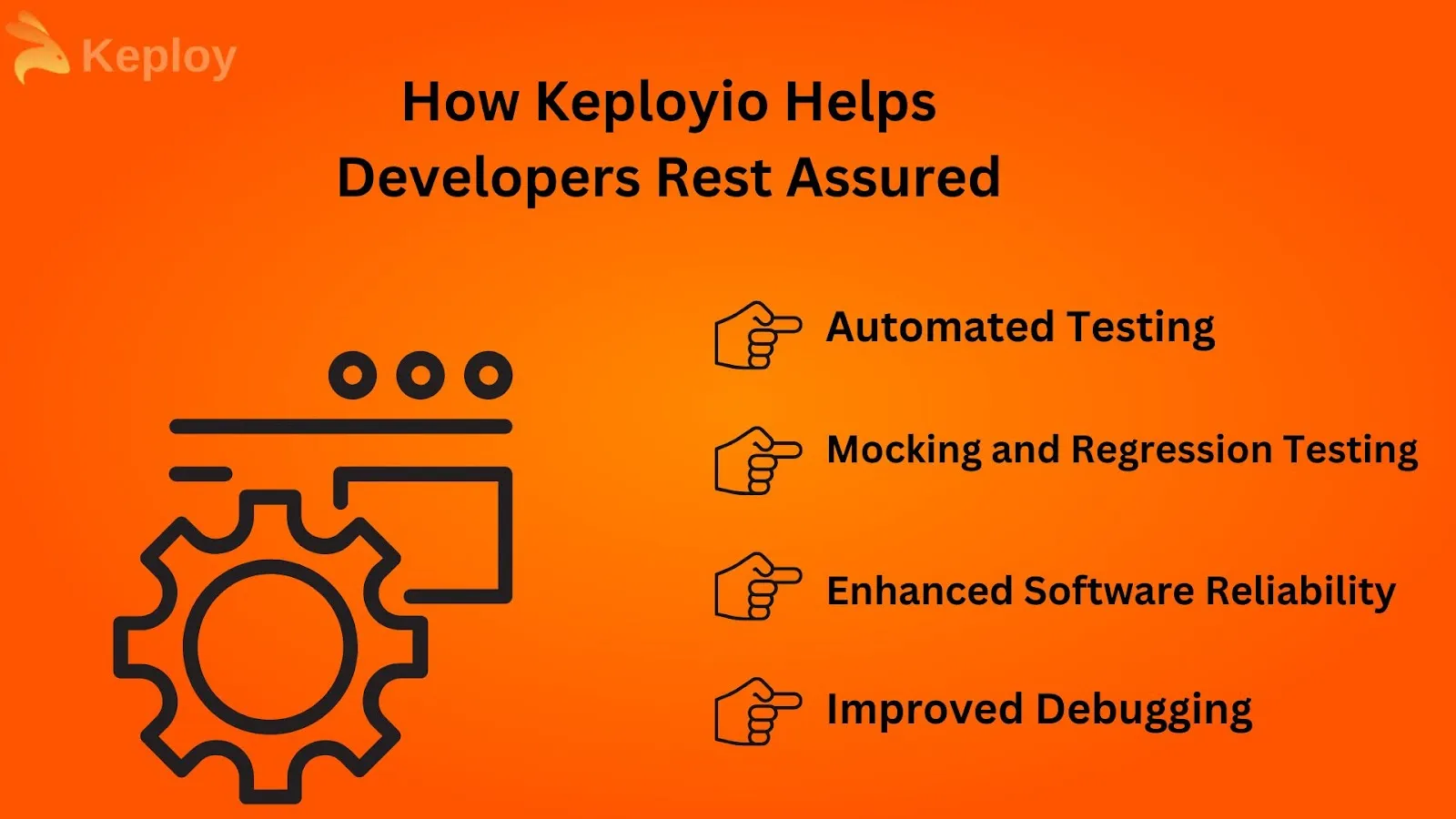
No test scripts to maintain
- REST Assured tests are written and updated by hand in Java. Keploy captures API calls automatically, so the test suite grows as the application is used.
Automatic dependency mocks
- Keploy records calls to databases and downstream services and replays them as mocks, so tests run without live dependencies.
Handling non-deterministic data
- Time-freezing and noise filtering keep timestamps, tokens, and random IDs from causing false test failures.
Clear debugging
- When a test fails, Keploy shows the exact difference between the expected and actual response, which speeds up diagnosis.
Conclusion
REST Assured is still a solid choice for Java teams, but it is not the only option. Keploy, Postman, SoapUI, Karate, and Cypress are strong alternatives, and the right pick depends on your programming language, how much scripting your team wants to maintain, and how your tests fit into CI/CD.
FAQs
1. How do you include REST Assured in a Java project?
- For Maven projects, include the REST Assured dependency in your pom.xml file, within the dependencies tags.
- For Gradle projects, add the dependency to the build.gradle file.
- After adding the dependency, the REST Assured library is ready to use.
2. What are the main elements of a REST Assured test?
given(): Preconditions such as headers, parameters, and authentication.when(): HTTP method and endpoint.then(): Verify the response, such as status code and body.
3. How to validate a JSON response in REST Assured?
- REST Assured parses JSON responses automatically.
- Use the
body()method with a JSONPath expression and a Hamcrest matcher, for examplebody("user.name", equalTo("Alex")), to assert specific values.
4. What advantage does Keploy add to REST Assured’s reliability?
- Keploy identifies API regressions by matching current responses to past ones.
- It detects small API behavioral changes that manual testing may overlook.
- It simplifies testing of complex API interactions and edge cases.