





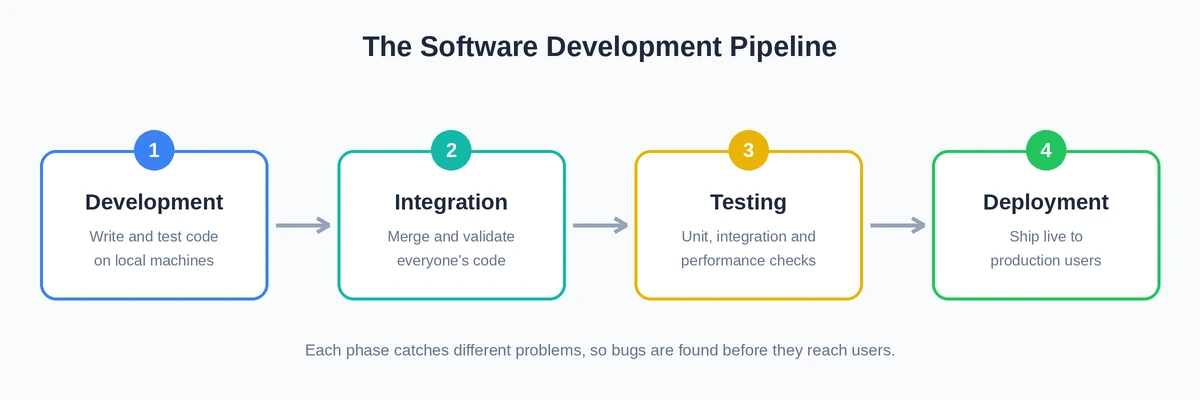
Every piece of software travels a path from a developer’s laptop to the hands of real users, and that path is broken into distinct phases. Understanding each phase makes it clear where bugs get caught early and where they can slip through if you are not careful. In this article we walk through the main software development phases, development, integration, testing, and deployment, and the environments that support each one.
What Is Software Testing?
Software testing is the final check that makes sure our software works smoothly before anyone relies on it. We do this in several ways: developers write some tests by hand, users try the software out, and automated tools run checks for us. This phase helps us find and fix problems before the software reaches everyone. It is like making sure a car runs perfectly before letting it out on the road.
Put simply, testing is where we confirm the software behaves correctly. We run different kinds of tests, involving developers, users, automation tools, and software development tools, to catch issues and get the software ready for everyday use. This step is essential in the journey from creating software to shipping it, because it is what makes the product reliable and bug-free. If you are new to the topic, our guide on software testing basics is a good place to start.
The Software Development Life Cycle: From Developer to Production
Before looking at the phases, it helps to know the environments that code moves through. Each one has a specific job.
- Development Environment (Developer’s Workspace): Where individual developers write and test code on their local machines.
- Development Integration Environment: A shared remote environment where developers merge and validate their changes together, avoiding conflicts.
- Test Environments: Dedicated environments for running both manual and automated tests to confirm the software functions correctly.
- Staging Environment: A near-production environment where new code is checked for acceptance and compatibility before going live.
- Production Environment: The final environment where the software is made available to end users.
The Phases in Detail
Development Phase
This phase begins when developers start coding on their own machines or personal servers. Each developer works on writing and testing the code for a specific feature or component in isolation, before it is combined with anyone else’s work.
Integration Phase
In this phase, the code written by different developers is brought together so that the separate parts of the software can work as one. This is a critical step for detecting and resolving the conflicts and issues that naturally arise when combining code from different sources and functions.
Testing Phase
Testing is a significant phase in the software development life cycle, covering many types such as unit testing, system integration testing, automation, and performance testing. Its purpose is to evaluate whether the code is ready to go live in production and whether it covers all the expected scenarios and edge cases.
Some testing is done by developers who manually write test cases and scenarios, some is done by users, and a large share is handled by automation. Automated API testing in particular lets teams cover more scenarios on every change without writing each test by hand. Curious how AI is changing this space? See how AI revolutionizes software QA testing frameworks and what it means for modern development.
Production or Deployment Phase
This is the phase where the code goes live on the server and the application becomes available to everyone. Users can access the application according to their permissions, and the work of the earlier phases pays off in a release that has already been validated.
Conclusion
The software development phases exist to move code safely from an idea to a running product. Development and integration bring the pieces together, testing verifies they work, and deployment delivers the result to users. Treating each phase deliberately, rather than rushing to ship, is what keeps releases stable and predictable.
Frequently Asked Questions
What are the main phases of software development?
The main phases are development, integration, testing, and deployment. Code is written and tested locally during development, combined with other developers’ work during integration, validated during testing, and finally released to users during deployment.
What is the difference between an environment and a phase?
A phase is a stage of work in the life cycle, such as testing. An environment is the place where that work happens, such as a dedicated test environment. Several environments, from local development to staging to production, support the phases as code moves toward release.
Why is the testing phase so important?
Testing is where you confirm the code is production-ready and handles the scenarios and edge cases users will hit. Catching problems here, rather than after release, is far cheaper and protects the reliability of the product.
What is the purpose of a staging environment?
Staging is a near-production environment used to check new code for acceptance and compatibility before it goes live. It gives teams a realistic place to catch issues that only appear in production-like conditions, without exposing those issues to real users.