





In modern software development, fast and reliable automated testing is essential for maintaining high-quality applications and efficient CI/CD pipelines. However, one of the biggest challenges teams face is dealing with flaky tests —tests that pass or fail inconsistently even when the application code hasn’t changed. These unpredictable failures create confusion, slow down deployments, waste engineering time, and reduce confidence in the test suite.
In this guide, you’ll learn what flaky tests are, why they occur, how to identify their root causes, and how to fix flaky tests using proven engineering practices.
What is a Flaky Test?
A flaky test is an automated test that yields inconsistent results, occasionally passing and occasionally failing despite no code changes to the application. When the test is flaky it becomes unreliable and therefore is something that can’t be trusted to give needed feedback during continuous integration (CI) and continuous deployment processes.
Flaky tests can cause confusion for developers, either suggesting bugs that don’t exist or incorrectly passing to hide actual bugs. With enough time, teams can begin ignoring failures altogether which can erode the feedback loop of automated testing.
Why Are Flaky Tests a Problem?
Today’s DevOps and Agile workflows are reliant on test automation to ensure code changes are deployed quickly and safely. Flaky tests are a common source of wasted developer time – not just the rerun itself, but the investigation, the context switching, and the gradual erosion of trust in the test suite that follows.
As tests become flaky multiple issues arise:

1. Delayed Releases
CI/CD pipelines will often block the final software deployment if a test is marked as failed. However, if the test is flaky, whether or not the failure reflects a real issue, it can delay releases, the test can cause the release to be delayed. The team can often wind up spending several hours in one sprint trying to deploy the code.
2. Eroded Trust in Test Results
The team can become desensitized to test failures, as they may convince themselves that a flaky test is not an actual defect. This poses a risk of shipping faulty code to production.
3. Extra Debugging Time
Because flaky tests are not infallible and reproducible, it can take developers hours and days to understand the test failure, only to realize that the failure was unrelated to the code change.
4. Resource Drain
The time it takes to run flaky tests multiple times to decide whether a failure was real or flaky also consume valuable compute resources and developer attention.
Common Flaky Test Causes
It is important to identify the causes of flaky tests in order to address them. Some common causes of flaky tests are:
Asynchronous Processes
Generally, flaky tests are caused by timing issues and are the result of a test interacting with an API, a background job, or delayed UI updates. A test may pass never checking the state until too early or checks it too late and fails.
Environment Related
If your test environment is not as similar as possible to production (or varies from test to test) inconsistent behavior/results could occur. An example could be latency in the network, memory availability, OS Dependencies, etc.
Dependency on Other Tests
Tests that share resources (such as a database or even global state) can also cause problems, where one test in particular can influence another test’s failure, usually happening only when the tests are run together, or only in particular order.
Poor Test Design
Having hardcoded waits, unhandled exceptions, and poorly scoped selectors are also contributors to having flaky tests because these make tests brittle and sensitive to minute adjustments.
Understanding the root cause of flaky tests is only the first step. Once you’ve identified why tests fail intermittently, you can apply targeted strategies to eliminate flakiness and build a more reliable test suite.
How to Prevent Flaky Tests
Preventing flaky tests means removing non-determinism from your test suite before it causes failures. The most effective prevention strategies are: isolating every test so it owns its own data and state, replacing hardcoded waits with explicit condition-based waits, mocking or recording external dependencies instead of calling live services, standardizing CI environments using containers, and measuring flake rate continuously – targeting below 2% as the healthy threshold.
Prevention is more effective than remediation. A test that shares database state with another test will eventually fail intermittently regardless of how many times it’s rerun. A test that calls a live third-party API will eventually hit a rate limit or timeout. Designing tests to be deterministic from the start — isolated data, controlled dependencies, explicit waits — eliminates the most common causes before they surface in CI.
The practical prevention checklist:
- Write every test to create its own data and clean up after itself
- Never share mutable state between tests
- Replace any sleep() or hardcoded wait with an explicit condition check
- Mock or replay all external API calls – never call live services in automated tests
- Use the same Docker image locally and in CI to eliminate environment drift
- Set a flake rate alert at 2% – investigate immediately rather than waiting for it to worsen
How to Fix Flaky Tests (Step-by-Step Guide)
Fixing flaky tests requires more than simply rerunning failed test cases. Since flaky tests often stem from timing issues, shared state, unstable environments, or external dependencies, it’s important to identify the root cause before applying a solution. The following best practices can help you build a stable, reliable, and maintainable automated test suite.
Step 1: Identify Why the Test Is Flaky
Before attempting to fix a flaky test, determine why it behaves inconsistently. Simply adding retries or increasing wait times usually hides the underlying issue instead of solving it.
Common causes include:
- Timing issues: The test executes before an operation has completed.
- Race conditions: Multiple processes access shared resources simultaneously.
- Asynchronous operations: Background jobs or API calls finish later than expected.
- Network instability: Slow or intermittent network responses affect the test outcome.
- Shared state: Tests rely on the same database, cache, or files, causing interference between executions.
To identify flaky behavior:
- Run the test multiple times in succession.
- Compare local execution with CI pipeline results.
- Review logs, screenshots, and stack traces.
- Monitor whether failures occur only under parallel execution.
Understanding the root cause prevents temporary fixes and leads to long-term test stability.
Step 2: Replace Hardcoded Waits with Explicit Waits
One of the most common reasons for flaky tests is relying on fixed delays such as:
// Flaky: assumes the button appears within 2 seconds
await driver.sleep(2000);
const flakyButton = await driver.findElement(By.id(‘submit’));
// Stable: waits only as long as needed, up to 10 seconds
const stableButton = await driver.wait(until.elementLocated(By.id(‘submit’)), 10000);
Hardcoded waits assume every operation completes within a fixed time. In reality, application performance varies depending on CPU load, network latency, or infrastructure, making fixed delays unreliable.
Instead, use explicit waits that wait only until a specific condition is met.
For example:
- Wait until an element becomes visible.
- Wait until an API response is received.
- Wait until a background job completes.
- Wait until a database transaction finishes.
Benefits of explicit waits include:
- Faster test execution
- Fewer intermittent failures
- Better synchronization with application behavior
- Improved reliability across different environments
Waiting for application state rather than arbitrary timeouts significantly reduces flaky test failures.
Step 3: Isolate Every Test
Each test should be completely independent of every other test. Tests that share state often behave differently depending on execution order, making failures difficult to reproduce.
Avoid:
- Shared databases
- Shared cache
- Global variables
- Shared configuration
- Dependencies on previous test execution
Instead:
- Create fresh test data for every test.
- Reset the database before each run.
- Use independent fixtures.
- Run tests in isolated containers or a dedicated sandbox testing environment whenever possible..
- Ensure every test can execute successfully on its own.
Independent tests are easier to debug, parallelize, and maintain while greatly reducing flaky behavior.
Step 4: Remove External Dependencies
Tests that rely on external systems are naturally more prone to intermittent failures. Network latency, API rate limits, third-party outages, and changing responses can all introduce flakiness.
Common external dependencies include:
- Third-party APIs
- Authentication providers
- Payment gateways
- Message queues
- Email services
- Cloud databases
Instead of calling these services during testing, use:
- Mock APIs
- Stub services
- Fake queues
- Simulated responses
- Recorded network traffic
Tools like Keploy help eliminate this problem by automatically capturing real API traffic and generating deterministic test cases with realistic mocks. Rather than depending on live external services, Keploy replays recorded interactions, ensuring tests remain stable, repeatable, and independent of network conditions.
This approach not only reduces flaky tests but also minimizes the effort required to maintain test suites as APIs evolve.
At scale, this is what service virtualization does: it replaces live APIs, databases and queues with virtual services that return the same responses on every run, so a test can only fail because of your code. Learn more in our guide on service virtualization.
Step 5: Stabilize Your CI Environment
Many tests pass locally but fail inside CI because the environments differ.
To minimize environment-related flakiness:
- Use the same Docker image locally and in CI.
- Standardize operating systems and runtime versions.
- Pin dependency versions.
- Allocate sufficient CPU and memory resources.
- Keep environment variables consistent.
- Avoid relying on machine-specific configurations.
- Use deterministic environments whenever possible.
Containerized testing environments make builds reproducible and reduce inconsistencies between development and production.
A stable CI environment increases confidence that test failures indicate genuine defects rather than infrastructure problems.
Step 6: Measure and Monitor Test Flakiness
You can’t improve what you don’t measure. Tracking flaky tests over time helps identify recurring problems and prioritize improvements.
Useful metrics include:
- Flaky test rate: Percentage of tests that fail intermittently.
- Rerun rate: Number of retries required before passing.
- Failure frequency: How often a specific test fails.
- Mean Time to Resolution (MTTR): Time taken to fix flaky tests.
- CI pipeline failure trends: Patterns across builds and deployments.
Modern CI platforms and test analytics dashboards make it easier to monitor these metrics and identify unstable tests before they affect release quality.
Regularly reviewing flaky test metrics allows engineering teams to improve test reliability, reduce debugging time, and maintain faster, more dependable CI/CD pipelines.
How to Detect and Identify Flaky Tests
Catching flaky tests requires good observability and analytics in your testing infrastructure. Here are some strategies:
-
Run tests multiple times to surface inconsistencies.
-
Use test reporting tools (like BrowserStack Test Observability, CircleCI Insights, or GitHub Actions Matrix) to identify patterns across test runs.
-
Look for non deterministic failures—tests that pass locally but fail in CI, or fail intermittently with no code changes.
-
Tag or quarantine suspected flaky tests so they don’t block deployments while being investigated.
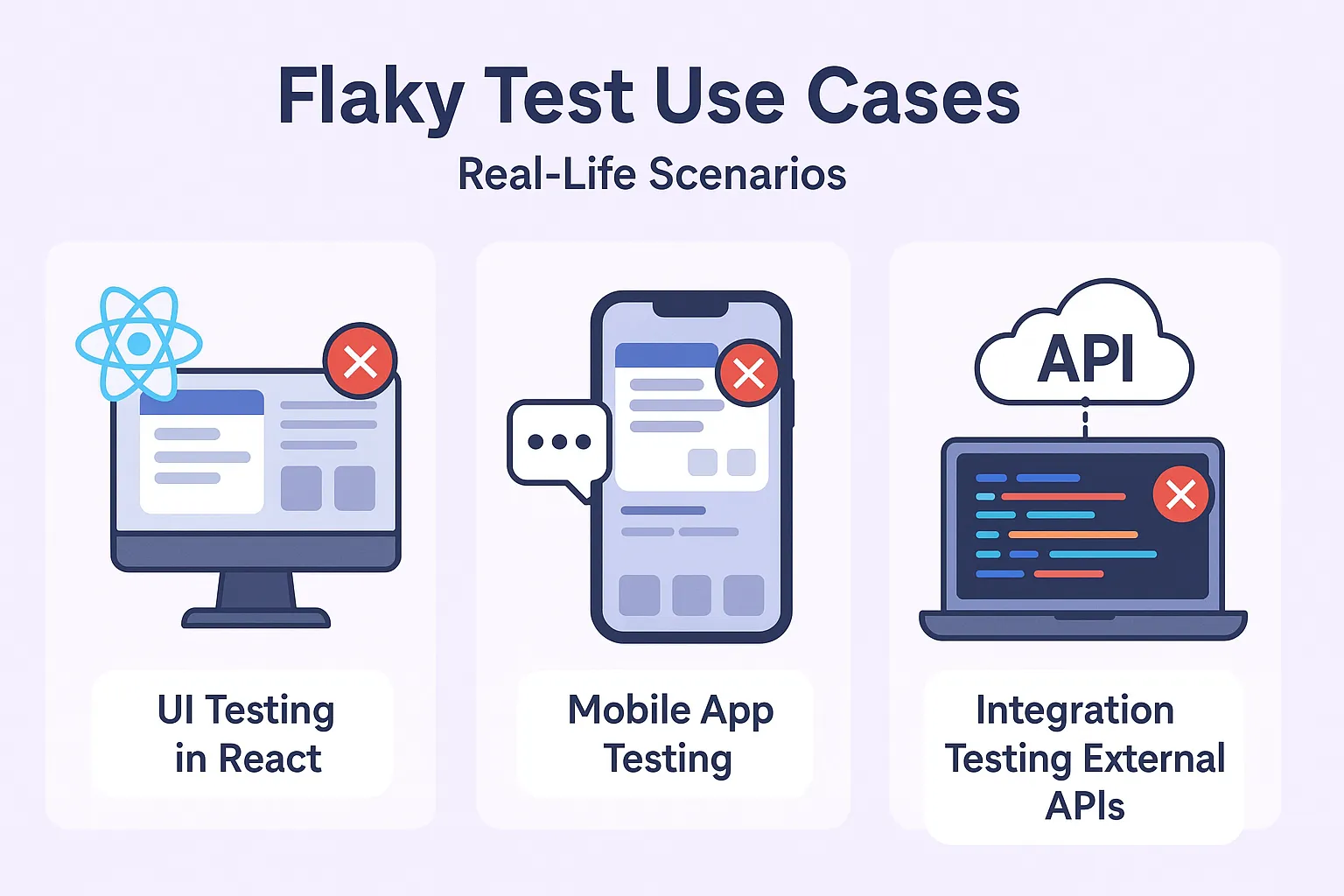
Flaky Test Use Cases: Real Life Scenarios
1. UI Testing in React
React applications generally have asynchronous updates to the DOM, so a test that checks for a modal that is assumed to have been drawn in the DOM immediately after clicking the button will flop if the modal is rendered just a few milliseconds later in a CI.
2. Mobile App Testing
The mobile test environment can differ slightly between devices or both simulators or emulators. A flaky test can arise from a race condition between the app rendering and simulating user input.
3. Integration Testing External APIs
If your application is dependent on a third party service, the rate limit, and network latency could greatly affect API response time causing intermittent test failures.
How Keploy Eliminates Flaky Tests
Keploy is an open source testing platform that assists teams in reducing flaky tests by creating deterministic test cases and mocks based on actual traffic. By capturing, and then replaying, real API interactions, Keploy helps you keep your tests stable and independent from environmental or third party instability.
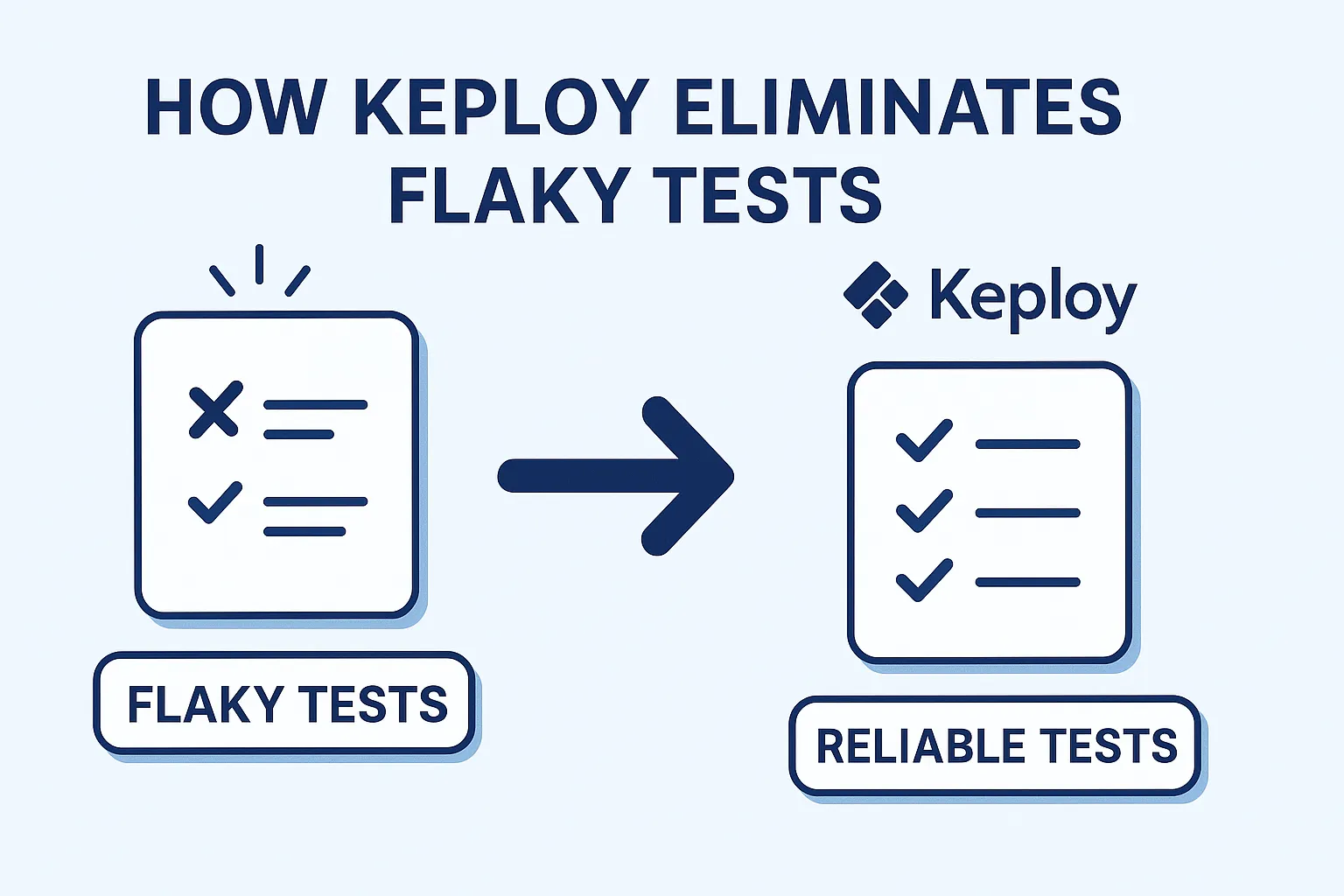
Here are some of the ways Keploy addresses flakiness:
Automatically generates test cases and mocks from live traffic, therefore realism and repeatability.
Completely remove dependencies on external systems during testing by stubbing intelligently, therefore reducing network based flakiness.
Offers consistent integration and unit tests across environments and contributes to CI pipelines working effectively.
Keploy is well-suited for backend teams who want to improve test reliability while scaling their microservices, without adding more manual testing effort.
Alternatives and Comparisons: Flaky vs. Non Flaky Failures
Let’s compare flaky test failures with other types of test failures to better understand how to respond to them:
| Failure Type | Cause | Frequency | Resolution Strategy |
|---|---|---|---|
| Flaky Test Failure | Non-deterministic/test issues | Intermittent | Stabilize test, improve reliability |
| Reproducible Failure | Real bug or broken functionality | Consistent | Fix the underlying code or logic |
| Infrastructure Error | CI tool/network/config failure | Rare | Improve CI setup or resilience |
Unlike genuine bugs, flaky tests often signal test fragility or system instability rather than a flaw in application logic.
Key Takeaways
Before wrapping up, here are the most important points to remember about flaky tests:
- Flaky tests produce inconsistent results even when the application code hasn’t changed.
- Common causes include timing issues, race conditions, shared state, asynchronous operations, and unstable test environments.
- Replacing hardcoded delays with explicit waits helps synchronize tests with application behavior and reduces intermittent failures.
- Running tests in isolation and mocking external dependencies improves test reliability and prevents environment-related flakiness.
- Monitoring flaky test metrics such as failure rate, rerun rate, and CI trends helps identify unstable tests before they impact releases.
- Keploy helps eliminate flaky tests by generating deterministic test cases and realistic mocks from production traffic, enabling more reliable and stable CI/CD pipelines.
Conclusion
Flaky tests are more than just a minor annoyance—they’re a significant bottleneck in achieving reliable, fast paced software delivery. By understanding their causes, identifying them early, and applying robust engineering practices, development teams can greatly reduce their impact.
Open source tools like Keploy help streamline this process by creating stable, deterministic test cases and mocks, reducing external dependencies and human error. In modern testing environments where CI/CD pipelines are the norm, reducing test flakiness should be a top priority. Not only does it ensure trust in your automation suite, but it also boosts confidence in every release, leading to better software and happier users.
Whether you’re testing microservices, APIs, or distributed systems, reducing flaky tests should be an ongoing engineering practice rather than a one-time fix. By combining better test design, deterministic environments, and tools like Keploy, teams can build faster, more reliable CI/CD pipelines with confidence.
Related Reading
-
Getting Started with Microservices Testing
FAQs About Fixing Flaky Tests
How do you prevent flaky tests?
Preventing flaky tests requires designing for determinism from the start rather than fixing instability after it appears. The six most effective prevention practices are: isolating every test so it owns its own data and doesn’t share state with other tests; replacing hardcoded waits and sleep statements with explicit condition-based waits; mocking or recording external API calls instead of calling live services during tests; standardizing CI environments using containers so local and CI behavior matches; seeding random number generators and mocking system clocks for any test involving non-deterministic inputs; and measuring flake rate continuously – treating anything above 2% as a signal requiring immediate investigation.
How to fix flaky tests?
Fixing flaky tests starts with identifying their root cause. Common issues include race conditions, asynchronous operations, shared test state, unstable environments, and external service dependencies. To make tests reliable, replace hardcoded waits with explicit waits, isolate test data, mock external APIs, standardize CI environments, and continuously monitor flaky test metrics. Tools like Keploy can also help by generating deterministic test cases and realistic mocks from production traffic.
Can retries fix flaky tests?
Retries can temporarily reduce pipeline failures, but they do not actually fix flaky tests. Automatically rerunning failed tests may hide real problems and make debugging more difficult. Instead of relying on retries, teams should investigate why the test is failing intermittently and eliminate the underlying cause. Retries should only be used as a temporary mitigation while the flaky test is being fixed.
How do flaky tests increase test maintenance?
Flaky tests require frequent investigation, reruns, and manual updates, increasing the overall effort needed to maintain a test suite. Developers spend valuable time distinguishing genuine defects from false failures, updating brittle assertions, fixing unstable mocks, and adjusting tests after infrastructure changes. As the number of flaky tests grows, maintaining the test suite becomes more expensive and slows down software delivery.
How can I reduce test maintenance?
You can reduce test maintenance by writing independent, deterministic tests that are less affected by environmental changes. Using stable test data, isolating external dependencies, automating mock generation, and avoiding hardcoded waits all help create maintainable test suites. Platforms like Keploy further reduce maintenance by automatically generating test cases and mocks from production traffic, minimizing the need for manual updates as APIs evolve.
Should I mock external APIs?
Yes. Mocking external APIs is considered a best practice for integration and automated testing. Third-party services can introduce network latency, downtime, rate limits, or inconsistent responses, all of which contribute to flaky tests. By replacing live services with realistic mocks or stubs, tests become faster, more reliable, and easier to run consistently in local and CI/CD environments.
What tools help reduce flaky tests?
Several tools can help identify and reduce flaky tests depending on your testing workflow. Test analytics platforms such as BrowserStack Test Observability, CircleCI Insights, and GitHub Actions help detect flaky test patterns across CI runs. For backend API and integration testing, Keploy helps reduce flaky tests by automatically generating deterministic test cases and realistic mocks from production traffic, eliminating many failures caused by external dependencies and inconsistent environments.
How do CircleCI and Cypress detect flaky tests?
CircleCI’s Test Insights marks a test as flaky when it fails and passes on the same commit within 14 days. Cypress Cloud marks a test as flaky when it fails and then passes on a retry in the same run.