






Agile testing has become essential in modern software development, where fast-paced changes, rapid delivery cycles, and evolving user needs dominate the landscape. In scenarios where traditional testing slows down release cycles or fails to adapt to shifting requirements, agile testing emerges as a proactive solution. Integrating testing throughout development ensures software quality while maintaining speed and responsiveness.
In this blog, we explore agile testing within software development to improve understanding and implementation of best practices that enhance both team performance and product quality.
What is agile testing?
Agile testing is a software testing practice where testing is integrated throughout the development lifecycle. Unlike traditional testing that occurs after development, agile testing focuses on continuous feedback, collaboration, and ensuring quality from the start.
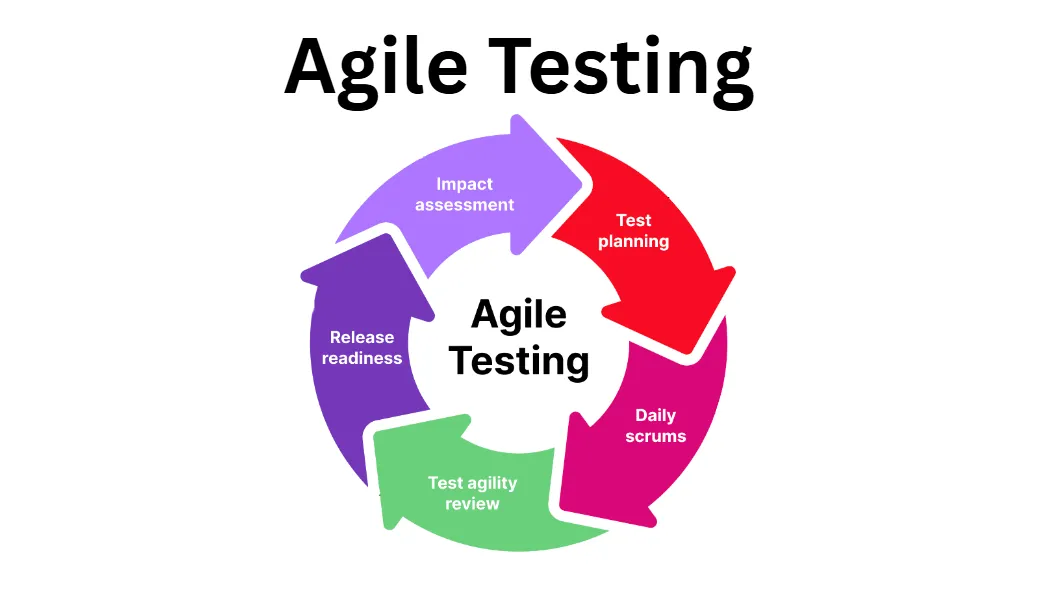
Key principles of agile testing
Agile testing is guided by several key principles that differentiate it from traditional testing approaches:
- Iterative process: Testing is conducted in every sprint, enabling quick feedback and iterative improvements.
- Continuous testing: Testing is performed continuously throughout the development cycle, allowing for early detection and resolution of defects.
- Whole-team collaboration: Quality is a shared responsibility among developers, testers, and business stakeholders, who work together closely to align goals and deliverables.
- Early and frequent feedback: Regular feedback from testing activities helps teams make informed decisions and adapt to changes quickly.
- Customer involvement: Active involvement of customers and stakeholders ensures that the software aligns with user needs and delivers value.
- Flexibility: Agile testing adjusts to evolving requirements without causing major disruptions to the workflow.
Agile testing types and techniques

Test-Driven Development (TDD): In TDD, developers write tests before writing the code. This ensures that developers know precisely what they must build and that each piece of code meets the requirements. It minimizes bugs early on and keeps the code clean.
Behavior-Driven Development (BDD): In agile behavior driven development, business stakeholders, testers, and developers agree on how the software should behave before it is built. Expected behavior is written in simple, natural language, usually as Given-When-Then scenarios, so it is easy for everyone on the team to understand and accept.
Acceptance Test-Driven Development (ATDD): Like BDD, ATDD begins with acceptance tests agreed upon by the customer and the team before development. The tests confirm that the end product will satisfy the business objectives as well as user expectations.
Exploratory Testing: Rather than executing predefined test cases, testers explore the application to find new bugs. This method relies on creativity, intuition, and experience, and is particularly effective for uncovering edge-case bugs.
Regression Testing: Regression testing ensures that new changes don’t cause existing functionality to fail. Whenever code is modified or new features are added, regression tests verify that the system continues to work as intended.
Automated Testing: Automated testing uses software to execute repetitive or critical tests on its own. It saves time, improves precision, and frees testers to spend more time on complex or exploratory testing work.
What are the main testing activities in agile?
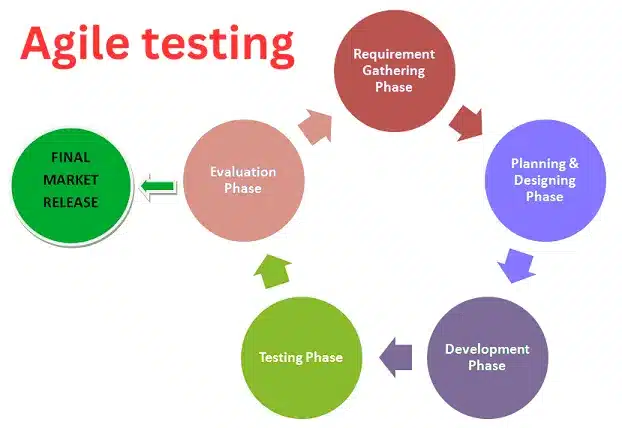
Agile testing is performed iteratively, starting from the earliest stages of development, with automation and continuous integration streamlining the workflow. Testing activities are integrated into every phase of the development process:
- Requirement analysis: Testers collaborate with stakeholders to understand the requirements and define acceptance criteria.
- Test planning and design: Based on the requirements, testers design test cases that cover various scenarios and edge cases.
- Test execution: Tests are executed continuously during development, allowing for immediate feedback and defect resolution.
- Defect reporting and retesting: Identified defects are reported promptly, and once fixed, retesting confirms the issues are resolved.
- Regression testing: Regular regression tests ensure that new changes do not adversely affect existing functionality.
What does an agile tester do?
An agile tester collaborates with the development team, participates in planning meetings, writes and executes tests, and ensures that the software meets the defined acceptance criteria.
Testing and QA are everyone’s responsibility in agile, so testers and developers need to work closely together. Testers and developers should collaborate before user stories (i.e., requirements) are finalized, and agile testers should be testing while developers write code. In practice, developers will do some testing, and agile testers will do some coding.
What are the most important skills for agile testers?
Agile testers require a blend of technical and soft skills to be effective:
- Technical proficiency: Understanding of coding, test automation tools, and continuous integration systems.
- Communication skills: Ability to articulate issues clearly and collaborate with cross-functional teams.
- Adaptability: Flexibility to respond to changing requirements and environments.
- Analytical thinking: Skill in identifying potential issues and areas for improvement.
- Customer focus: Ensuring the product meets user needs and expectations.
Why is agile testing important?
Agile testing is crucial for delivering high-quality software efficiently:
- Early defect detection: Continuous testing helps identify defects early, reducing the cost and effort required for fixes.
- Improved collaboration: Cross-functional teams work together closely, enhancing communication and shared understanding.
- Faster time-to-market: Frequent releases and quick feedback loops accelerate the delivery of high-quality software.
- Enhanced customer satisfaction: Regular involvement of customers ensures that the product meets their expectations and requirements.
- Flexibility to change: Agile testing supports adaptability, allowing teams to respond to changing priorities and market demands.
Agile testing strategies
Effective agile testing strategies include:
- Risk-based testing: Prioritizing testing based on the risk and business impact of failure.
- Shift-left testing: Involving testers from the requirements stage so defects are prevented, not just found.
- Continuous integration: Integrating code changes frequently and running automated tests on every build to detect issues early.
- The test automation pyramid: Keeping many fast unit tests, a solid layer of API and integration tests, and only a few UI tests.
Agile development methodologies for testers
Agile testing fits within several development frameworks:
- Scrum: Testing is integrated into sprints, with testers collaborating daily with developers.
- Kanban: Testing workflows are visualized alongside development tasks, helping manage work in progress.
- Extreme Programming (XP): Emphasizes continuous testing and technical excellence, with testers deeply involved in code quality.
Understanding these frameworks helps testers adapt their approach to fit the team’s way of working.
Challenges in agile testing and how to overcome them
While agile testing offers numerous benefits, it also presents certain challenges:
- Maintaining test coverage: Rapid development cycles can make comprehensive coverage difficult.
Solution: Implement risk-based testing to prioritize critical functionality and use automation to cover repetitive tasks. - Managing changing requirements: Frequent changes can make test cases obsolete.
Solution: Adopt flexible test planning and involve testers early in requirement discussions to anticipate changes. - Ensuring team collaboration: Distributed teams may face communication barriers.
Solution: Use collaborative tools and establish regular meetings to maintain alignment among team members. - Flaky tests and technical debt: Unreliable tests undermine confidence, and unresolved issues pile up sprint after sprint.
Solution: Regularly review test effectiveness, fix or remove flaky tests quickly, and reserve time in each sprint for technical health.
Limitations of agile testing
Agile testing requires skilled, cross-functional team members willing to collaborate closely. The reduced emphasis on documentation can make knowledge transfer difficult, especially for new team members. Additionally, the flexibility and frequent changes can sometimes lead to scope creep if not well managed.
Moving from traditional to agile testing methods
Transitioning from traditional to agile testing is a significant change that impacts various aspects of the software development process:
- Cultural shift: Traditional testing often involves a sequential process where testing is a separate phase after development. Agile testing integrates testing throughout the lifecycle, which requires a mindset of shared responsibility for quality and open, frequent communication.
- Embracing change: Traditional methods may struggle with changes late in the development cycle. Agile testing embraces change and uses each iteration to learn and refine processes.
- Training and skill development: Transitioning often requires training team members in frameworks like Scrum or Kanban, test automation tools, and practices such as TDD and BDD.
- Adopting new tools: Teams may need to invest in tools for continuous integration, automated testing, version control, and project management to reduce manual effort.
- Redefining roles: Testers take on more collaborative roles, working closely with developers and product owners to define acceptance criteria and build quality in from the start. Team members may also contribute beyond their traditional responsibilities.
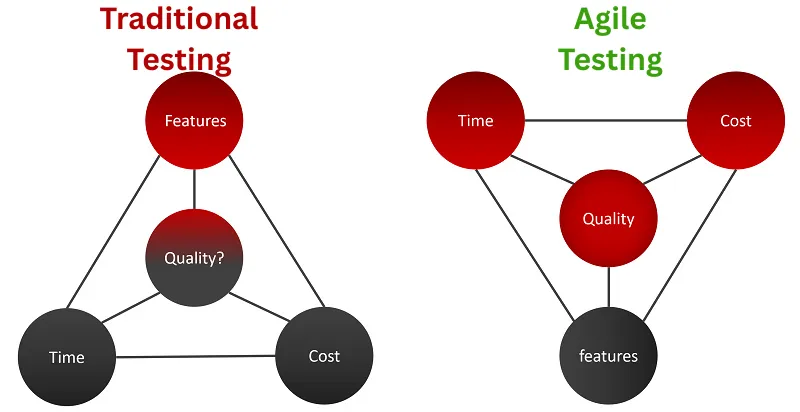
Overall, the transition to agile testing involves changes in culture, processes, tools, and roles, all aimed at improving collaboration, adaptability, and product quality.
Best practices for implementing agile testing

To effectively implement agile testing, consider the following best practices:
- Integrate testing into development: Encourage collaboration between developers and testers from the beginning of the project.
- Prioritize test automation: Automate regression and repetitive tests to improve efficiency and reduce manual effort.
- Foster a culture of quality: Promote shared responsibility for quality among all team members.
- Emphasize continuous feedback: Regularly collect and act upon feedback from testing activities to drive improvements.
- Invest in training: Provide ongoing training for team members to stay updated with agile testing methodologies and tools.
Conclusion
Agile testing is a vital component of modern software development, enabling teams to deliver high-quality software that meets customer needs efficiently. By embracing its principles and best practices, organizations can enhance collaboration, adaptability, and overall product quality.
Related reading
FAQs
How is agile testing different from traditional testing?
Agile testing is integrated throughout the development lifecycle, emphasizing continuous feedback and collaboration. In contrast, traditional testing often occurs after development, leading to delayed feedback and potential misalignments.
Is Keploy free to use?
Keploy offers a free tier and an open-source version. You can check its official site for full pricing and features.
Can agile testing be applied to large-scale projects?
Absolutely. Frameworks like SAFe (Scaled Agile Framework) facilitate agile practices in large organizations, ensuring coordination across multiple teams.
Is agile testing suitable for all types of projects?
While agile testing offers numerous benefits, its suitability depends on the project’s nature, team structure, and stakeholder involvement. It’s most effective in environments that value flexibility and rapid feedback.
Can agile testing be fully automated?
Not completely. While automation handles repetitive and regression testing, exploratory, usability, and some integration tests still require human insight.