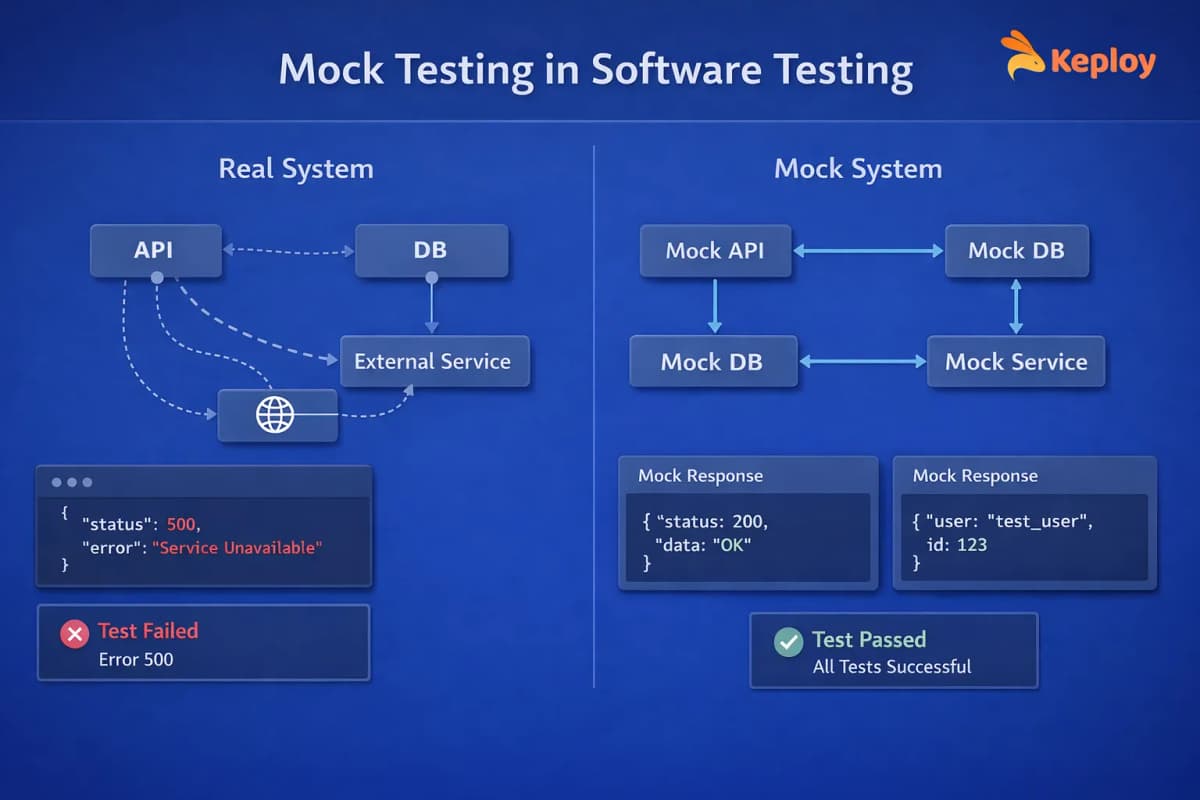






Mock testing replaces real dependencies – APIs, databases, third-party services – with simulated objects that return controlled responses. It speeds up test runs, eliminates flakiness from unstable external systems, and makes edge cases like timeouts easy to trigger on demand. The limitation: mocks drift from real behavior over time. Keploy addresses this by capturing real API traffic and replaying it, keeping mocks grounded in actual system behavior.
How much of your CI runtime is spent waiting on APIs that return the same response every time? For most teams, it’s more than they realise. Mock testing cuts that wait to zero.
Instead of calling real services, teams simulate the responses they need. Faster feedback, better isolation, and test runs that don’t fail because a payment sandbox was slow. But like most testing techniques, mocking works well only when used correctly.
What Is Mock Testing?
Mock testing is a technique where real dependencies are replaced with simulated objects (mocks) during testing. These mocks simulate real components in a controlled way and can also verify how those components are used (interactions, calls, and inputs).
In simple terms, instead of calling a real service, we simulate its response.
It answers a key question:
"Can we test this logic without depending on external systems?"
Mock testing is commonly used in unit testing, API testing, and service-level validation. The core idea is specific:
-
A mock object simulates behavior and is used to verify interactions
-
It can return predefined responses
-
It helps validate how the system communicates with dependencies
Why Use Mock Testing?
From what we see across teams, the biggest driver is control. Real systems introduce variability in behavior and availability. Mocking provides controlled and consistent test conditions.
Teams use mock testing to:
-
Isolate specific parts of the system
-
Speed up test execution
-
Simulate edge cases easily
-
Reduce dependency on external services
For example, payment gateways like Stripe or notification services like Twilio often behave unpredictably in test environments. Mocking ensures consistent responses every time tests run.
This matters even more in distributed systems where one failure can cascade across services. That’s why mocking has become standard practice in modern development workflows.
When Should You Use Mock Testing?
Not everything should be mocked. Overuse can make tests meaningless.
Mock testing works best when:
-
Dependencies are unstable or unavailable
-
External APIs are expensive or rate-limited
-
You need to simulate rare scenarios (timeouts, failures)
-
Fast feedback is required in CI pipelines
-
Deterministic test behavior is needed across multiple environments
Avoid mocking when:
-
You need to validate real integrations
-
System behavior depends on real data flows
-
End-to-end validation is critical
A practical approach most teams follow: use mocks for unit-level validation, use real systems for integration and E2E testing.
When those real systems include third-party APIs or payment providers, a sandbox testing environment gives you live-like behavior without the cost or rate limits of calling production endpoints. Mock testing is useful for isolated validation, but not for end-to-end confidence.
How Does Mock Testing Work?
Mock testing replaces real dependencies with controlled substitutes so tests can run without relying on external systems.
Instead of calling an actual API or database, we simulate how that dependency should behave.
A typical workflow:
-
Identify the external dependency (API, database, third-party service)
-
Replace it with a mock object that mimics its behavior
-
Define expected inputs and outputs for different scenarios
-
Execute tests against the mock instead of the real system
Mocking is commonly implemented using:
-
Dependency injection: mock objects are passed instead of real dependencies
-
Monkey patching: functions or methods are replaced at runtime
-
Proxy or interceptor layers: commonly used for API-level mocking
What makes this approach powerful is predictability. In real environments, responses can vary due to latency, failures, or data changes. With mocks, we define responses upfront, which means tests run faster, results stay consistent, and edge cases become easier to simulate.
If mocks don’t closely reflect real responses, though, tests may pass consistently while real systems fail. This is one of the most common gaps teams encounter when relying heavily on mock testing.
How to Mock Dependencies in Integration Tests
Integration tests verify how multiple components of an application work together. Unlike unit tests, they involve communication between services, databases, caches, and third-party APIs. Depending on every real service during testing can make tests slow, flaky, and difficult to reproduce.
Learning how to mock dependencies in integration tests helps developers isolate external systems while validating application logic. Instead of relying on unstable services during every test run, developers can simulate expected behavior to create faster, more reliable, and deterministic integration tests.
The process of mocking dependencies in integration tests differs from unit testing because multiple components still communicate together while external systems are replaced with controlled mocks. The objective is to validate integration logic without introducing failures caused by third-party services or infrastructure.
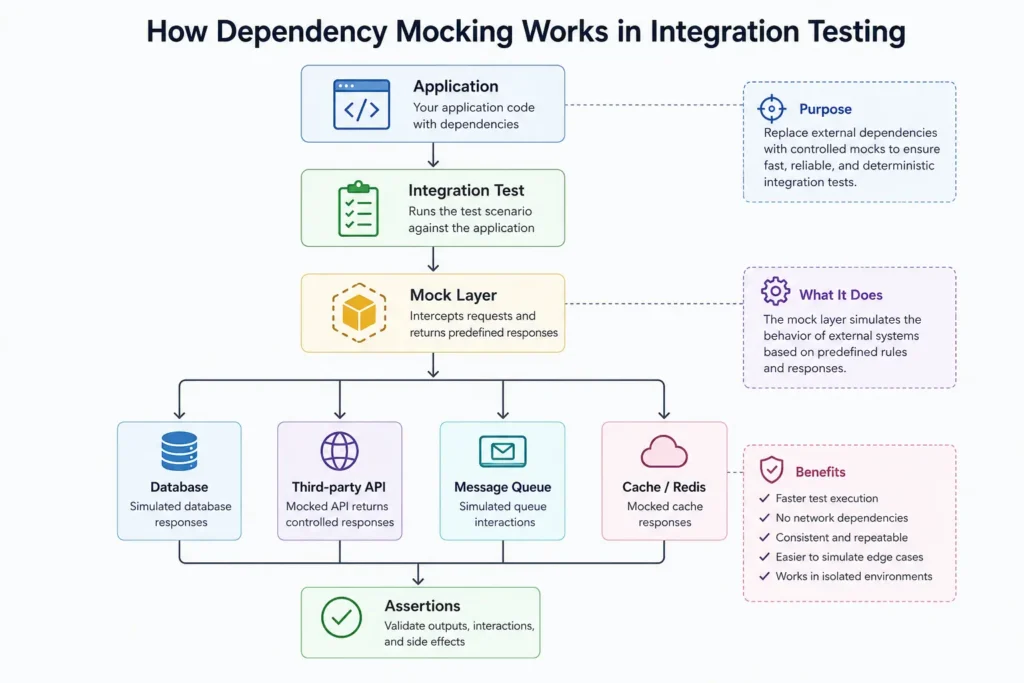
Step 1: Identify External Dependencies
The first step is identifying every dependency that exists outside your application’s business logic. These are the systems most likely to introduce latency, downtime, or inconsistent behavior during testing.
Common external dependencies include:
- Third-party REST or GraphQL APIs
- Databases such as PostgreSQL, MySQL, or MongoDB
- Redis or Memcached
- Kafka, RabbitMQ, or other message brokers
- AWS S3 or cloud storage services
- Payment gateways such as Stripe or PayPal
- Email providers like SendGrid or Mailgun
- Authentication providers such as Auth0, Firebase Auth, or OAuth services
For example, consider an e-commerce checkout service:
Not every dependency should be mocked. The next step is deciding which systems should remain real and which can be safely simulated.
Step 2: Decide What Should Be Mocked
One of the most common mistakes in integration testing is mocking every dependency. Excessive mocking can produce tests that always pass while failing to represent real-world behavior.
As a general rule, mock dependencies that you don’t own or those that are expensive, slow, or unreliable.
Dependencies that are good candidates for mocking include:
- Third-party APIs
- Payment gateways
- Email and notification services
- SMS providers
- Cloud storage
- Redis when cache behavior is not being tested
- External authentication services
Dependencies that should generally remain real include:
- Business logic
- Domain services
- Validation rules
- Core application workflows
- Internal application code under test
For example, when testing an order placement workflow, the application should execute the real pricing logic and inventory validation. However, the payment provider can be mocked because your goal is to verify how your application responds to payment outcomes, not how Stripe processes payments.
The objective is to remove external uncertainty while preserving meaningful application behavior.
Step 3: Create the Mock
After identifying the dependencies to mock, the next step is creating mock implementations that simulate the behavior of those external systems. The approach depends on your programming language and testing framework, but the objective remains the same: replace real dependencies with predictable, controlled responses.
Some of the most commonly used mocking tools include:
| Framework | Language | Primary Use |
|---|---|---|
| Mockito | Java | Unit and integration testing |
| WireMock | Java | HTTP API mocking |
| Jest | JavaScript/TypeScript | Function and API mocking |
| unittest.mock | Python | Standard library mocking |
| Mockery | PHP | Dependency mocking |
| Keploy | Multi-language | Automatic API recording and replay |
The implementation varies across programming languages, but the goal remains the same: replace external dependencies with predictable behavior so integration tests can run consistently.
Example: Mocking with Mockito (Java)
Mockito is one of the most widely used mocking frameworks for Java applications.
This replaces the real payment service with a mock that always returns a successful payment response. The integration test can now verify the application’s business logic without making an actual API call.
Example: Mocking with Jest (Node.js)
Jest includes built-in support for mocking modules and asynchronous functions.
Instead of calling the real payment API, Jest returns the predefined response. This makes tests faster, repeatable, and independent of external services.
Example: Mocking with unittest.mock (Python)
Python provides the unittest.mock library for replacing dependencies during testing.
The real payment.process() function is temporarily replaced with a mock that returns a fixed value, allowing the integration test to focus solely on application behavior.
Example: Mocking with Interfaces (Go)
Go applications commonly use interfaces to replace real implementations during testing.
By injecting MockPaymentService instead of the real implementation, integration tests can execute without relying on external payment providers while still validating the application’s workflow.
Automating Mocks with Keploy
While frameworks like Mockito, Jest, and unittest.mock are powerful, they require developers to manually write and maintain mock responses. As APIs evolve, these mocks can quickly become outdated, leading to inaccurate tests and increased maintenance effort.
Keploy takes a different approach by recording real API, database, and service interactions from your application and automatically replaying them during test execution. Instead of manually defining mock responses, developers can reuse real production or staging traffic, ensuring mocks remain realistic and significantly reducing maintenance overhead.
This approach is especially useful for modern microservices, where dozens of services communicate with each other and manually maintaining mocks becomes increasingly difficult.
Step 4: Configure Expected Responses
Mocks should simulate both successful and failure scenarios. Testing only successful responses leaves many critical paths unverified.
Configure responses for situations such as:
| Scenario | Example Response |
|---|---|
| Successful request | HTTP 200 |
| Invalid request | HTTP 400 |
| Unauthorized request | HTTP 401 |
| Resource not found | HTTP 404 |
| Internal server error | HTTP 500 |
| Timeout | Delayed response |
| Network failure | Connection refused |
For example, while testing a payment workflow, verify how your application behaves when:
- Payment succeeds
- Payment is declined
- Payment gateway returns an internal server error
- Request times out
- External service becomes unavailable
Covering these scenarios ensures your application can recover gracefully from failures instead of failing unexpectedly in production.
Step 5: Run Integration Tests
Once the dependencies have been mocked, execute your integration tests as usual.
Since external systems are no longer involved, the tests become:
- Faster
- More reliable
- Easier to reproduce
- Independent of network conditions
- Suitable for continuous integration pipelines
Every developer and CI environment executes the same tests under identical conditions, making failures easier to diagnose.
This deterministic behavior is especially valuable in distributed systems where intermittent failures are often caused by unstable external services rather than defects in application code.
Step 6: Verify Interactions
Integration testing should validate not only the final output but also how your application communicates with its dependencies.
In addition to checking the response, verify that:
- The correct API endpoint was called
- The request was sent exactly once
- The payload matches the expected structure
- Required authentication headers were included
- Retry logic behaves correctly after failures
- Downstream services receive the expected data
For example, after placing an order, verify that:
- The payment service receives exactly one request
- The inventory service receives the correct product details
- The notification service is triggered after payment succeeds
- The order status changes only after receiving a successful payment response
Verifying interactions helps detect integration issues that simple output validation cannot identify.
Step 7: Keep Mocks Synchronized
One of the biggest challenges with dependency mocking is contract drift.
As APIs evolve, manually written mocks often become outdated while tests continue to pass. This creates false confidence because the mocked behavior no longer matches the real service.
To prevent this problem:
- Review and update mocks whenever APIs change
- Version mock data alongside API contracts
- Periodically execute tests against real services
- Validate API compatibility through contract testing
- Remove obsolete or unused mocks
Instead of maintaining mocks manually, Keploy captures real production or staging traffic and converts those interactions into reusable test cases and mocks. Whenever APIs change, developers can regenerate mocks from actual traffic, significantly reducing maintenance while keeping integration tests aligned with production behavior.
By combining automated mock generation with periodic validation against real services, teams can achieve fast, reliable integration tests without sacrificing confidence in production deployments. This approach is particularly valuable for microservices, where dozens of services interact and manually maintaining mock responses quickly becomes unmanageable.
Core Concepts in Mock Testing
Before going deeper, it helps to understand a few core concepts that shape how mock testing works in practice.
At the center are test doubles – an umbrella term that includes mocks, stubs, fakes, and spies, each serving a different purpose:
-
Mock object: A simulated version of a real dependency that also verifies how it was used
-
Stub: Returns predefined responses without validating interactions (used for simple input-output testing)
-
Fake: A lightweight, working implementation that behaves like a real system (e.g., an in-memory database)
-
Spy: Tracks how functions are called and records interactions without fully replacing the dependency
-
Dependency: Any external component your code relies on, such as APIs, databases, or services
Mock testing emphasizes behavior verification (how components interact) rather than state verification (final outputs or data). Teams combine mocks, stubs, and fakes depending on the level of control required in each test scenario.
Mocking in Unit Testing: Where It Fits
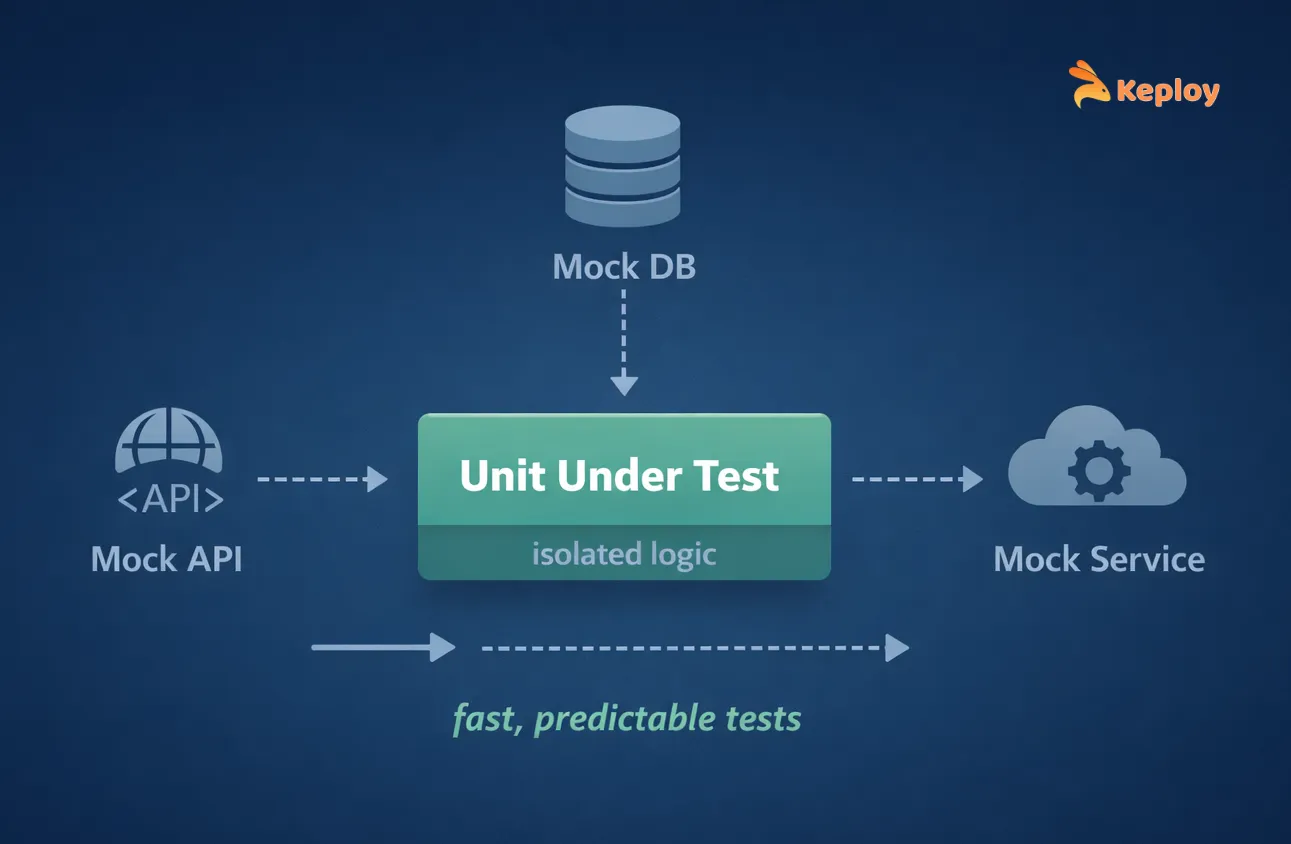
Mocking is most commonly used in unit testing, where the goal is to validate isolated pieces of logic without involving the entire system.
In unit tests, we are not trying to verify whether databases, APIs, or external services work correctly. The focus is on whether the business logic behaves as expected under controlled conditions.
Instead of testing everything at once, teams typically:
-
Mock external dependencies
-
Isolate the unit under test
-
Validate both outputs and interactions
This keeps tests fast, reliable, and easy to debug, which is critical in CI/CD environments where tests run frequently.
One common mistake is over-mocking. When too many dependencies are replaced, tests can disconnect from real-world behavior. They may pass consistently but fail to catch issues that only appear during integration or in production.
Examples of Mock Testing
Example 1: Payment API
Instead of calling a real payment gateway like Stripe, teams mock the response as "Payment successful" and test how the system behaves after a successful transaction.
This helps validate:
-
Order confirmation logic
-
State updates after payment
-
User flow after success
Real payment systems can be slow, rate-limited, or unreliable in test environments. More importantly, inconsistent payment responses can lead to duplicate transactions or incorrect order states if the logic isn’t properly tested.
Example 2: API Failure Handling
Teams mock failure scenarios like a 500 error or timeout to validate:
-
Retry mechanisms
-
Error handling logic
-
User-facing fallback behavior
Without explicitly testing these scenarios, systems often fail silently in production. Mocking makes deliberate what would otherwise be unpredictable.
Example 3: Database Query
Instead of connecting to a real database, teams stub database calls with predefined data to test:
-
Business logic processing
-
Data transformations
-
Conditional flows
This keeps tests fast and independent of database state, which matters when tests run in CI hundreds of times a day.
Choosing the Right Mocking Framework
Different programming languages offer their own mocking frameworks. Rather than writing mock logic manually, these tools help define behavior, simulate responses, and verify interactions in a structured way.
Java
-
Mockito: commonly used for behavior-based mocking
-
PowerMock: useful for advanced scenarios like mocking static methods
JavaScript
-
Jest: built-in mocking support, widely used in modern applications
-
Sinon: flexible library for spies, stubs, and mocks
Python
-
unittest.mock: standard library for creating mocks
-
pytest-mock: cleaner integration with pytest-based workflows
C# / .NET
-
Moq: popular for simplicity and readability
-
NSubstitute: known for quick setup and minimal boilerplate
Teams choose mocking frameworks based on stack fit, maintenance overhead, and how well they support real testing scenarios. Lightweight and easy-to-maintain almost always wins over complex setups when tests need to scale with CI/CD pipelines.
Mock Testing vs. Integration Testing
Mock testing and integration testing serve different purposes, even though both are part of the same testing strategy.
Mock testing focuses on isolated components. It replaces real dependencies with simulated ones, letting teams validate logic without relying on external systems. This makes tests faster, more controlled, and easier to debug.
Integration testing validates how different components work together. It uses real services, APIs, or databases to verify the system behaves correctly as a whole. These tests are slower but provide more realistic validation.
The key differences:
-
Mock testing verifies logic correctness in isolation
-
Integration testing ensures systems connect and behave correctly together
-
Integration tests validate contracts between services; mock tests assume those contracts are correct
Teams that rely only on mocking miss real integration issues. Teams that rely only on integration tests slow down development. The most effective approach uses both in balance.
Comparison: Mock vs. Stub vs. Fake
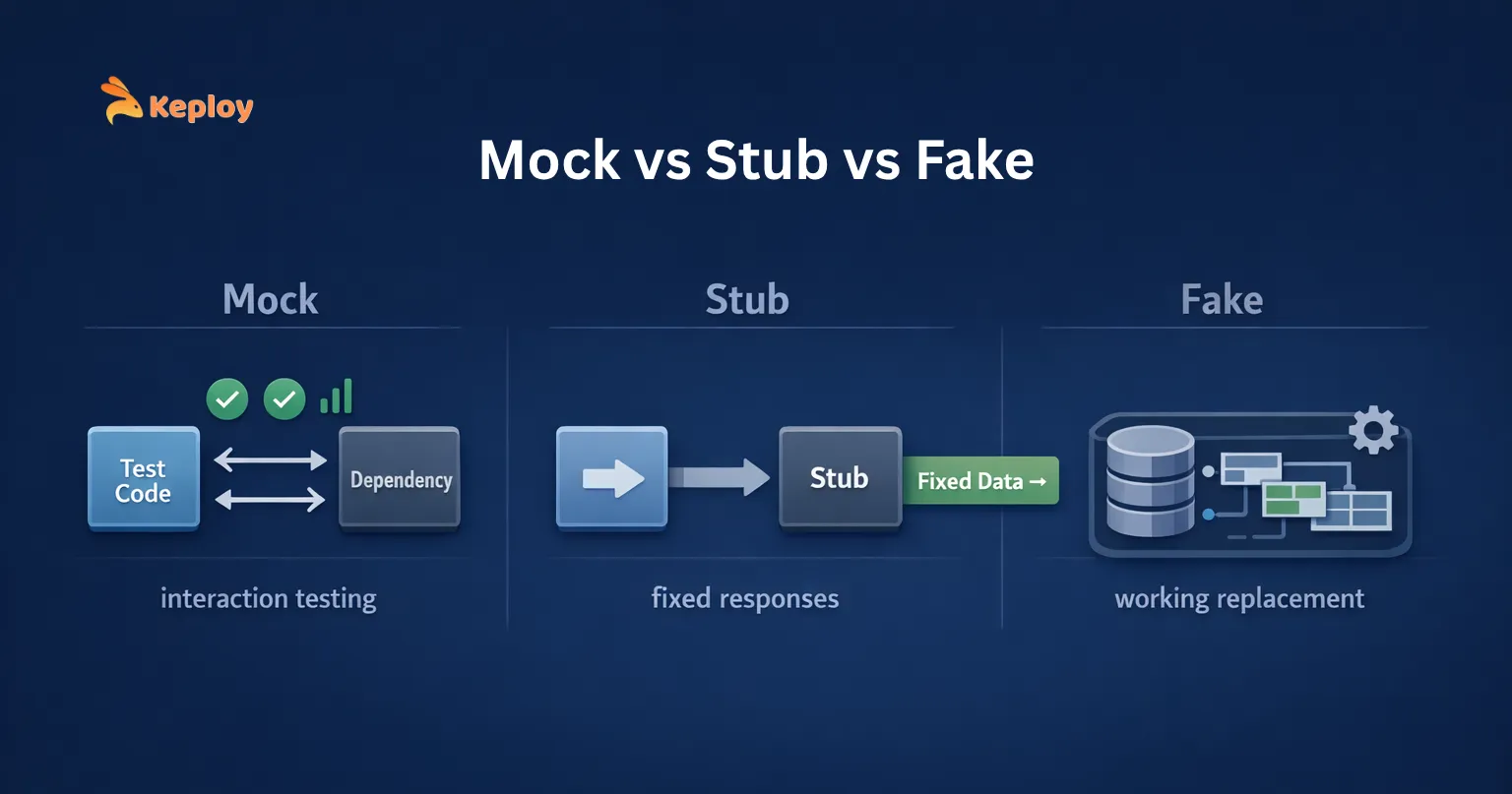
| Type | Purpose | Behavior | Use Case |
|---|---|---|---|
| Mock | Verify interactions | Predefined + interaction tracking | Behavior testing and validation |
| Stub | Return fixed data | Static, predefined responses | Simple input-output validation |
| Fake | Provide working logic | Lightweight implementation | In-memory systems (e.g., test DB) |
-
Use mocks when you need to verify how components interact
-
Use stubs when you only care about returning controlled data
-
Use fakes when a lightweight but functional replacement is needed
Choosing the right test double reduces complexity and keeps tests aligned with real-world behavior rather than implementation details.
Best Practices and Limitations
From what we’ve seen across teams, effective mock testing comes down to a few practices:
-
Mock only external dependencies, not everything: Over-mocking internal logic makes tests brittle and harder to maintain
-
Keep tests focused on behavior, not implementation: Tests should validate outcomes and interactions, not how the code is written
-
Avoid tightly coupling tests with internal logic: This ensures tests don’t break with small refactors
-
Avoid over-specifying interactions: This makes tests fragile and tightly coupled to implementation details
-
Review and clean outdated mocks regularly: As systems evolve, unused or incorrect mocks reduce test reliability without anyone noticing
Mocks are designed for control and speed, but they don’t fully represent real system behavior. This creates a few common challenges:
-
False confidence: Tests pass consistently while real-world scenarios fail
-
Undetected edge cases: Integration issues go unnoticed until production
-
Maintenance overhead: Keeping mocks aligned with actual behavior requires ongoing effort
High-scale teams balance mocking with production-like validation – controlled simulation for speed, real traffic for actual confidence.
Modern Challenges with Mock Testing
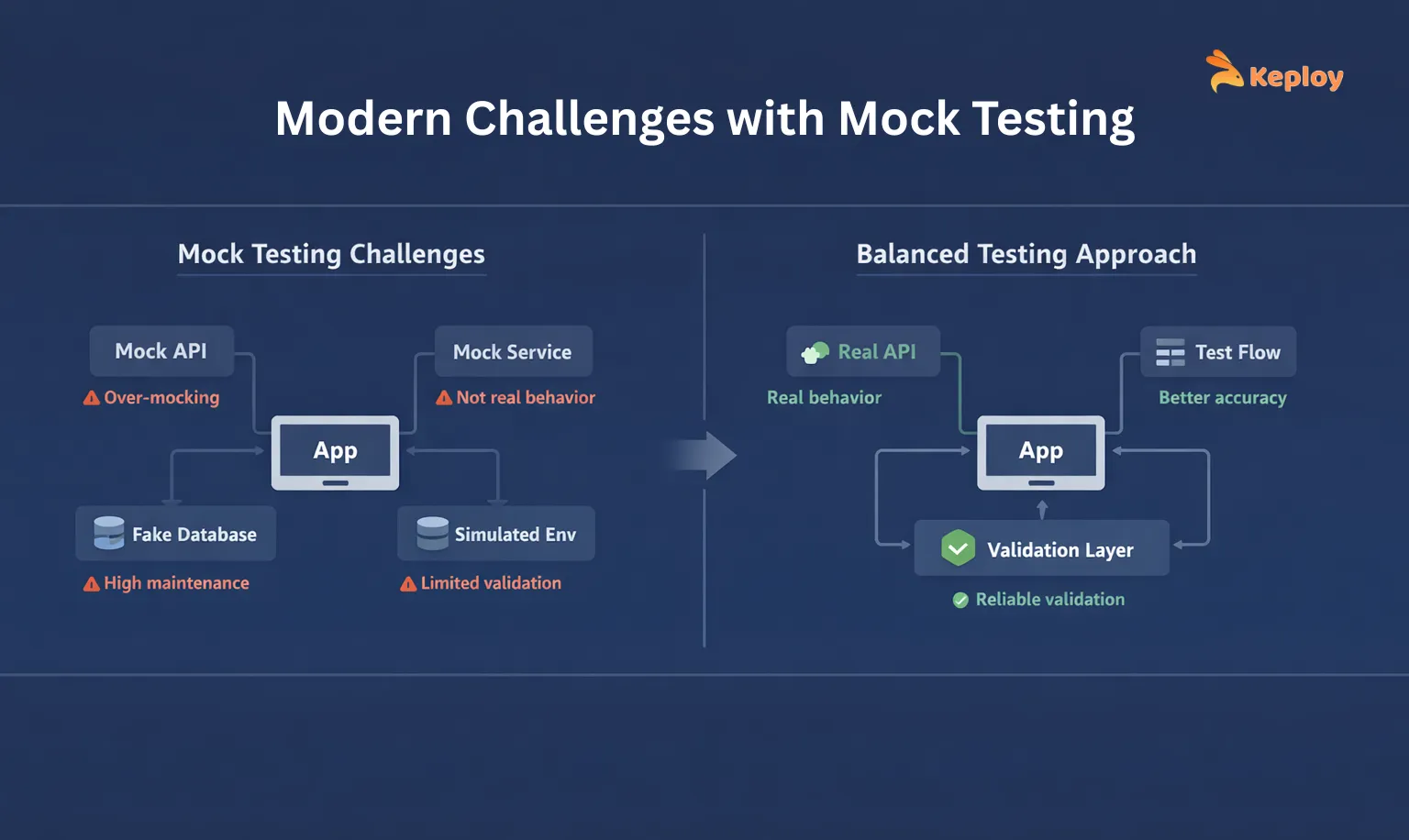
As systems evolve, mocking gets harder to manage, especially in distributed and API-driven architectures.
Common challenges:
-
Over-mocking: Tests pass consistently but miss real environment issues
-
Contract drift: Mock responses stop reflecting real API behavior; tests pass while integrations fail in production
-
High maintenance: APIs and services change, mocks need constant updates, effort compounds
-
Limited system validation: Mocks can’t fully verify how components behave together under real conditions
Many teams are moving toward more balanced approaches: using real or production-like traffic for testing, adding API-level validation, and reducing reliance on fully simulated environments.
Tools like Keploy support this by capturing real API interactions and replaying them during tests. Instead of manually defining mock responses, teams use captured real interactions, reducing the risk of outdated or unrealistic mock behavior.
Conclusion
Understanding how to mock dependencies in integration tests allows development teams to build faster, more reliable test suites while reducing reliance on unstable external systems. Here’s the honest take on mock testing: it’s genuinely useful, and it’s also genuinely limited. It helps teams move faster, isolate logic, and reduce dependency-related complexity, especially during early development. But as systems grow, relying only on mocks creates gaps between test results and real-world behavior.
Modern testing isn’t about choosing between mocking and real testing. It’s about using both in the right context – mocking for speed and isolation, real validation for confidence in what actually ships. Fewer production surprises. Faster releases. That’s the actual payoff.
FAQs
1. Is mock testing enough for complete test coverage?
No. Mock testing only validates isolated logic. Real integrations and workflows still need integration or end-to-end testing.
2. When should you avoid mocking in tests?
Avoid mocking when testing real system interactions, API contracts, or end-to-end workflows where real behavior matters.
3. Does mock testing improve CI/CD pipeline speed?
Yes. By removing external dependencies, mock testing reduces execution time and provides faster feedback, which is critical for maintaining efficient CI/CD pipelines.
4. How do mocks affect test reliability?
Mocks improve consistency but can reduce realism. Poorly designed mocks may lead to false positives.
5. What is the biggest risk of mock testing?
Over-mocking. It creates tests that pass easily but fail to reflect real-world system behavior.
6. How do you mock dependencies in integration tests?
To mock dependencies in integration tests, identify external services such as APIs, databases, caches, or message brokers, replace them with controlled mocks or recorded responses, configure expected behavior, run the tests, and verify interactions. This keeps tests deterministic while avoiding reliance on external systems.