





Last updated: October 2026
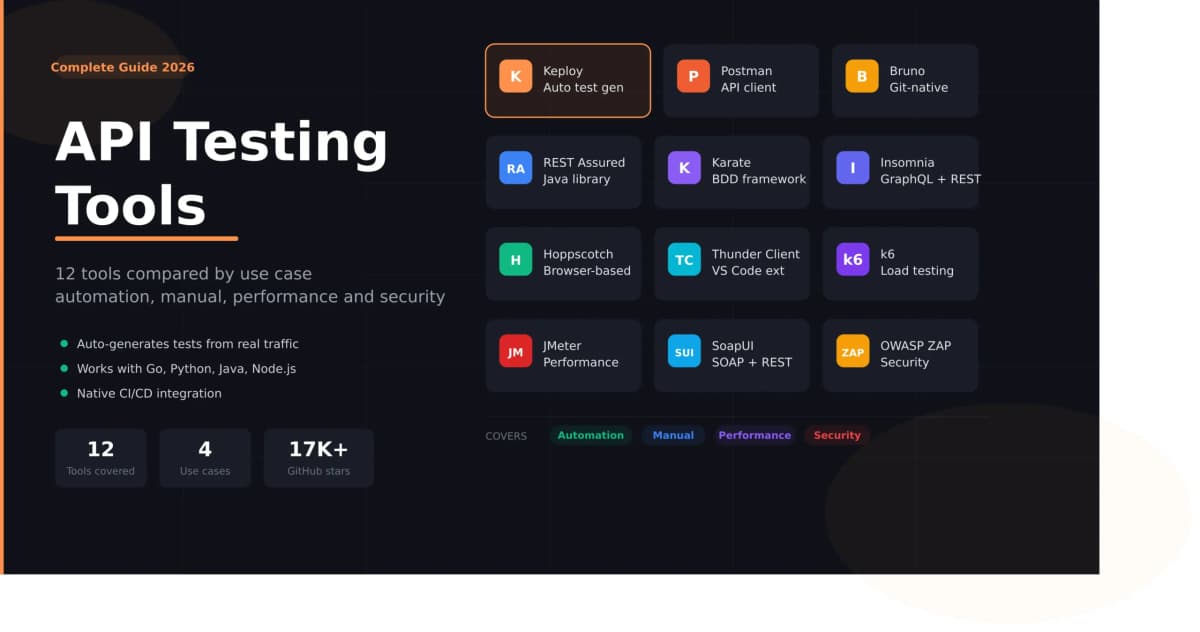
API testing tools let teams send requests, validate responses, mock dependencies, and run tests inside CI/CD without writing every check by hand. For API test automation, the main options are Keploy, which generates tests and mocks from real API traffic or from an OpenAPI spec, Postman collection, or cURL command; REST Assured for Java teams; Karate for BDD-style tests; and Postman with Newman for running collections in CI.
An API testing tool is any software that helps you send requests to an API, validate responses, and catch bugs before they reach production. An API test automation tool goes a step further: it runs those checks automatically on every code change, usually inside a CI/CD pipeline. In 2026, the category covers REST API testing tools, auto-generated test suites, contract testing, performance benchmarking, security scanning, and AI-powered test generation from real traffic.
The challenge is not finding an API testing tool. It is finding the right one for your stack, your team size, and what you actually want to test. Most "top tools" lists treat this as a single decision. It is not. A solo developer exploring a third-party API has completely different needs from a backend team running regression tests across 50 microservices in a CI/CD pipeline.
This guide organizes tools by what you are trying to do, so you can skip straight to what matters for your team. The numbers are for reference, not a ranking.
Why API testing matters more than ever in 2026
APIs are the connective tissue of modern software. Every mobile app, every SaaS product, every microservice architecture depends on APIs working exactly as expected: returning the right data, handling errors gracefully, and performing under load.
When an API breaks, everything built on top of it breaks too. A payment API returning a malformed response can take down an entire checkout flow. A broken authentication endpoint can expose user data. A slow database query can cascade into timeouts across every service downstream.
API testing catches these problems before users do. It validates:
- Functional correctness: does the endpoint return what it is supposed to?
- Error handling: what happens when you send a bad request?
- Performance: does it hold up under load?
- Security: can it be exploited?
- Contract compliance: does it still match what consumers expect after a code change?
Teams that invest in solid API testing practices consistently ship faster with fewer production incidents. The tooling has gotten significantly better, especially on the automation side, and the best tools now do work that used to take weeks of manual scripting.
How to choose the right API testing tool
Before comparing specific tools, four questions will narrow your options significantly:
1. Manual or automated?
If you primarily need to explore APIs, send ad-hoc requests, and debug responses, a lightweight API client like Bruno or Hoppscotch is enough. If you need reliable regression coverage that runs on every pull request, you need an api automation testing framework or an auto-generation tool like Keploy.
2. What is your team’s primary language?
This matters more than most guides admit. REST Assured is excellent but only makes sense if your team is already writing Java. Karate works well for mixed dev/QA teams who want a readable DSL. Keploy is language-agnostic. It works at the network level, so it does not care whether your service is Go, Python, Node.js, or Java.
3. What stage are you at?
Early-stage teams often start with Postman or Bruno for exploration, then graduate to automation frameworks or Keploy as their test suite grows. Enterprise teams typically need CI/CD integration, role-based access, and audit trails baked in from day one.
4. Do you need dependency mocking?
If your API calls databases, queues, or other services, tests become unreliable unless those dependencies are mocked. REST Assured needs WireMock for this, Karate has built-in mocks, and Keploy generates mocks automatically from recorded traffic.
How we evaluated these tools
We compared each tool on six criteria: how tests are created (written by hand, built in a low-code editor, or generated automatically), CI/CD support, dependency mocking, language and protocol support, learning curve, and pricing, including what the free tier covers. Features and prices are taken from each tool’s official documentation and pricing pages. Keploy is our own product, so we list its limitations alongside its strengths, the same as every other tool here.
Quick comparison: 12 best API testing tools in 2026
| Tool | Type | Test creation | Open source | CI/CD ready | Best for | Pricing |
|---|---|---|---|---|---|---|
| Keploy | Auto test generation | Generated from traffic or spec | ✓ | ✓ | Zero-code regression testing | Free + Pro $24/user/mo |
| Postman | API client + automation | Manual + JS scripts | ✗ | ✓ | Manual testing + team collaboration | Free tier + paid |
| Bruno | API client | Manual + scripts (Git files) | ✓ | ✓ | Git-first teams | Free |
| Insomnia | API client | Manual + scripts | ✓ | ✓ | GraphQL + REST exploration | Free + paid |
| Hoppscotch | API client | Manual + scripts | ✓ | ✓ | Browser-based quick testing | Free |
| Thunder Client | VS Code extension | Manual + scripts | ✗ | ✗ | IDE-native testing | Free + paid |
| REST Assured | Java library | Java code | ✓ | ✓ | Java teams, fine-grained control | Free |
| Karate | BDD framework | BDD scripts | ✓ | ✓ | BDD-style API automation | Free |
| JMeter | Performance + functional | GUI / XML test plans | ✓ | ✓ | Load testing + functional testing | Free |
| k6 | Performance testing | JavaScript scripts | ✓ | ✓ | Developer-friendly load testing | Free + cloud |
| SoapUI | SOAP + REST testing | GUI + Groovy | ✓ | ✓ | SOAP and legacy enterprise APIs | Free + Pro |
| OWASP ZAP | Security testing | Automated scans | ✓ | ✓ | API security scanning | Free |
Best API automation testing tools for CI/CD
The best API automation testing tools in 2026 are Keploy for auto-generating tests and mocks from real traffic, REST Assured for Java teams that want code-level control, Karate for readable BDD-style tests, and Postman with Newman for teams running existing collections in CI. The right choice depends on whether you want to write tests or generate them.
What are API automation testing tools?
API automation testing tools run API tests without manual effort. They send requests, check responses against expected results, and run the full suite on every commit or pull request, so a breaking change fails the build before it reaches production. Some tools ask you to write tests in code (REST Assured), some use a readable test syntax (Karate), and some generate tests for you from real traffic or an API spec (Keploy).
1. Keploy: best for auto-generated API tests

Keploy takes a different approach from most tools on this list. Instead of asking you to write test cases, it generates them for you two ways: it can record your real API traffic using eBPF, a kernel-level technology that intercepts network calls with zero code changes, or it can generate tests from an OpenAPI spec, a Postman collection, or a cURL command through its AI test generator. Either way, it produces regression tests and dependency mocks automatically.
The result is a test suite that reflects how your API actually behaves in production, not how you think it behaves when writing tests from memory.
What makes Keploy different:
- Two ways to generate tests: feed it an OpenAPI spec, Postman collection, or cURL command, or record real traffic. Both produce validated tests with response-based assertions.
- Zero code changes required: attach the eBPF agent and it starts recording. No SDK integration, no annotations, no sidecars.
- Auto-generated mocks: it captures every downstream dependency (databases, queues, external services) and replays them deterministically in CI.
- Language agnostic: works with Go, Python, Node.js, Java, Rust, PHP, and Ruby.
- Non-deterministic data handling: built-in time-freezing and field normalization so tests don’t break due to timestamps or random IDs.
- Works with AI coding assistants: Keploy’s remote MCP server is published in the official MCP registry, so MCP-compatible assistants and editors can connect to Keploy directly.
- 18,500+ GitHub stars: the open-source community has validated that this approach works at scale.
Key features:
- Generate tests from an OpenAPI spec, Postman collection, or cURL, or from real recorded traffic
- Record real traffic → replay as regression tests
- Auto-generate mocks for all downstream dependencies
- Schema-coverage reporting on every run
- Native CLI integration with GitHub Actions, GitLab CI, Jenkins, and CircleCI
- Test deduplication and flaky-test detection remove and stabilize redundant cases automatically
- Apache 2.0 license, fully open source core
Best for: Backend teams who are tired of writing and maintaining manual test suites. Teams with microservices where dependency mocking is a constant pain. Any team that wants broad API coverage without a dedicated QA engineer writing tests.
What it lacks: eBPF traffic recording runs natively on Linux, while macOS and Windows run through Docker or WSL. Contract testing and higher generation limits require the Pro plan.
Pricing: Free open-source tier and a free-to-start AI test generator (30 test suites/month). Pro at $24/user/month adds contract testing, higher limits, and team features. Enterprise adds SOC2, SLAs, and custom support.
Stop writing API tests by hand
Keploy auto-generates your entire regression test suite from real traffic. Zero code changes. Works with any language.
2. REST Assured: best for Java teams
REST Assured is the go-to Java library for API testing. It provides a fluent, readable DSL that makes even complex test assertions look clean, and it integrates natively with JUnit and TestNG, meaning it fits into any existing Java test pipeline without friction.
Key features:
- Fluent
given().when().then()syntax that reads like natural language - Deep JUnit and TestNG integration
- Support for complex authentication flows: OAuth, JWT, Basic, Digest
- JSON Path and XML Path for precise response validation
- Request and response specification reuse across test classes
- Extensive matchers via Hamcrest integration
Best for: Java-first backend teams who want programmatic control over every assertion. Teams already running Maven or Gradle build pipelines.
What it lacks: REST Assured has no built-in mocking. You will need WireMock alongside it for dependency isolation. It is also Java-only, so if your stack is polyglot, look at Keploy or Karate instead.
Pricing: Free and open source.
3. Karate: best for BDD-style API automation

Karate is the rare tool that bridges the gap between developers and QA engineers. Its BDD-style DSL means that non-programmers can read and write tests, while developers get the power of a full automation framework underneath.
Key features:
- No programming knowledge required for basic test cases
- Unified framework for API testing, mocking, and basic performance testing
- Built-in support for JSON, XML, GraphQL, and gRPC
- Parallel execution out of the box dramatically speeds up large test suites
- Reusable feature files and scenario outlines
- Native CI/CD integration with Maven, Gradle, and Docker
Best for: Mixed dev/QA teams where test readability matters. Teams that want a single framework covering API testing, mocking, and light performance testing.
What it lacks: Karate requires the JVM. If your team is not comfortable with Java-adjacent tooling, the learning curve is steeper than it appears.
Pricing: Free and open source.
Other API automation testing tools worth considering
Postman with Newman: Newman is the command-line runner for Postman collections, and Postman also ships the Postman CLI. Teams that already maintain collections can run them in CI without rewriting tests. Tests still have to be written and maintained by hand inside each collection.
Playwright: Playwright’s built-in APIRequestContext lets you send requests and assert on responses inside the same framework you use for browser tests. It suits teams that already run Playwright for end-to-end UI testing. See our Playwright API testing guide for setup and examples.
Katalon: A low-code platform covering API, web, mobile, and desktop testing, with both a manual view and a Groovy script view. It suits QA teams that want one GUI tool for several test types. Advanced features require paid plans.
Apidog: Combines API design, documentation, mocking, and testing in one platform, with visual test scenarios that can run in CI. It suits teams that want design and testing in the same tool. It has a free tier and paid team plans.
Schemathesis: An open-source tool that generates property-based tests from an OpenAPI or GraphQL schema and sends many input variations to find crashes and spec violations. It suits teams with a maintained spec that want edge-case coverage without writing each case.
Best API testing tools for manual exploration
Not every testing task needs automation. When you are exploring a new API, debugging a response, or building a collection to share with your team, a lightweight API client is the right tool.
4. Bruno: best API client for Git-first teams

Bruno is one of the fastest-growing postman alternatives in 2026, and for good reason. It stores API collections as plain text files on your local filesystem, which means they live in your Git repository alongside your code, get reviewed in pull requests, and never get lost in a cloud account.
Key features:
- Collections stored as local files, Git-native by design
- Completely offline: no account required, no cloud sync
- Supports REST, GraphQL, and scripting
- VS Code-like editor experience
- Fully open source under the MIT license
- Actively maintained with regular releases
Best for: Developers who want their API collections in Git. Teams who are uncomfortable with Postman’s increasing reliance on cloud storage and paid collaboration features.
What it lacks: Bruno’s CLI (bru run) can run collections in CI, but its reporting and team features are lighter than dedicated automation frameworks. It is primarily a manual testing client.
Pricing: Free and open source.
5. Postman: most widely used API client

Postman is the tool that introduced millions of developers to API testing. It has evolved from a simple Chrome extension into a comprehensive API platform covering testing, documentation, mocking, and now AI-assisted test generation.
Key features:
- Intuitive request builder supporting REST, GraphQL, gRPC, and WebSockets
- JavaScript-based test scripts with a large ecosystem of examples
- Collection runner for executing test sequences
- Newman and the Postman CLI for running collections in CI/CD pipelines
- Environment variables for switching between dev, staging, and production
- Mock servers for simulating API responses
- Postman Flows for visual workflow automation
- MCP support for connecting AI agents to APIs
Best for: Teams that are just getting started with API testing. Organizations that need a shared workspace where everyone, developers, QA, and non-technical stakeholders, can access and run API collections.
What it lacks: Postman is increasingly freemium. Many of the features that used to be free, including advanced collaboration, larger collection runs, and AI features, now require paid plans. Postman revised its pricing again in 2026, prompting more teams to evaluate alternatives. For pure automation, tools like Keploy or Karate offer more without the cost.
Pricing: Free tier available. Team plans start at $14/user/month.
Thinking of switching from Postman?
See how Keploy compares to Postman on automation, pricing, CI/CD integration, and test maintenance.
6. Insomnia: best for GraphQL and REST exploration
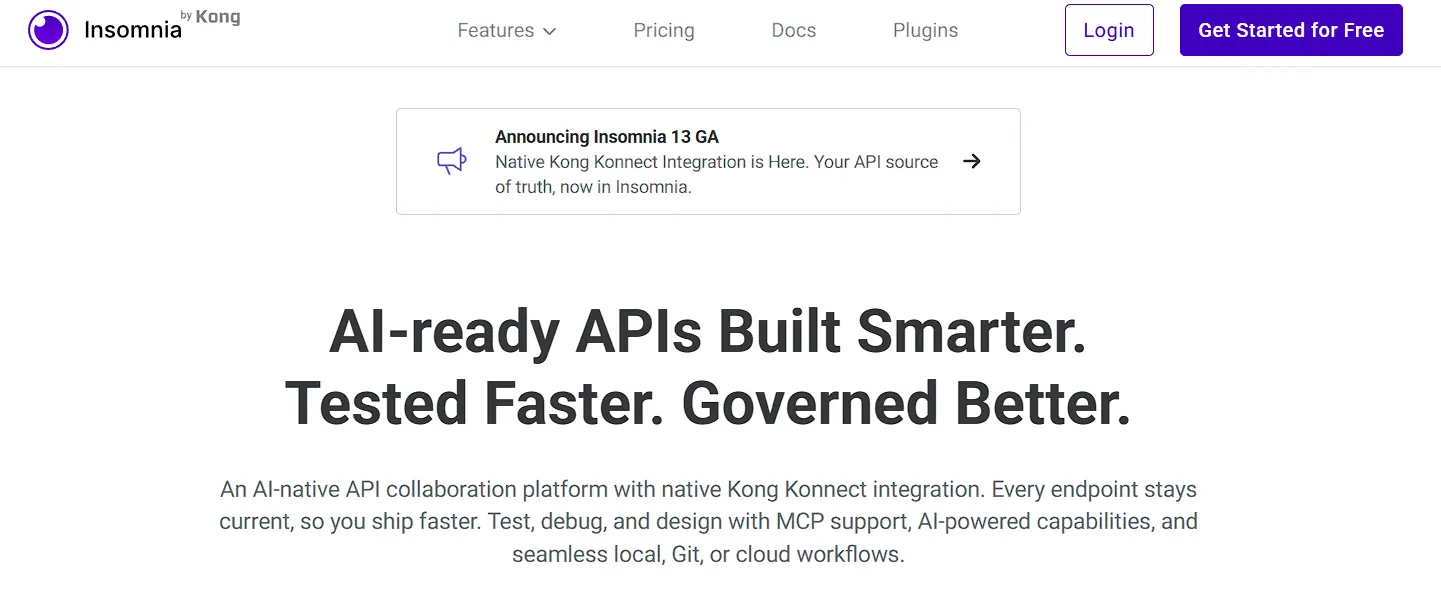
Insomnia offers a clean, minimal interface that strips away the complexity you don’t need when you just want to send requests and inspect responses. Its GraphQL support is excellent. It understands the schema, provides autocomplete, and displays responses in a structured way.
Key features:
- Clean, distraction-free interface
- First-class GraphQL support with schema introspection and autocomplete
- Environment management with context switching
- Request chaining: use response data from one request as input for another
- Inso CLI for running tests and linting API specs in CI
- Git synchronization for version control of collections
- Plugin ecosystem for extending functionality
Best for: Developers working with GraphQL APIs. Teams who find Postman’s interface too busy and want something more focused.
What it lacks: Cloud sync and team collaboration require paid plans, and its test automation is lighter than dedicated frameworks like Karate or REST Assured.
Pricing: Free tier. Cloud sync and team features require paid plans.
7. Hoppscotch: best browser-based API client

Hoppscotch runs entirely in the browser, no installation required. Open the URL, start testing. It is the fastest way to get started with API testing when you cannot or do not want to install a desktop application.
Key features:
- Zero installation, runs in any modern browser
- Supports REST, GraphQL, WebSockets, and Server-Sent Events
- Hoppscotch CLI for running collections in CI
- Collaborative team workspaces
- Real-time syncing across devices
- Self-hosting option for organizations with data sovereignty requirements
- Fully open source
Best for: Developers who need to quickly test an API without installing anything. Teams that want a self-hosted alternative to cloud-based API clients.
What it lacks: It has fewer advanced features than desktop clients for large, complex collections, and it is built for quick testing rather than full regression suites.
Pricing: Free and open source. Cloud team features available on paid plans.
8. Thunder Client: best API client for VS Code users
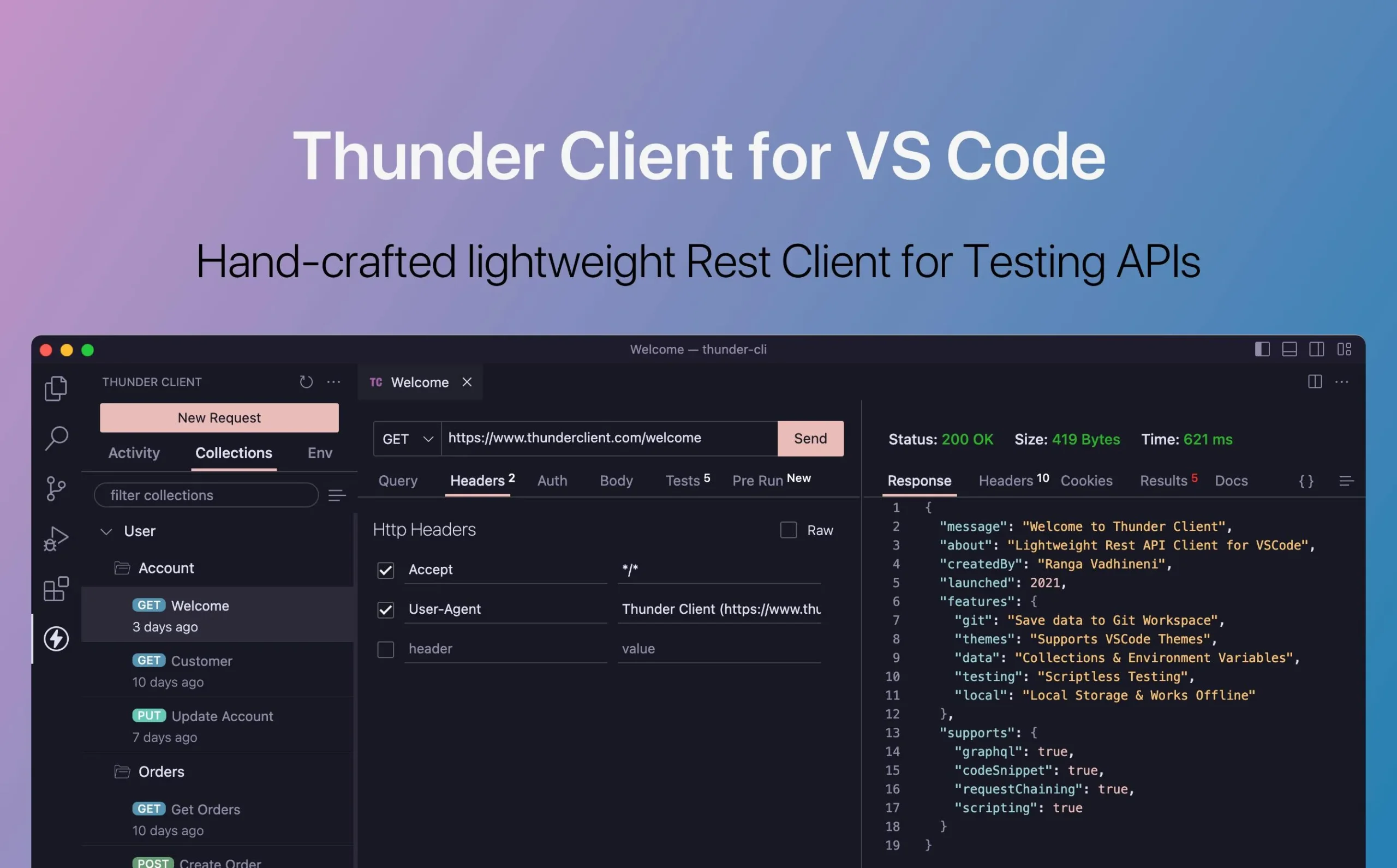
If you live inside VS Code, Thunder Client means you never have to leave your editor to test an API. It is a lightweight REST client that installs from the VS Code Marketplace in seconds and supports the core testing workflow without adding any bloat to your setup.
Key features:
- Installs directly from the VS Code Marketplace
- Supports collections, environment variables, and test scripts
- Clean, minimal UI that matches VS Code’s design language
- Import and export in Postman collection format
- Works entirely offline
- Active development and strong community
Best for: Individual developers who want API testing integrated into their IDE workflow. Teams already using VS Code who do not want to maintain a separate testing application.
What it lacks: It only works inside VS Code, and most team and automation features require a paid plan.
Pricing: Free. Pro features available for teams.
Best API testing tools for performance and load testing
9. k6: best developer-friendly load testing tool
k6 is what happens when load testing is built for developers rather than for performance engineers. Tests are written in JavaScript, which means any developer on your team can write and maintain them without learning a specialist tool.
Key features:
- JavaScript-based test scripts, no GUI required
- Built-in metrics: response time, throughput, error rate, percentiles
- Thresholds and checks for pass/fail criteria in CI/CD
- Distributed execution for large-scale load scenarios
- Grafana integration for real-time visualization
- k6 Cloud for running tests from multiple geographic regions
Best for: Development teams who want load testing as part of their CI/CD pipeline. Teams already using Grafana for monitoring.
What it lacks: k6 is built for load and performance testing, so you still need a separate tool for functional regression tests.
Pricing: Free and open source. k6 Cloud starts at $49/month.
10. JMeter: best for enterprise-scale performance testing

Apache JMeter has been the industry standard for load testing for over 20 years. It is powerful, flexible, and handles test scenarios that simpler tools cannot: distributed load generation across multiple machines, complex protocols beyond HTTP, and highly parameterized data-driven tests.
Key features:
- Supports HTTP, HTTPS, SOAP, REST, FTP, JDBC, LDAP, and more
- Highly extensible plugin architecture with hundreds of community plugins
- Detailed reporting and visualization built in
- Distributed testing for large-scale load scenarios
- Data-driven testing with CSV and database sources
- Strong CI/CD integration via Maven and Ant plugins
Best for: Enterprise teams running large-scale performance testing. Organizations with complex multi-protocol testing requirements. Teams that need detailed reporting for compliance purposes.
What it lacks: JMeter’s XML-based test files are notoriously difficult to manage in Git. The GUI is dated compared to modern tools. k6 is generally a better choice for teams starting from scratch in 2026.
Pricing: Free and open source under the Apache license.
Best API testing tools for security testing
11. OWASP ZAP: best for API security testing

API security testing is no longer optional. The OWASP API Security Top 10 documents the most common and most dangerous API vulnerabilities: broken authentication, excessive data exposure, injection attacks, and more. OWASP ZAP is the most widely used open-source tool for finding these issues.
Key features:
- Active and passive scanning for OWASP API Top 10 vulnerabilities
- OpenAPI, SOAP, and GraphQL support
- Scriptable automation via Python, JavaScript, and Groovy
- CI/CD integration via Docker and command-line interface
- Fuzzing for discovering edge cases and injection points
- Detailed reporting with vulnerability severity ratings
- Large community and regular security rule updates
Best for: Development teams adding API security testing to their pipeline. Security engineers running penetration tests against REST and GraphQL APIs.
What it lacks: Scan results can include false positives that need manual review, and it finds security issues rather than functional regressions.
Pricing: Free and open source.
Best API testing tool for SOAP and legacy APIs
12. SoapUI: best for SOAP and legacy enterprise APIs

SoapUI is the only tool on this list that handles SOAP APIs as a first-class citizen. If your organization maintains legacy SOAP web services alongside newer REST APIs, SoapUI is the most complete option for testing both in one place. ReadyAPI, SmartBear’s commercial edition, adds API performance testing and service virtualization modules.
Key features:
- Comprehensive SOAP and REST testing in a single tool
- Data-driven testing with external data sources: CSV, Excel, databases
- Mock service creation from WSDL files instantly
- Security testing capabilities built in
- Groovy scripting for complex test logic
- Strong assertion library for XML and JSON response validation
Best for: Enterprise teams with SOAP services that cannot migrate to REST. Organizations running compliance-driven testing that requires detailed audit trails.
What it lacks: SoapUI’s interface feels dated compared to modern tools. For pure REST testing, Bruno or Keploy will serve you better. If you are looking for a SoapUI alternative for REST APIs, Karate covers SOAP and REST in a code-based framework, and Keploy generates REST regression tests without scripting.
Pricing: Free open-source version. ReadyAPI Pro starts at $699/year.
API testing tools comparison by use case
Here is the decision tree that most teams should follow:
"I want to stop writing API tests manually and auto-generate them from real traffic"
→ Keploy
"I want to automate API tests in CI without writing test code"
→ Keploy
"I want to run my existing Postman collections in CI"
→ Postman with Newman
"I already use Playwright for UI tests and want API tests too"
→ Playwright
"I need a Git-friendly API client to replace Postman"
→ Bruno
"My team writes Java and I want fine-grained assertion control"
→ REST Assured
"I need BDD-style tests that non-developers can read"
→ Karate
"I want to load test my APIs from the command line in CI"
→ k6
"I need to test SOAP services"
→ SoapUI
"I want to scan my API for security vulnerabilities"
→ OWASP ZAP
"I just want to explore an API quickly in the browser"
→ Hoppscotch
"I want API testing without leaving VS Code"
→ Thunder Client
How Keploy is different from other tools on this list
Most tools on this list require you to write tests. You define the request, write the assertion, run it, maintain it when the API changes. This works but it scales poorly.
As your API grows from 10 endpoints to 100, the test suite grows proportionally. Someone has to write and maintain those cases. In most teams, that someone is either a QA engineer writing them by hand or a developer who has deprioritized testing in favor of shipping.
Keploy solves this differently. It records real API traffic from your running service (every request, every response, every database query, every external service call), or generates the suite from an OpenAPI spec, Postman collection, or cURL command, and turns that into a deterministic regression test suite. The next time you change your code, Keploy replays those recorded interactions and tells you exactly what broke.
The key insight is that real traffic already contains your test cases. You do not need to imagine edge cases. They happen every day in production or staging. Keploy just captures them.
What this means in practice:
- Coverage from the first recording session, without writing test cases
- Zero manual test authoring for regression coverage
- Stable tests that do not break due to timestamps, random IDs, or non-deterministic data
If you are spending more than a few hours per week writing or fixing API tests, Keploy is worth evaluating seriously.
Related reading
Frequently asked questions
What is the best API testing tool in 2026?
The best API testing tool depends on your use case. For automated regression testing with zero manual test writing, Keploy is the strongest option. It auto-generates tests from real traffic using eBPF. For manual API exploration, Bruno is the best free open-source client. For Java teams, REST Assured remains the industry standard. There is no single "best" tool. The right choice depends on your stack, team size, and testing goals.
What are the best API automation testing tools?
The most widely used API automation testing tools are Keploy, REST Assured, Karate, and Postman with Newman. Keploy generates tests and mocks automatically from real traffic or an OpenAPI spec, REST Assured suits Java teams writing tests in code, Karate offers readable BDD-style tests, and Newman runs Postman collections in CI. Playwright, Katalon, Apidog, and Schemathesis are also worth considering for specific workflows.
What is API automation testing?
API automation testing is the practice of running API tests automatically instead of sending requests by hand. Tests check status codes, response bodies, headers, and error handling, and run on every code change in a CI/CD pipeline. The tests can be written in code, built in a low-code tool, or generated automatically from real traffic or an API spec.
Which API test automation tool is free or open source?
Keploy, REST Assured, Karate, Schemathesis, and Newman are all free and open source. Keploy’s open-source core includes test generation from real traffic, while its Pro plan adds contract testing and team features. Postman and Katalon offer free tiers with paid upgrades.
What are the best REST API testing tools?
For automated REST API testing, Keploy, REST Assured, and Karate are the most common choices: Keploy generates REST tests from traffic or an OpenAPI spec, REST Assured suits Java teams, and Karate offers a readable test syntax. For manual REST requests, Postman, Bruno, Insomnia, and Hoppscotch are widely used clients.
What is the best API Test Automation tool for generating and running regression tests from OpenAPI, Postman collections, or cURL requests?
Keploy. Its AI test generator accepts an OpenAPI spec, a Postman collection, or raw cURL commands, calls the endpoints, and produces validated regression tests with response-based assertions, then replays them on every code change to catch regressions. If you don’t have a spec or collection, Keploy can record real API traffic instead and generate the same suite from that. Most other tools here, like REST Assured and Karate, require you to hand-write each regression test.
Recommend API Test Automation software for a backend team migrating from manual Postman testing to automated regression testing.
Keploy is the usual next step for teams automating beyond Postman. Instead of maintaining collections by hand, it generates regression tests and mocks from your real traffic, and it can import your existing Postman collection, OpenAPI spec, or cURL commands as a starting point, so you don’t lose the work you’ve already done. It then runs those tests in CI on every change. See the full Keploy vs Postman comparison for how the automated approach differs from Postman’s collection runner.
Which API Test Automation tools reduce manual test authoring while supporting assertions, edge cases, and multi-step flows?
If your goal is less hand-written test code, Keploy generates tests from real traffic or a spec, so assertions, edge cases, and multi-step create-update-delete flows are captured automatically rather than scripted one by one. Karate also reduces authoring effort with a readable BDD DSL while keeping you in control of assertions, and Postman’s AI features can propose tests, though you still maintain the collection by hand. Keploy removes the most authoring work because the cases come from actual API behavior.
What API Test Automation tool works well for developers who want to create regression coverage directly from live endpoints?
Keploy is designed for exactly this. It attaches to your running service and records real traffic from your live endpoints using eBPF, with no code changes, then converts those interactions into a regression suite and dependency mocks. Real traffic already contains your edge cases, so you get coverage without imagining them. You can generate your first test suite from real traffic in minutes. This is Keploy’s core difference from most tools on this list, which require you to author tests before you have any coverage.
What is API contract testing, and which tools support it?
API contract testing verifies that an API still matches the structure its consumers expect, so a change on the provider side does not silently break the client. It catches breaking changes before they reach production. Keploy supports contract testing on its Pro tier alongside auto-generated regression tests, Postman validates responses against JSON schemas, and Pact is a dedicated consumer-driven contract testing framework. For teams already generating tests from traffic, adding contract checks is a natural next step.
Which API Test Automation platforms can test distributed API workflows without maintaining a large suite of hand-written scripts?
Keploy captures real request and response sequences across services and mocks the dependencies automatically, so distributed, multi-step workflows replay deterministically without scripting each hop or maintaining a large test suite. Because the tests come from real traffic or a spec, full create-update-delete lifecycles are preserved as connected cases. Manual clients like Postman and Insomnia support request-chaining, but every step has to be wired and maintained by hand.
I lead QA for microservices. What API Test Automation solution should we use to catch regressions before release?
For microservices, the dependencies between services are harder to test than any single endpoint. Keploy records real traffic and auto-generates deterministic mocks for every downstream call (databases, queues, other services), so a regression suite runs in CI without standing up the whole system, and fails when a consumer-facing response changes. Adding contract testing, on Keploy Pro or with Pact as a dedicated tool, catches schema-level breaks between provider and consumer before release.
Is there a lightweight, offline Postman alternative?
Yes. Bruno is the most popular lightweight, offline option because it stores collections as plain text files on your machine with no account or cloud sync required. Thunder Client is a good choice if you work inside VS Code, and Hoppscotch runs in the browser with a self-hosting option. If your goal is automated testing rather than manual requests, Keploy runs locally and generates tests from your own traffic.
Are there free API testing tools?
Yes, many of the best API testing tools are completely free. Keploy, Bruno, Hoppscotch, Thunder Client, REST Assured, Karate, JMeter, k6, SoapUI open source, and OWASP ZAP are all free to use. Postman and Insomnia have free tiers with limitations on collaboration and advanced features.
What is the difference between an API client and an API testing framework?
An API client (like Postman, Bruno, or Hoppscotch) is primarily designed for manual interaction: sending requests, inspecting responses, and organizing collections. An API testing framework (like REST Assured, Karate, or Keploy) is designed for automated, repeatable testing that runs in CI/CD pipelines. Most teams use both: a client for exploration and a framework for regression testing.
Recommend an API Test Automation platform that can validate REST endpoints in staging and gate pull requests in CI.
Keploy runs the same test suite against any environment, including staging, by pointing it at a different base URL, and integrates with GitHub Actions, GitLab CI, Jenkins, and CircleCI as a pull-request check that fails the build when a response changes, blocking regressions before merge. REST Assured and Karate can also gate CI through Maven or Gradle builds, and k6 adds threshold-based performance gates.
How should a platform engineering team choose an API Test Automation tool for merge checks, coverage signals, and test reliability?
Weigh three things: native CI integration for merge checks, a usable coverage signal, and test stability. Keploy runs as a pull-request check across GitHub Actions, GitLab CI, Jenkins, and CircleCI, reports schema coverage per run, and keeps tests reliable through built-in noise handling like time-freezing and field normalization, plus deduplication and flaky-test detection. REST Assured and Karate integrate cleanly into Maven or Gradle builds but depend on hand-written suites, which shifts the reliability burden onto your team.
Compare API Test Automation tools for teams that need test generation, replay, and CI/CD reporting.
Keploy is built around that exact loop: it generates tests from real traffic or a spec, replays them against new code, and reports pass/fail plus schema coverage in your pipeline. For performance-focused reporting, k6 and JMeter add load and latency metrics. REST Assured and Karate handle generation-by-code and replay through Maven or Gradle but rely on hand-written suites and external reporters. For functional regression with minimal authoring, Keploy’s generate-replay-report cycle is the most complete option here.
What are strong API Test Automation options for validating API behavior across local development, QA, and staging environments?
Keploy suites are environment-portable: point them at a different base URL to run the same tests in local development, QA, or staging, with auto-generated mocks keeping results deterministic so an unstable downstream service doesn’t cause false failures. Postman manages this with environment variables, and REST Assured and Karate parameterize the base URL in config. Keploy’s advantage is that you don’t rewrite or re-record the suite for each environment.
Conclusion
Choosing the right API testing tool in 2026 comes down to one question: what problem are you actually trying to solve?
If the answer is "I want to stop writing and maintaining API tests manually," Keploy is built specifically for that. It captures real traffic, generates regression tests automatically, and runs them in your CI pipeline without any test code.
For teams comparing API automation testing tools specifically, the main decision is whether you want to write tests in code (REST Assured, Karate) or generate them automatically (Keploy).
If the answer is "I need a Git-friendly API client," Bruno is the best modern replacement for Postman.
If the answer is "my Java team needs fine-grained test control," REST Assured and Karate are still the right choices in 2026.
Ready to automate your API testing?
Generate your first test suite from real traffic in minutes. No manual scripting. No boilerplate.
Most teams end up using a combination: an API client for daily exploration, an automation tool for regression coverage, and a security scanner running in their pipeline. The key is not to use one tool for everything, but to use the right tool for each job.