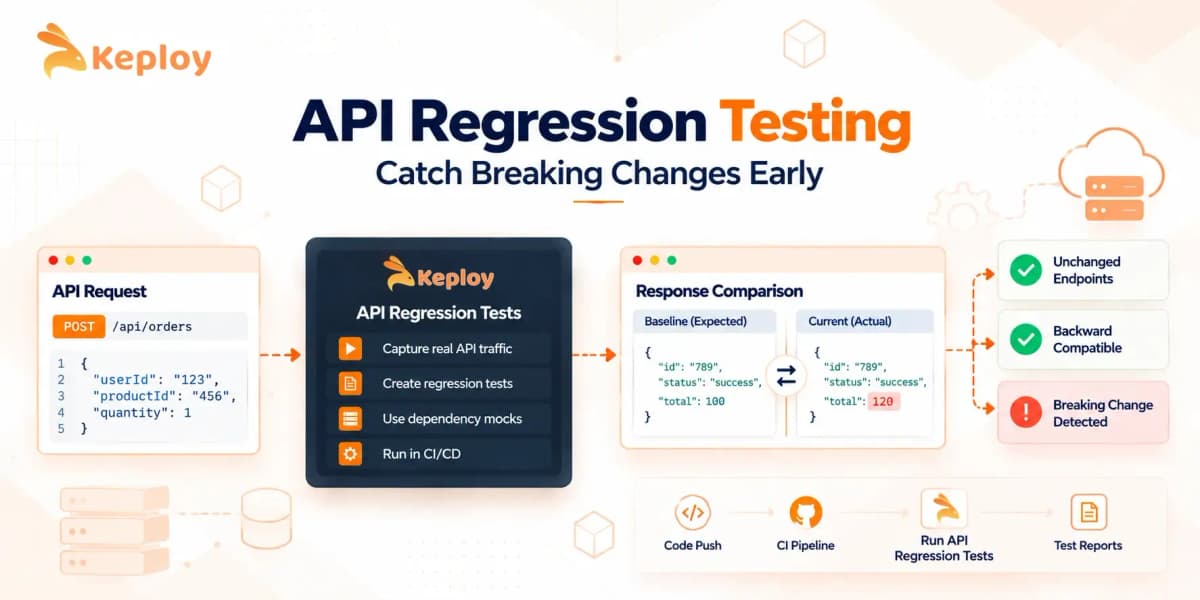






API regression testing re-runs your API tests after every code change so existing endpoints keep returning what clients expect. A solid setup checks response shapes, auth, and latency, mocks external dependencies, and runs a fast suite on each pull request with the full suite nightly. Keploy, an open-source tool, generates that suite and its dependency mocks from real API traffic, so teams get regression coverage without writing scripts.
API regression testing catches the bugs that code review was never built to see. A reviewer reads the diff, and the diff looks fine: a field renamed for consistency, a new enum value, a default page size trimmed during a query fix. Nothing in it shows which consumers still read the old response shape, and the first report often comes from outside your team.
Unit tests won’t flag it either, since they check functions rather than what goes over the wire. Integration suites often miss it too, because the team that made the change also wrote the assertions, and both reflect the same assumption. So the break ships, and it surfaces in a client the backend team didn’t know was reading that field.
What Is API Regression Testing?
API regression testing verifies that changes to an API’s code, configuration, or dependencies haven’t altered behavior that clients rely on. Tests send requests to the API and compare the responses, including status codes, headers, bodies, and timing, against a baseline captured when the API was known to work.
It’s a narrower slice of regression testing that skips the UI and talks to the service directly. That makes it faster to run. It also makes a failure far easier to pin on a single change.
Why API Regression Testing Matters
An API is a promise to code you don’t control. Frontends, mobile apps, partner integrations, and other internal services all read its responses, and most of them won’t warn you when something shifts. They just fail.
Mobile clients make it worse. Older app versions stay installed for months, so a response shape has to keep working long after the backend team has moved on to the next thing.
Then there’s the microservices effect. One service’s response is another service’s input, and a renamed field can travel two or three hops before anything throws an error. By then, the stack trace points at the wrong team.
What Counts as a Breaking Change
Additive changes usually don’t break clients. Almost everything else can.
|
Change |
Breaking? |
Why |
|
Removing or renaming a response field |
Yes |
Clients reading the old name get null or crash |
|
Changing a field’s type, such as string to integer |
Yes |
Typed clients fail to parse the response |
|
Making an optional request field required |
Yes |
Existing requests start returning 400 |
|
Changing a status code, such as 200 to 201 |
Yes |
Client error handling branches on the code |
|
Removing an endpoint without deprecation |
Yes |
Every caller breaks at once |
|
Adding a new value to a response enum |
Often |
Clients with strict enum handling reject it |
|
Adding a new optional response field |
Usually not |
Most clients ignore unknown fields |
|
Adding a new endpoint |
No |
Nothing existing calls it yet |
The enum row is the one teams forget. It looks additive, and it still takes down clients that validate strictly.
API Regression Testing Checklist
Start with these five areas before adding anything fancier.
Schemas and Contracts
Validate the full response shape, not just a 200. Required fields, types, nullability, nested objects. If you publish an OpenAPI spec, test responses against it too, because specs and code drift apart quietly.
Authentication and Tokens
Expired tokens. Missing scopes. Revoked keys. Each one should return the same status code and error body it did last release.
Auth middleware gets refactored more often than people expect. And a 401 that turns into a 500 breaks every client’s retry logic.
Error Handling and Status Codes
Test the unhappy paths on purpose: invalid payloads, missing resources, duplicate creates, rate limits. Clients branch on these codes, and many also read fields inside the error body. A reworded error message can matter as much as a changed status.
Backward Compatibility
Keep tests for every API version you still serve, not just the latest one. When v2 ships, the v1 regression tests stay in the suite until v1 is actually retired.
Removed or renamed fields should fail the build unless they went through a deprecation window first.
Performance Thresholds
Set a latency budget per endpoint, such as a p95 target, and fail the run when a change blows past it. An N+1 query slipped in during a refactor won’t break a single assertion. It’ll just make the endpoint slower on every call, for every user.
Approaches to API Regression Testing
Most teams combine two or three of these. Each one catches a different kind of break.
Record and Replay
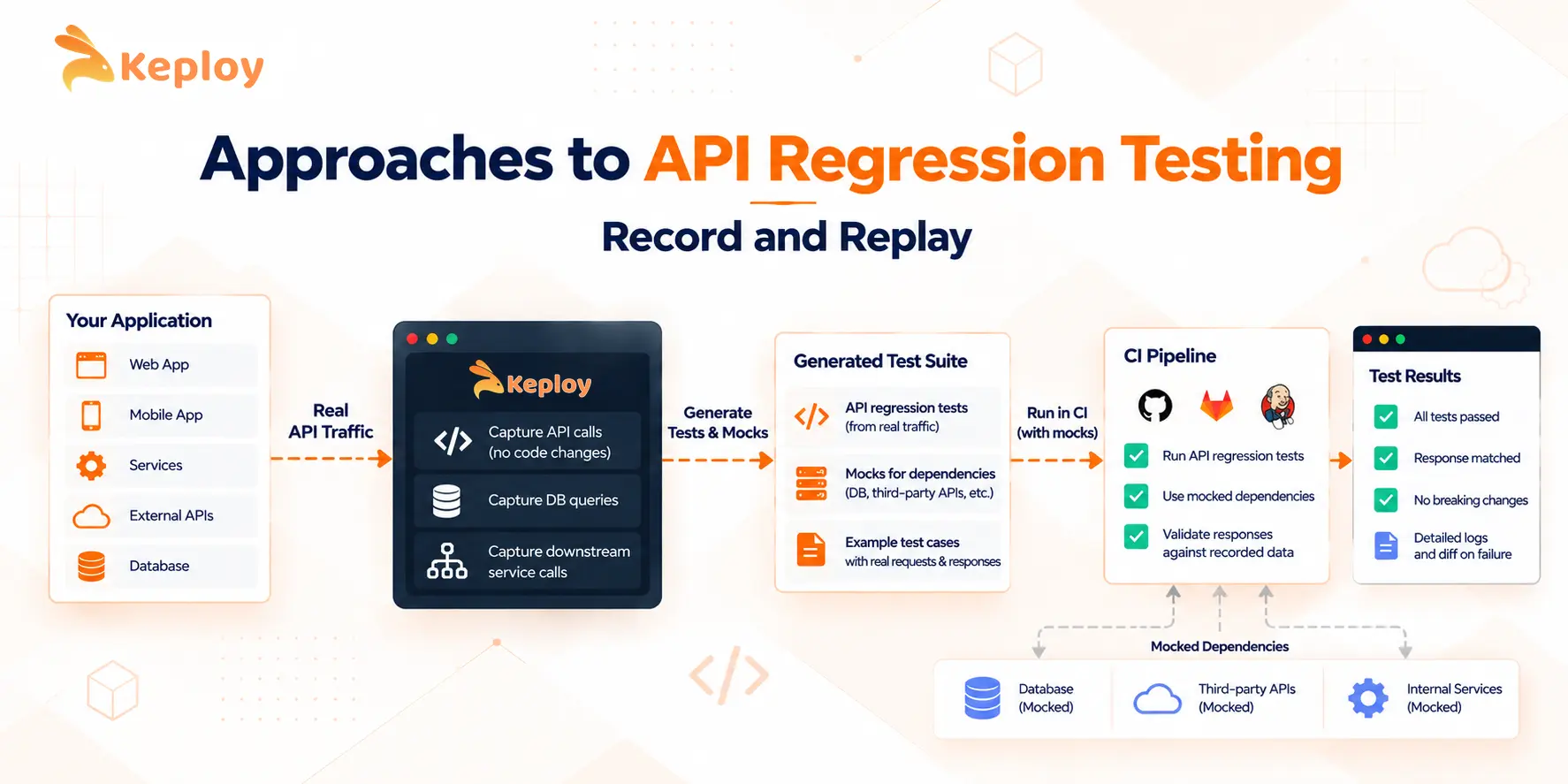
Keploy records API calls together with the database queries and downstream calls behind them, then replays them in CI with those dependencies mocked. Tests come from real usage, so nobody writes or maintains scripts.
- Catches: changed fields, values, and status codes on any exercised endpoint, with timestamps and IDs filtered out as noise
- Trade-off: coverage grows with usage, so a brand-new endpoint is covered once it’s been exercised in record mode
Spec-Based Testing
Schemathesis reads an OpenAPI or GraphQL schema and generates requests automatically, edge cases included.
- Catches: crashes, 500s, and responses that violate the schema
- Trade-off: it doesn’t know your business rules
Breaking-Change Diffs
oasdiff compares two versions of an OpenAPI spec on each pull request and lists what breaks.
- Catches: removed endpoints, renamed fields, and type changes before any test runs
- Trade-off: it’s only as accurate as the spec
Contract Testing
With Pact, consumers write down what they expect, and the provider verifies those expectations in its own pipeline.
- Catches: changes that break a specific consumer between services
- Trade-off: every consuming team has to maintain its contracts
Live Traffic Replay
GoReplay mirrors production traffic against a new build for shadow testing at volume.
- Catches: errors and behavior changes under real request patterns
- Trade-off: dependencies have to be running, since nothing is mocked
Downstream Mocking
WireMock serves hand-written HTTP stubs for the services your API calls.
- Catches: regressions in your own code without flakiness from external sandboxes
- Trade-off: stubs drift unless someone keeps them current
Collections in CI
Teams with existing Postman collections can run them through Newman or the Postman CLI.
- Catches: failed assertions written into each request
- Trade-off: per-request scripts get harder to maintain as collections grow
Performance Gates
k6 runs load scripts with thresholds and fails the CI job when one is missed.
- Catches: latency and throughput regressions on search, checkout, and login
- Trade-off: it checks speed, not correctness
Test Business Workflows, Not Just Endpoints
Endpoint tests check one request at a time. Real clients don’t work that way.
A checkout depends on sign up, create cart, create order, and pay, with each step reading an ID or token from the one before. Every endpoint can pass in isolation while the flow fails, because step three now returns the order ID under a different key.
Treat these as black-box tests. Send requests the way a client would, carry values between steps, and assert on the final state as well as each response.
Which flows deserve this? Start with the ones that cost money or lock users out when they break:
- Sign up and login
- Checkout and payment
- Password reset
A handful of those on every pull request says more about release safety than a long tail of endpoint checks run once a night.
Snapshot and Schema Comparison
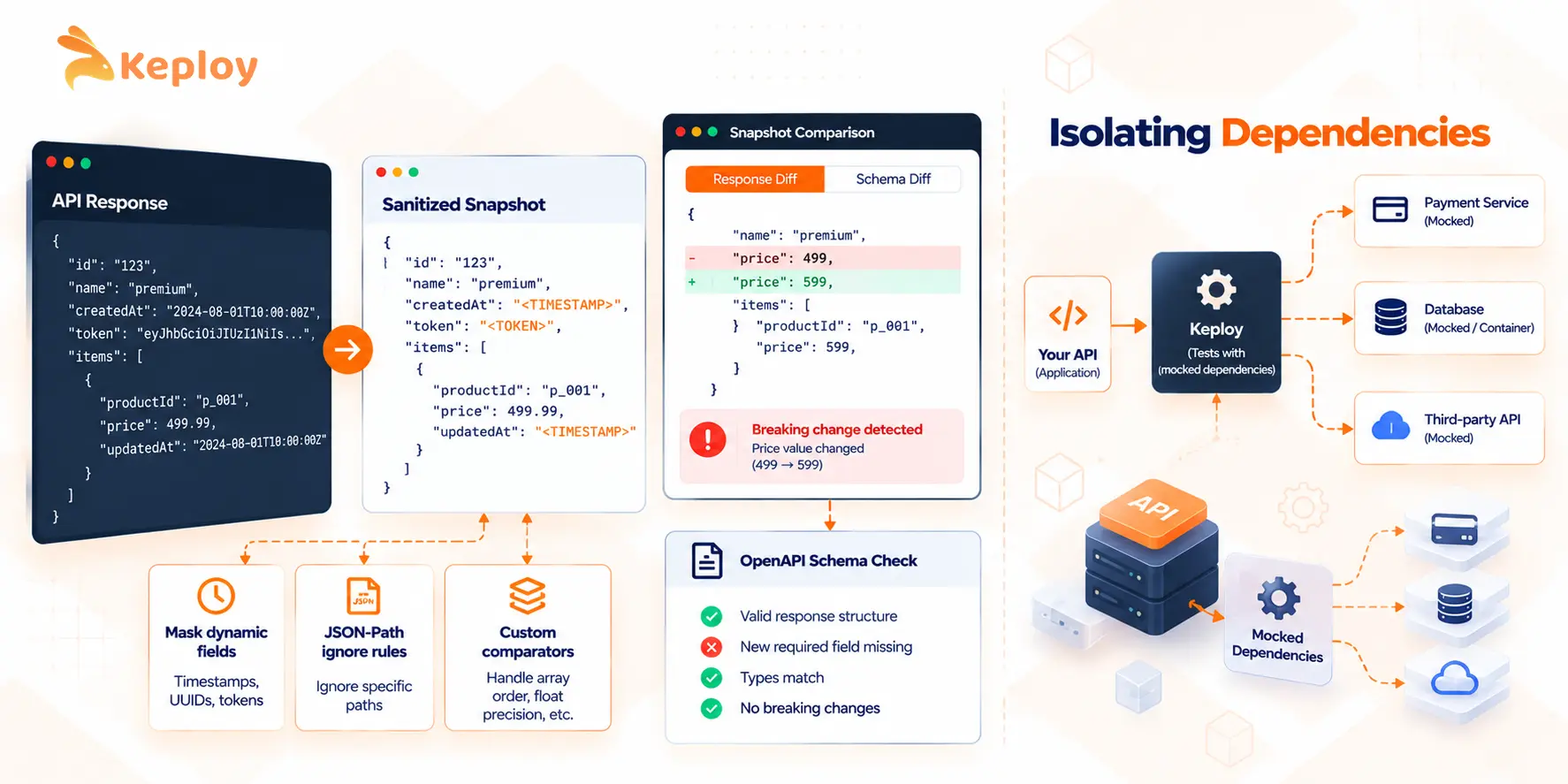
Snapshot testing saves a known-good response and compares every future response against it. It’s quick to set up, and it catches changes nobody thought to assert on. The catch is noise.
Masking Timestamps, UUIDs, and Tokens
Timestamps, UUIDs, session tokens, and request IDs are dynamic fields that change on every call, so a raw comparison fails every run. Masking noisy fields before the diff fixes most of it. For some fields, checking the format instead of the value is enough.
JSON-Path Ignore Rules
Ignore rules exclude specific paths from the comparison, such as a generatedAt field under meta or an updatedAt field inside every item of a list. Keep the list short and reviewed.
Every ignored path is a place where a real regression can hide.
Custom Comparators for Nested Payloads
Some differences matter and some don’t. Array order often doesn’t. Float precision past a couple of decimals often doesn’t either.
Write comparators for those cases instead of ignoring the whole field. That way, the rest of the object still gets checked.
Schema Diffs on Pull Requests
Snapshots catch value changes. Schema diffs catch structural ones, and they’re cheaper to run. Diff the spec on every pull request and post any breaking changes as a review comment.
Tracking schema coverage shows which parts of the spec your tests actually exercise. And schema drift between the spec and the running code is a failure mode of its own, worth checking separately.
Isolating Dependencies
A regression test that calls a real payment sandbox will fail the day that sandbox goes down. That failure has nothing to do with your change, and it trains people to ignore red builds.
|
Approach |
How it works |
Strengths |
Trade-offs |
|
Lightweight HTTP stubs |
Hand-written fixed responses for downstream calls |
Fast, simple, no infrastructure |
Drift from the real service over time |
|
Record and replay |
Real dependency responses captured once and replayed in tests |
Realistic data with little authoring |
Recordings need refreshing when dependencies change |
|
Service virtualization |
Virtual services with rules, state, and behavior |
Fault injection, response templating, request verification |
More setup, and someone has to own the virtual services |
|
Disposable containers |
Real databases and queues started for each test run |
Real engine behavior, no mocking |
Slower startup, and CI needs Docker |
Service virtualization earns its setup cost when you need to test failure modes on purpose:
- A downstream timeout
- A 503 from a dependency
- A slow response that should trigger a retry
Hand-written stubs rarely get maintained well enough to cover those.
For databases and message queues, Testcontainers is a common pick when you want real engines instead of mocks.
Most teams end up mixing these. Does the test need the dependency’s real behavior, or just a believable response? That question sits at the center of dependency mocking, and the answer often changes from one dependency to the next.
API Regression Testing in CI/CD
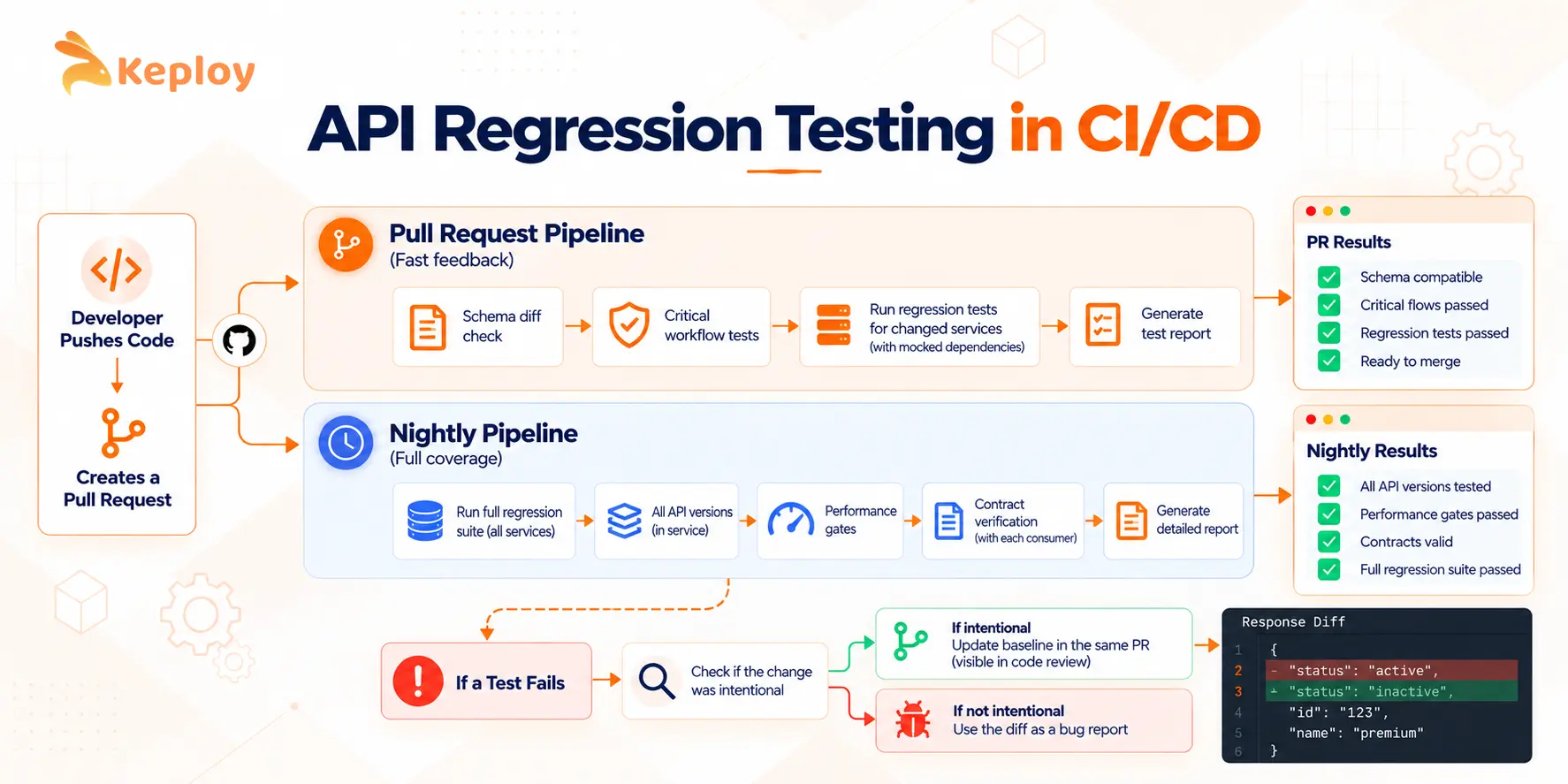
Two tiers cover most pipelines.
- On every pull request: the schema diff, the critical workflow tests, and regression tests for the services that changed. This run has to finish fast enough that developers wait for it instead of merging around it.
- Nightly: the full suite, every API version still in service, performance gates, and contract verification against each consumer.
When a run fails, ask first whether the change was intentional. If it was, update the baseline in the same pull request, so the reviewer sees the code change and the expected response change side by side. If it wasn’t, the diff is your bug report.
Flaky API tests mostly trace back to shared test data or a live dependency that sometimes answers slowly. Quarantine a flaky test the day someone spots it. Rerunning until green teaches the team to ignore failures, and that habit outlives the one bad test.
Example: Record, Replay, and Review the Flagged Diff
Here’s how the record-and-replay workflow handles a real breaking change.
- Record. A developer starts the service in record mode and uses it the normal way, through the frontend, a few curl calls, or an existing collection. Each request and response becomes a test case, and each database query or downstream call becomes a mock.
- Change. A pull request renames total_amount to totalAmount in the order response, to match the rest of the API.
- Replay. In CI, the recorded tests run against the new build with the same mocked dependencies. The order test fails.
- Review the diff. The report shows the expected field, the actual one, and the endpoint that returned it. Timestamps and IDs stay out of the diff, because they’re configured as noise.
Now there’s a decision. If the rename was a mistake, revert it. If it was intentional, it still breaks every client reading total_amount, so the safer path is returning both fields for a deprecation window and updating the baseline once clients have moved.
Choosing an API Regression Testing Tool
Pick by the problem in front of you, not by feature count. The table below groups common regression testing tools for APIs by approach.
|
Tool |
Best for |
Approach |
Mocks |
CI |
|
Keploy |
Regression tests for existing APIs without writing scripts |
Record and replay of API and dependency calls |
Yes, generated from recorded calls |
Yes |
|
Schemathesis |
Finding crashes and schema violations from a spec |
Property-based, spec-driven |
No |
Yes |
|
oasdiff |
Blocking breaking spec changes on pull requests |
OpenAPI spec diff |
No |
Yes |
|
Pact |
Contracts between services owned by different teams |
Consumer-driven contracts |
Yes, consumer-side mock provider |
Yes |
|
GoReplay |
Replaying production traffic at volume against a new build |
Live traffic capture and replay |
No |
Yes |
|
WireMock |
Controlling downstream HTTP dependencies |
Hand-written stubs |
Yes |
Yes |
|
Postman with Newman |
Teams with existing request collections |
Scripted collections |
Yes, mock servers |
Yes |
|
k6 |
Latency and throughput regressions |
Scripted load tests with thresholds |
No |
Yes |
|
Testcontainers |
Real databases and queues inside tests |
Disposable containers |
No, uses real engines |
Yes |
A spec diff plus one functional approach is a sensible minimum. Add contract testing once several teams consume the same API, and a performance gate for the endpoints users notice when they slow down.
Conclusion
API surfaces are growing faster than the teams that test them. AI coding assistants push more endpoint changes through review each week, and AI agents are turning into API consumers themselves, calling endpoints with none of the patience a human developer brings to a changed field.
Suites that grow from real usage will keep pace with that. Suites that depend on someone finding a free afternoon to write tests won’t.
FAQs
What is API regression testing and why is it important?
API regression testing re-runs API tests after code changes to confirm that existing endpoints still behave the way clients expect. It matters because APIs are consumed by frontends, mobile apps, and other services that break silently when a field, type, or status code changes.
How do I do regression testing for REST APIs?
Capture a baseline of known-good responses, then re-run the same requests after every change and compare status codes, schemas, and bodies. Mask dynamic values like timestamps, mock external dependencies, and run a fast subset on each pull request with the full suite nightly.
What’s the difference between API regression testing and contract testing?
Contract testing checks that a provider still meets the expectations its consumers have written down. API regression testing is broader: it checks behavior, error handling, workflows, and performance against a baseline. Many teams run both.
How do I handle timestamps and IDs in API regression tests?
Mask or ignore fields that change on every call, such as timestamps, UUIDs, and tokens, before comparing responses. For fields where the format matters, check the format instead of the exact value.
How do I mock databases and third-party APIs in API regression tests?
Use HTTP stubs or service virtualization for third-party APIs, and either recorded mocks or disposable containers for databases and queues. Record-and-replay tools can capture both kinds of dependency automatically while you use the API.
Can API regression tests be generated automatically?
Yes. Spec-based tools generate requests from an OpenAPI schema, and traffic-based tools turn real API calls into test cases and mocks. Generated tests still need noise rules for dynamic fields before they run reliably in CI.
How often should API regression tests run?
Run a fast suite on every pull request and the full suite at least nightly. Also run the full suite before each release and after any dependency upgrade.