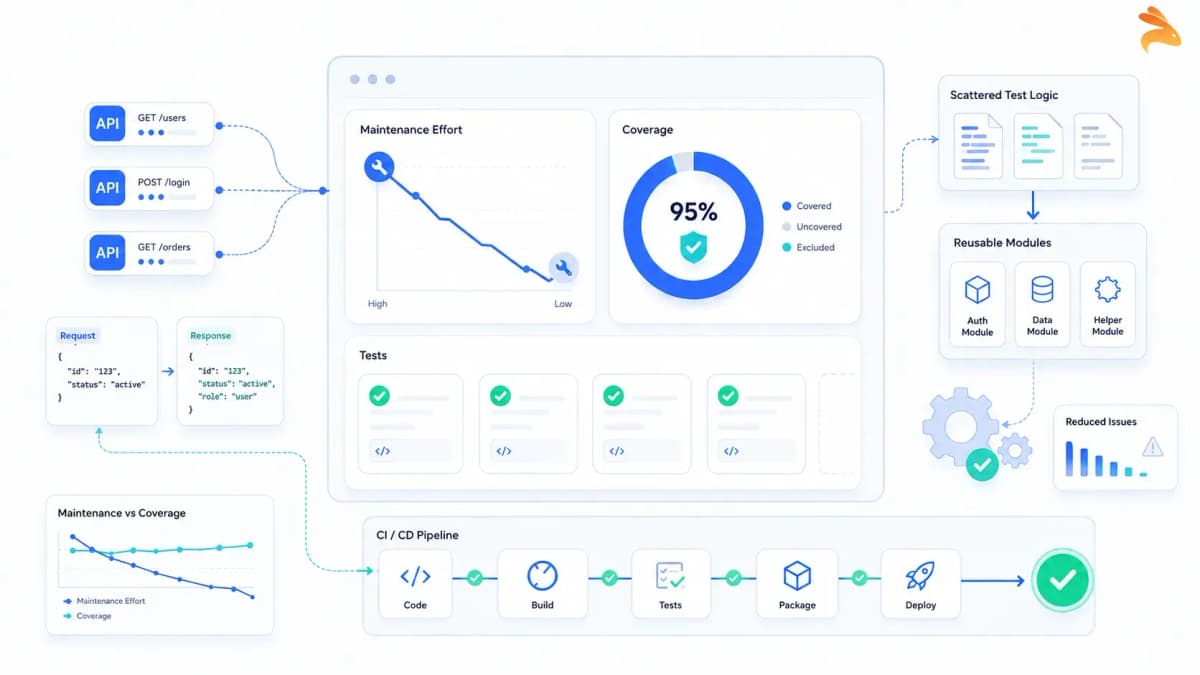






If your team spends more hours fixing tests than writing features, you already know the problem. You don’t need another lecture on "why testing matters." You need to reduce test maintenance without gutting your coverage, and you need it to actually stick past next sprint.
Industry estimates put the scale of the problem in perspective: QA teams often spend 30-50% of their automation time on maintenance rather than writing new tests, and that ratio climbs fast once a suite crosses a few hundred cases. Teams that fix root causes before adding more tooling commonly report cutting that overhead by 60-70%.
This isn’t a UI-locator problem alone. A huge chunk of maintenance pain lives at the API layer, where a single schema change can quietly break dozens of tests overnight. We’ll walk through why maintenance piles up, what actually fixes it, and where API-first testing changes the math entirely.
Why Does Test Maintenance Keep Piling Up?
Most teams don’t have a testing problem. They have a test design problem. Maintenance overhead almost always traces back to a handful of repeat offenders, and they compound over time.
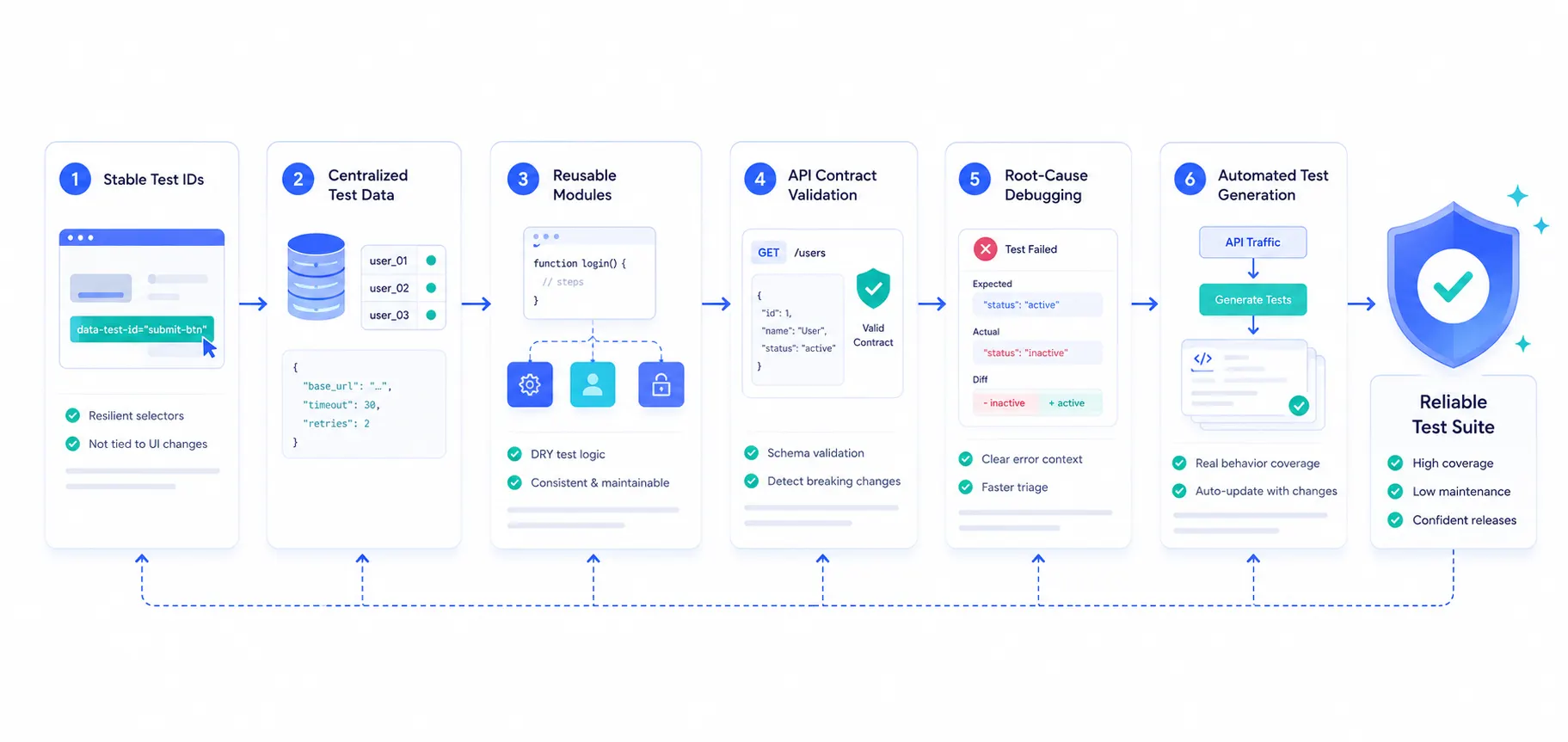
Brittle locators and hard-coded selectors
UI tests built on fragile XPath or dynamic CSS selectors break the moment a developer moves a button. A field shifting from a sidebar to a modal shouldn’t force a rewrite of five test files, but that’s exactly what happens when tests are wired to implementation details instead of intent.
Hard-coded and stale test data
Static usernames, passwords, and IDs baked directly into test scripts age fast. Once multiple teams reuse the same data, one team’s test run starts corrupting another’s, and nobody notices until CI turns red for the wrong reason.
Duplicated test logic
As suites grow, the same login flow or setup steps get copy-pasted across dozens of files. Change one business rule, and now you’re hunting through the whole repo to update every duplicate.
API contract drift
This is the one most testing blogs skip. Backend teams change a response field, rename an endpoint, or tweak a status code, and every test hard-coded against the old contract fails, even though nothing is actually broken. Multiply that across microservices and the noise becomes unmanageable.
Flaky tests
Tests that pass sometimes and fail other times, usually from timing issues or environment inconsistencies, quietly destroy trust in your suite. Once a team stops believing red means "broken," they start ignoring failures altogether, which defeats the entire point of automation.
What Does High Test Maintenance Actually Cost You?
It’s tempting to treat maintenance as a background tax. It isn’t. Teams stuck in this loop see:
-
Release cycles stretching out because QA is triaging false failures instead of shipping
-
Engineers quietly losing confidence in the test suite, which leads to skipped tests and unreviewed merges
-
A regression suite that keeps growing in size but not in real coverage
More test cases don’t equal better coverage. Past a certain point, they just mean more things to fix every time the app changes. Teams often respond by writing even more tests, which is survival mode, not progress.
How Do You Actually Reduce Test Maintenance?
Here’s where most guides stay generic. The fixes below work, but they only compound if you attack the root cause, not just the symptom.
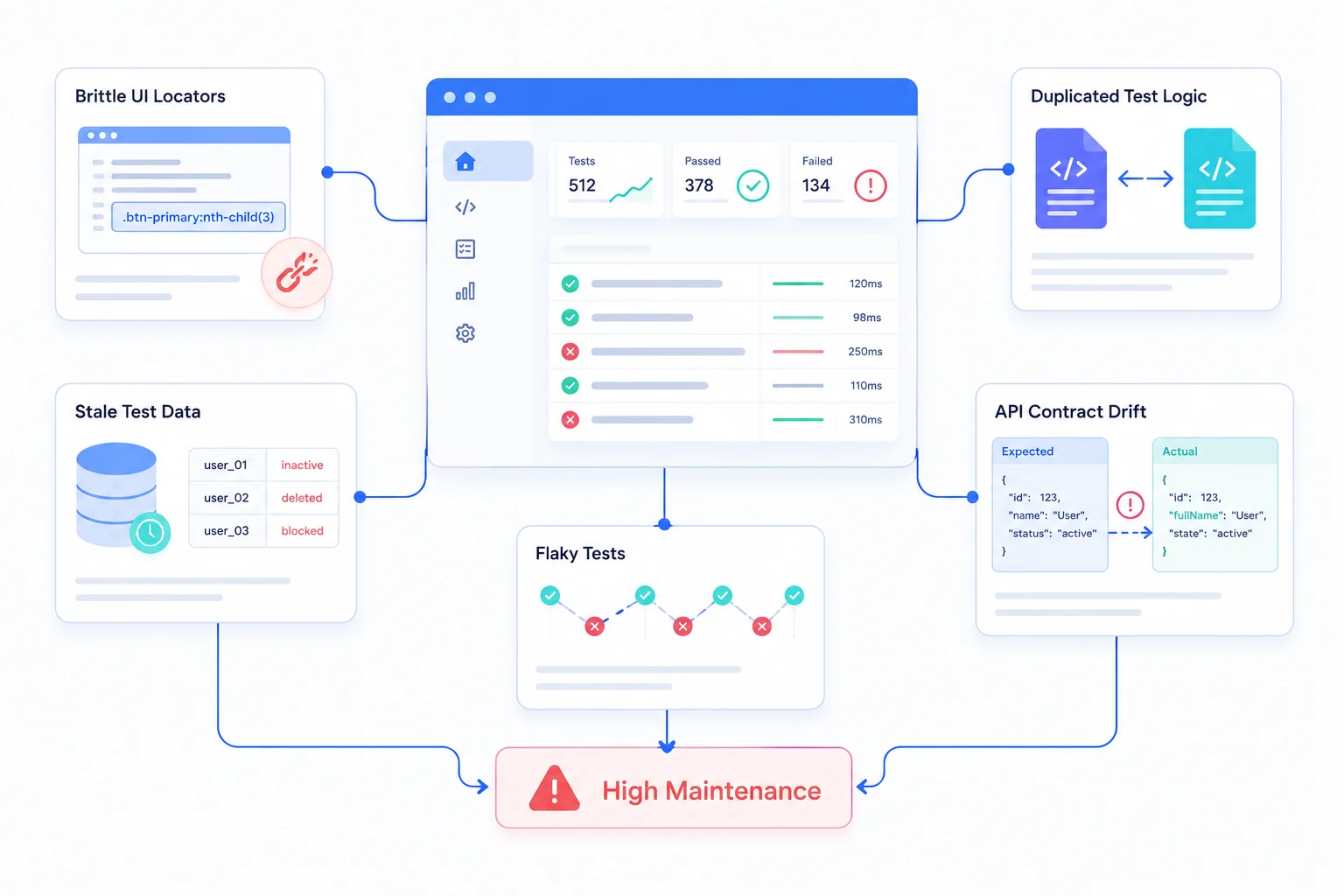
1. Design tests around intent, not implementation
Tie UI tests to purpose-built attributes like data-test-id instead of DOM structure. These survive refactors because they exist specifically for testing, unlike a CSS class that was never meant to be a test hook.
2. Modularize and centralize test data
Move away from hard-coded credentials scattered across files. Centralize test data behind reusable rules or fixtures, so a single update propagates everywhere instead of requiring a find-and-replace across your repo.
3. Cut duplicated logic into shared building blocks
If five tests repeat the same login sequence, that sequence belongs in one reusable function, not five copies waiting to drift out of sync.
4. Catch API contract changes before they break tests
Schema-driven contract testing flags breaking changes at the API boundary, before they cascade into failing end-to-end tests further downstream. This is the difference between finding out an API broke from a Slack alert versus finding out from twenty failed regression tests three hours later.
Here’s what that looks like in practice. A hand-written test asserting on a specific response field looks like this:
The moment a backend team renames user_status to account_status, this test fails, even though the API itself works fine. Multiply that across 40 tests hitting the same endpoint, and one rename turns into 40 "broken" tests and an afternoon of manual fixes.
A schema-driven or traffic-based approach instead validates against the current contract automatically, so the test adapts when the field is renamed instead of hard-failing on an assumption written months earlier.
5. Separate real bugs from maintenance noise
Not every red test means the app is broken. Teams that add root-cause context, like the request payload, response diff, or the exact assertion that failed, cut triage time dramatically because engineers stop guessing.
6. Generate tests from real behavior instead of hand-writing every case
This is where most manual test suites lose the fight. Hand-written tests encode assumptions about how the API should behave. Real traffic shows how it actually behaves, including edge cases nobody thought to write a test for.
Comparison: Manual Test Maintenance vs. Traffic-Based Test Generation
| Factor | Hand-Written Tests | Traffic-Based (Record-Replay) |
|---|---|---|
| Updates after API changes | Manual rewrite required | Regenerated from live traffic |
| Mocks and stubs | Written and maintained by hand | Auto-captured during recording |
| Edge case coverage | Limited to what engineers anticipate | Reflects real production requests |
| Time to onboard new service | Days to weeks | Hours |
| Failure noise from schema drift | High | Low, since tests reflect current behavior |
Where API-First Testing Changes the Equation
Most of the content ranking for this topic, including guides from Applitools and AccelQ, focuses almost entirely on UI test maintenance: locators, visual regression, DOM structure. That’s a real problem, but it’s only half the picture. API test suites carry their own maintenance debt, and it’s often worse because it’s invisible until a release breaks in production.
This is the layer where Keploy operates differently. Instead of hand-writing API tests and mocks, Keploy uses eBPF-based traffic capture to record real API calls and generate tests and mocks directly from that traffic. A few practical effects of that:
-
Tests update as the API evolves, since they’re generated from current traffic instead of a spec someone wrote six months ago
-
Mocks and stubs are captured automatically, removing one of the most common sources of hand-maintained test debt
-
Duplicate and noisy test cases get filtered out, so your regression suite grows in relevance, not just in size
-
CI/CD stays fast, because tests reflect what your API is actually doing right now, not what it was doing at some earlier snapshot
Teams running Keploy in CI typically spend less time asking "why did this test fail" and more time actually shipping, because the tests are a mirror of production behavior instead of a static guess at it.
For a service with a few hundred endpoints, that difference compounds quickly. A hand-maintained suite might need a few hours of manual updates every time an API changes shape. A traffic-based suite regenerates those same tests in minutes, since the source of truth is live behavior rather than a script someone has to remember to update.
A Quick Checklist to Audit Your Own Test Suite
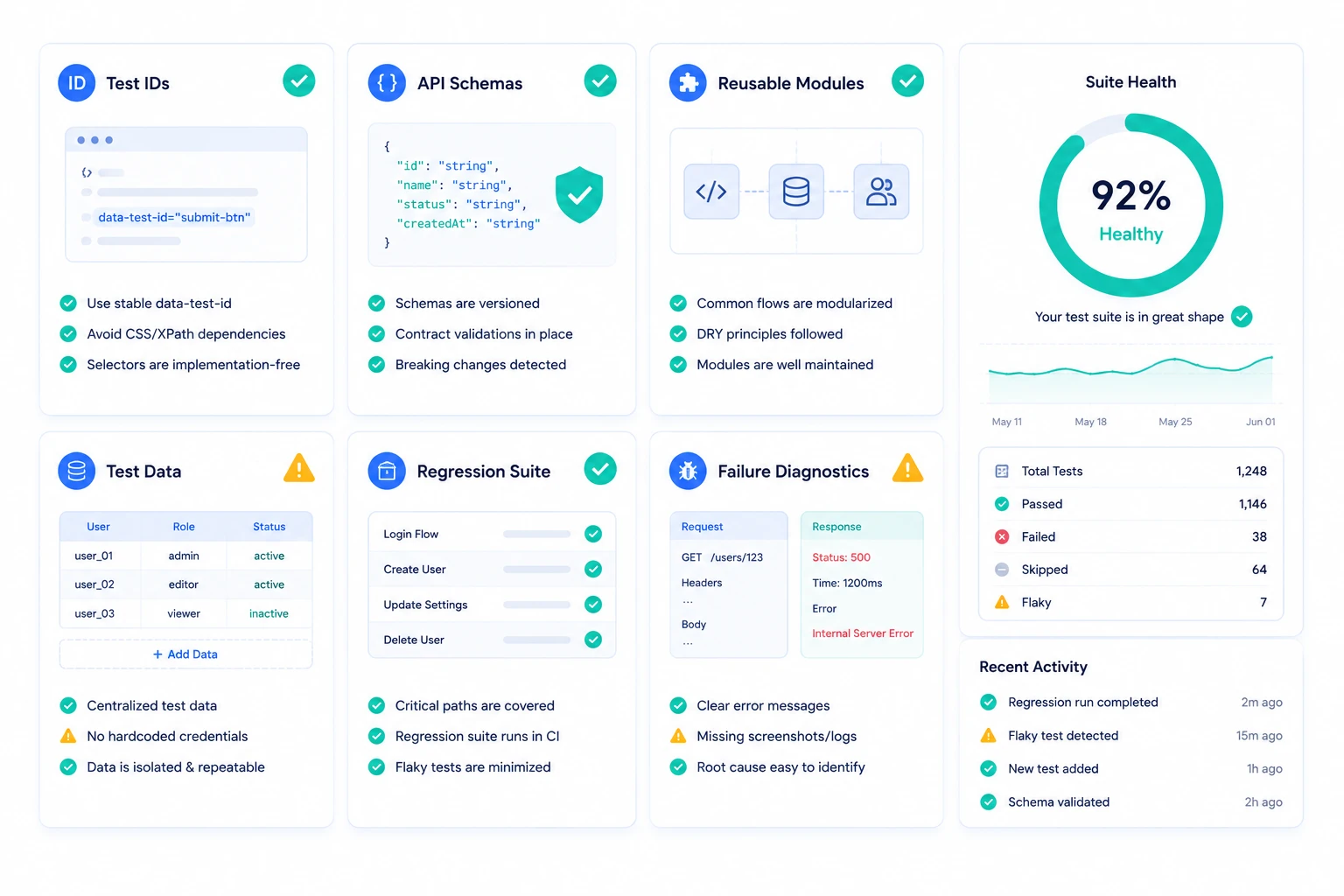
Before your next sprint, run your suite through this:
-
Are any tests tied to CSS classes or XPath instead of stable test IDs?
-
Is test data hard-coded anywhere it’s used in more than one file?
-
Do more than two tests repeat the same setup or login logic?
-
Would an API schema change break tests without anyone touching the UI?
-
Do failing tests tell you why they failed, or just that they failed?
-
Is your regression suite growing faster than your actual feature set?
If you nodded at three or more of these, maintenance debt is already compounding, not staying flat.
Frequently Asked Questions
What is the main cause of high test maintenance?
Tests tied too tightly to implementation details, whether that’s a UI locator, a hard-coded data value, or an assumed API response, break every time that implementation changes, even when the actual behavior is fine.
Does more test coverage mean more maintenance?
Not necessarily. Coverage that’s built on modular, intent-based tests scales without a proportional rise in maintenance. Coverage built from duplicated, brittle scripts scales maintenance faster than it scales confidence.
Can API testing reduce overall test maintenance?
Yes, and it’s often the highest-leverage place to start. API contracts change more predictably than UI layouts, and catching a broken contract at the API layer prevents it from cascading into dozens of failing UI and E2E tests downstream.
How does traffic-based test generation reduce maintenance compared to hand-written tests?
Hand-written tests reflect what an engineer assumed the API would do at the time of writing. Traffic-based generation, like Keploy’s record-replay approach, reflects what the API is actually doing right now, so tests stay current without manual rewrites every time the service changes.
Final Thoughts
Reducing test maintenance isn’t about writing fewer tests or caring less about coverage. It’s about building tests that reflect real behavior instead of frozen assumptions, so they don’t shatter every time something upstream shifts. Start with the root cause, whether that’s brittle locators, duplicated logic, or untracked API drift, and the maintenance tax drops on its own.
If API contract drift is your biggest source of broken tests, see how Keploy generates tests directly from real traffic instead of hand-written scripts.