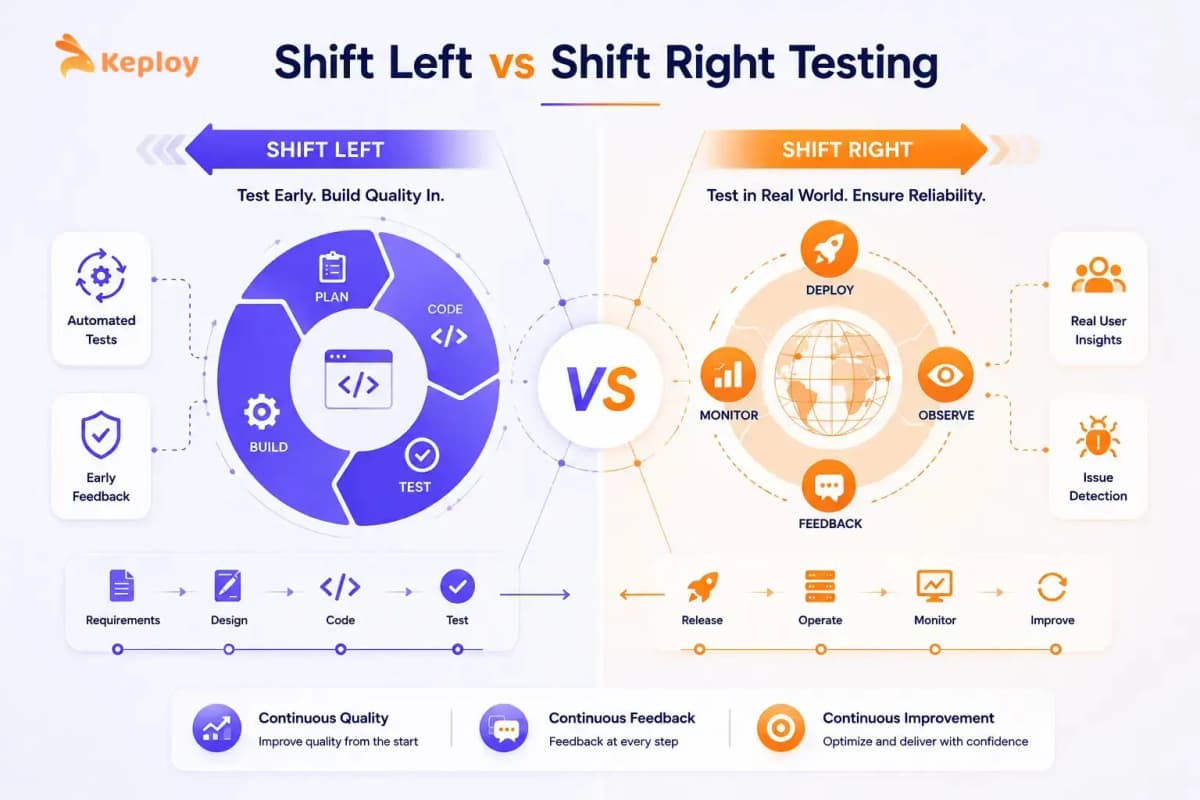






Shift left vs shift right testing isn’t really a debate. Teams that treat it as one end up with gaps that neither approach covers alone. Shift left catches defects before they reach production. Shift right learns from what happens after they do.
The teams shipping most reliably in 2026 don’t choose between them. They run both and build a feedback loop where each approach makes the other more effective.
What is Shift Left vs Shift Right Testing?
Shift left testing moves quality activities earlier in the software development lifecycle, catching defects during development before they reach production. Shift right testing extends quality activities into the production environment, validating real user behavior and system reliability after deployment. Used together, they form a continuous quality loop that covers the full software delivery lifecycle.
Shift Left vs Shift Right: Key Differences at a Glance
| Criteria | Shift Left | Shift Right |
|---|---|---|
| When it runs | Before deployment, during development and CI | After deployment, in staging or production |
| Primary goal | Prevent defects early, reduce cost of fixing | Validate real user behavior, catch what pre-production misses |
| Testing types | Unit tests, integration tests, TDD, SAST, contract testing | Canary releases, A/B testing, chaos engineering, observability, shadow traffic |
| Who runs it | Developers and QA engineers | DevOps engineers, SREs, QA engineers |
| DORA metric impacted | Change Failure Rate | Mean Time to Recovery |
| Limitation | Can’t replicate real user behaviour or production load | Risks exposing users to failures if guardrails aren’t in place |
The comparison table covers the mechanics. Now let’s understand the decisions behind them: when each approach applies, where each falls short, and what a mature team does when it runs both.
What Is the Shift Left Approach?
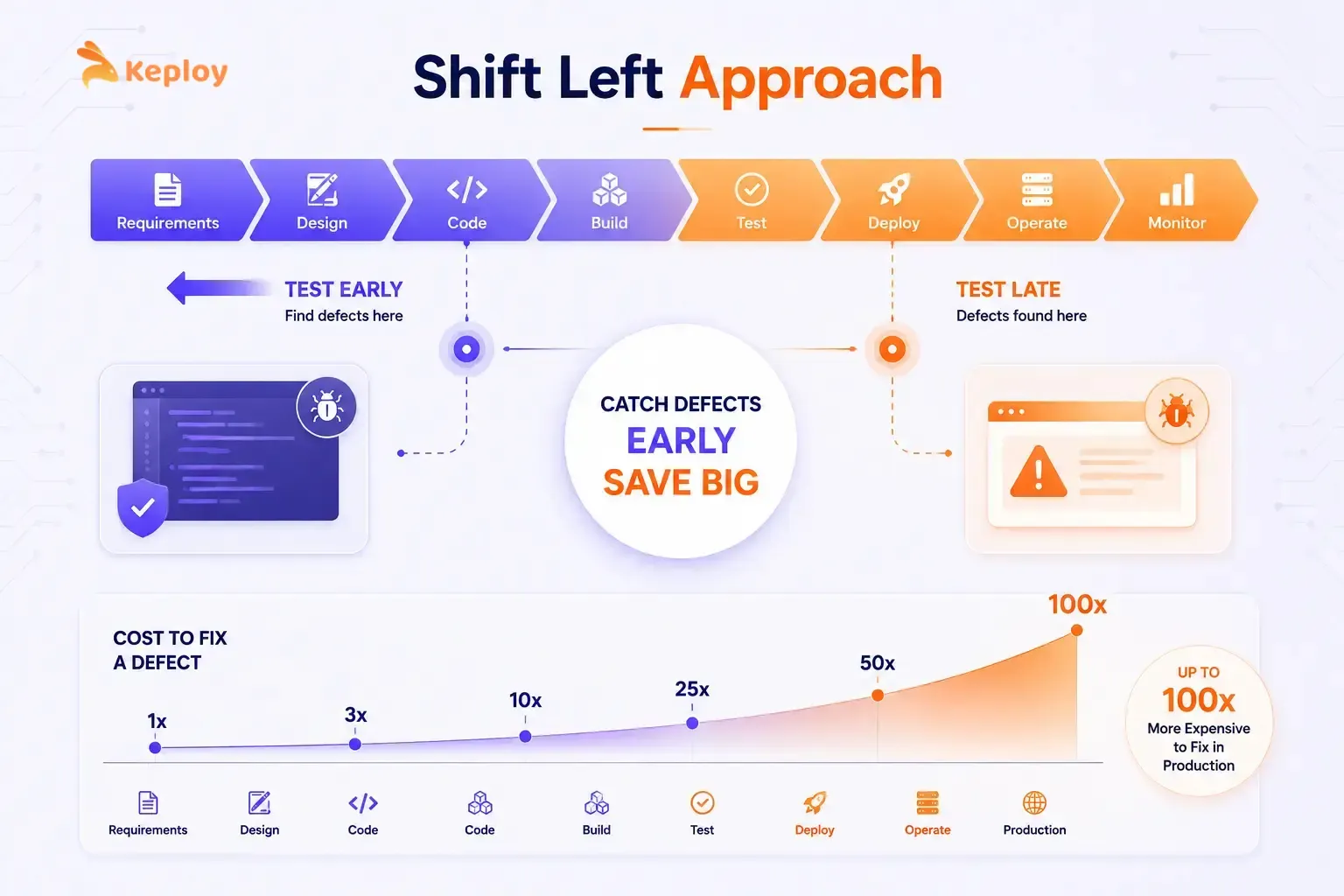
Shift left means moving testing to the earliest possible point in the development cycle. Traditionally, testing happened at the end: after code was written, after features were built, right before release. The shift left approach flips that model.
Instead of discovering defects at the gate, teams find them when the code is being written. A bug caught in development costs a fraction of what it costs to fix in production. IBM’s Systems Sciences Institute research found the cost multiplier between the design phase and the production phase can be as high as 100x. That number alone explains why shift left has become the default in serious engineering organisations.
Types of Shift Left Testing
1. Unit testing
Unit testing is the most fundamental shift left activity. Developers write tests for individual functions and methods as they write the code itself, not after. The feedback loop is immediate. Seconds, not hours.
What it catches: Logic errors, off-by-one mistakes, and missing condition handling at the function level.
2. Integration testing
Integration testing validates that components work together correctly. It sits one level above unit testing in the testing pyramid and catches contract mismatches that unit tests miss because they test components in isolation.
What it catches: Data flow errors between components, API contract violations, and integration failures that unit tests can’t surface.
3. Test-driven development (TDD)
Test-driven development (TDD) takes shift left further. Tests are written before the code that makes them pass. The test defines the expected behaviour; the implementation follows.
What it catches: Missing requirements, ambiguous specifications, and implementation drift from the intended design.
4. Static analysis (SAST)
Static analysis (SAST) scans code for vulnerabilities, bugs, and quality issues without executing it. Tools like SonarQube and Semgrep flag problems at commit time, often before a pull request is even opened. Microsoft runs static analysis as a blocking gate in their CI pipelines.
What it catches: Security vulnerabilities, code smells, dead code, and dependency issues before a single line runs.
5. Contract testing
Contract testing matters most in microservices architectures. It verifies that services communicate with each other according to agreed interfaces, catching breaking changes before they propagate downstream.
What it catches: Breaking API changes between services before they cause downstream failures in production.
Benefits and Limitations of Shift Left
Shift left reduces Change Failure Rate (the DORA metric measuring how often deployments cause production problems). Teams with strong shift left practices catch logic errors, security gaps, and integration issues before users see them. Feedback is fast. Fixes are cheap.
But shift left has a real ceiling. No pre-production environment fully replicates real user behaviour, production load, or the combinations of conditions that only emerge at scale. A test suite that covers 90% of anticipated scenarios still leaves the other 10% for users to discover. That’s where shift right comes in.
What Is the Shift Right Approach?
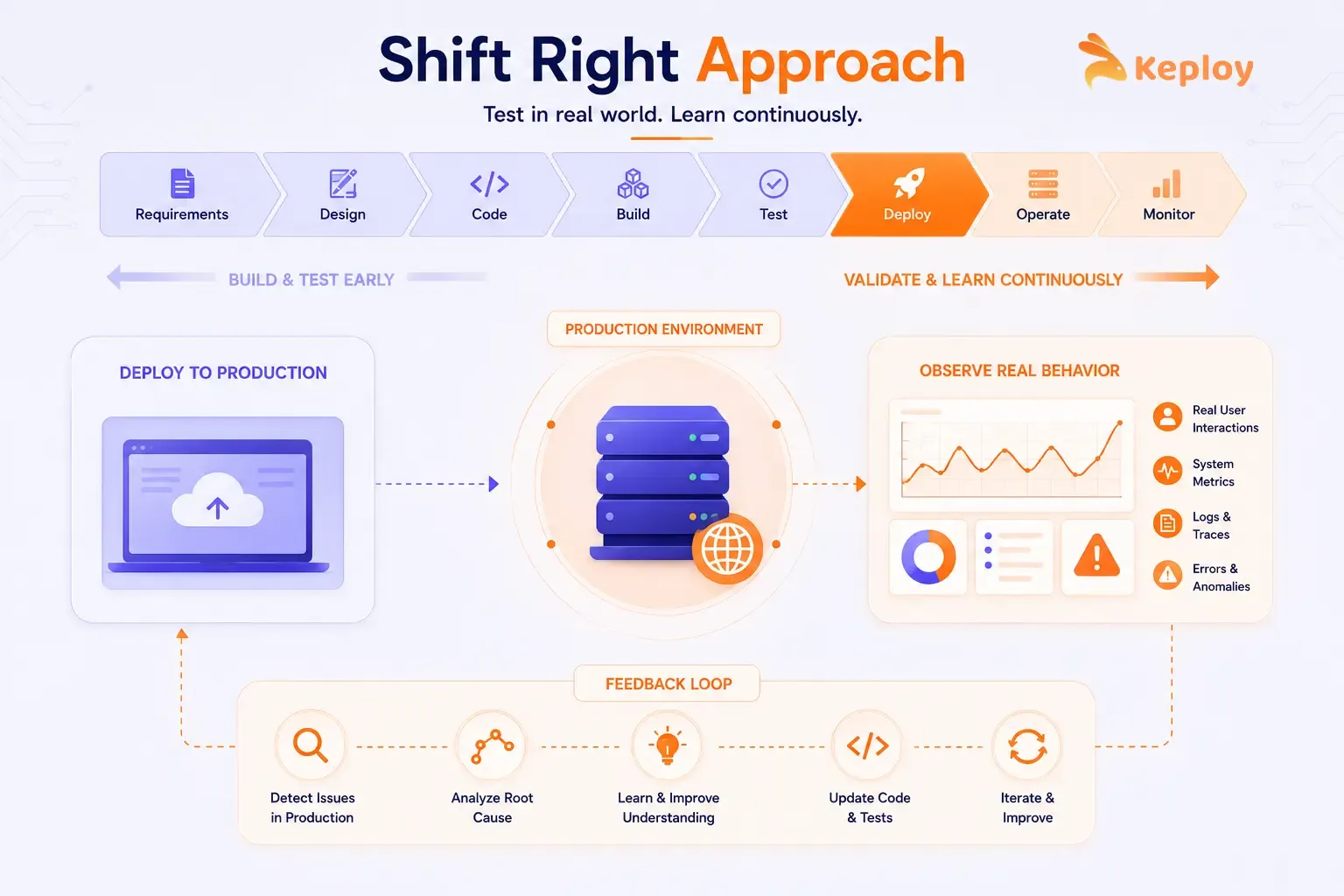
Shift right means testing doesn’t stop at deployment. The production environment becomes a quality signal: information about how the system actually behaves under real conditions.
The shift right approach recognises something shift left can’t solve: staging environments lie. They use different traffic patterns, different data volumes, and different user behaviour than production. The bugs that only appear at 3 pm on a Tuesday with a specific combination of user actions can’t be predicted in a CI pipeline. They have to be observed.
Types of Shift Right Testing
Canary releases
Canary releases deploy new code to a small percentage of users first. Typically 1-5%. Engineers watch error rates, latency, and user behaviour before expanding to full rollout. Google uses canary releases for virtually every significant change to their services.
What it catches: Deployment-specific bugs, configuration errors, and performance regressions that only surface under real production conditions.
A/B testing
A/B testing runs two versions of a feature simultaneously against different user segments. It validates not just whether the code works, but whether it produces the intended business outcome. Meta has been running A/B tests in production for over a decade.
What it catches: Feature effectiveness gaps where the code works correctly but the feature doesn’t deliver the expected user outcome.
Chaos engineering
Chaos engineering deliberately introduces failures in production (or production-like environments) to validate that recovery mechanisms actually work. Netflix built Chaos Monkey specifically for this. Randomly terminating services to ensure the system stays available even when components fail.
What it catches: Weaknesses in fault tolerance, missing retry logic, and recovery mechanisms that look good in theory but fail under real failure conditions.
Shadow traffic
Shadow traffic mirrors a copy of real production traffic to a new service version without affecting live users. The responses are compared but not returned to users. It’s one of the safest ways to validate a new version against real request patterns.
What it catches: Behavioural differences between old and new service versions when exposed to real request patterns, without any user impact.
Observability
Observability (logs, metrics, and distributed traces) is the foundation everything else sits on. Without visibility into what’s happening in production, shift right is blind. OpenTelemetry has become the standard instrumentation layer for teams serious about this.
What it catches: Performance anomalies, error rate spikes, and latency degradation that only become visible under real production load.
Guardrails That Make Shift Right Safe
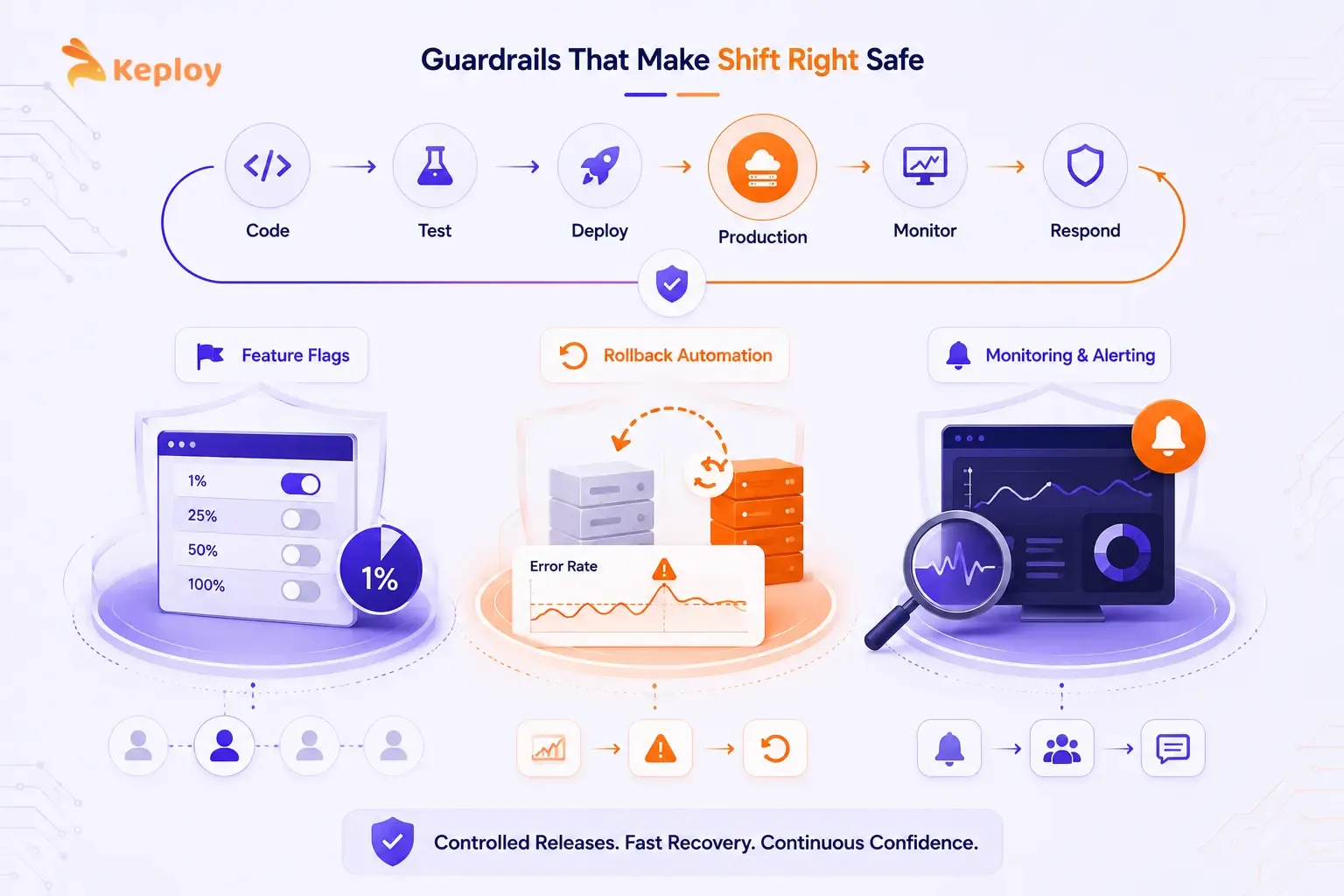
Shift right doesn’t mean deploying carelessly. The practices that make it work are:
-
Feature flags let you expose new functionality to specific users or traffic percentages without a separate deployment. LaunchDarkly and Unleash are the two most common tools. You can turn a feature on for 1% of users and off again in 30 seconds if something goes wrong.
-
Rollback automation ensures that if error rates spike after a deployment, the previous version can be restored without a manual process. Teams at Amazon have automated rollback pipelines that trigger on error rate thresholds, not on human observation.
-
Clear monitoring and alerting tells you something has gone wrong before users report it. Alerting on symptoms ("error rate on the checkout endpoint is above 1%") beats alerting on causes ("CPU is at 80%").
Benefits and Limitations of Shift Right
Shift right improves MTTR (Mean Time to Recovery) by giving engineering teams visibility into production systems and the tools to respond quickly when problems surface. It catches the class of bugs that pre-production environments systematically miss: performance issues under real load, user behaviour edge cases, and failures that only appear at scale.
The limitation is risk. Testing in production means real users are potentially exposed to failures. That’s why the guardrails above aren’t optional. Without feature flags, canary traffic, and rollback automation, shift right is just hoping production works rather than validating it.
For the full picture on production testing practices, read our guide on production testing, which covers methods, tools, and safety patterns in depth.
Shift Left vs Shift Right: Detailed Comparison
Common Misconceptions
The most common one is that shift left and shift right are competing strategies. They’re not. They target different failure modes and run at different points in the delivery cycle. Choosing one doesn’t mean abandoning the other.
The second misconception: shift right is only for large teams with SRE functions. That’s not accurate. Feature flags and canary releases are accessible to teams of any size, and the observability tooling has become significantly cheaper and easier to set up in the last few years.
The third: more shift left means less shift right. In practice, the opposite is often true. Teams with strong shift left practices tend to invest more in shift right because they’ve already built the culture of continuous quality. They’re not treating production monitoring as a substitute for testing. They’re using it as an additional layer.
When to Use Each
Use shift left when you have known failure modes that can be specified as test cases:
-
logic errors
-
API contract violations
-
security vulnerabilities
-
integration mismatches.
If you can write a test that would catch the failure, shift left is the right place to catch it. It’s also the right choice when speed of feedback matters. A bug caught in CI surfaces in seconds, not the 20 minutes a canary release might take.
Use shift right for failures you couldn’t have predicted. Real user behaviour, production data patterns, third-party service behaviour under real load, and performance at scale all belong here. It’s also the right choice when you need to validate outcomes rather than just functionality. Shift left tells you whether the code does what the test expects. Shift right tells you whether the feature does what users need. Those aren’t always the same thing.
Shift Left vs Shift Right Examples
Shift Left in Practice
Google’s engineering culture mandates that no code change merges without passing automated tests. For changes to critical services, test coverage thresholds are enforced as blocking CI gates. Static analysis flags potential bugs before a pull request is even submitted for review.
Microsoft runs SAST tools across every commit to their Azure codebases. Security vulnerabilities flagged at the code level cost a fraction of what they cost to remediate post-deployment. The shift left investment in security tooling is justified by incident reduction alone.
Teams using TDD write the expected API response before writing the service logic. When the test passes, the contract is guaranteed to match the expectation. Keploy takes this a step further: rather than writing the expected response manually, it records real API interactions from development and staging environments and generates the test assertions automatically.
Shift Right in Practice
Netflix runs Chaos Monkey in production every day. Randomly terminating service instances sounds reckless. In practice, it forces engineers to build services that degrade gracefully rather than fail catastrophically. The discipline of expecting failure produces systems that recover from it fast.
Amazon’s canary deployment pipeline rolls changes out to single-digit percentages of traffic, watches for error rate increases, and either expands the rollout or rolls it back based on real signal. Their change failure rate is consistently below industry averages because problems surface when 1% of users see them, not 100%.
Google’s progressive rollouts for Chrome follow the same pattern. A new version reaches a small percentage of users first. Crash reports from that group inform the decision to proceed.
Teams Running Both
The strongest outcomes come from teams that close the loop between shift right and shift left. Netflix doesn’t just catch failures in production. They turn those failures into test cases that prevent the same failure from reaching production again. A production incident that triggered a chaos experiment and exposed a missing retry mechanism becomes a unit test that runs on every future commit.
That feedback loop (from production signal to pre-deployment test) is the mechanism that makes both approaches compound over time. Each shift right observation becomes a new shift left gate.
Shift Left vs Shift Right in DevOps and Agile
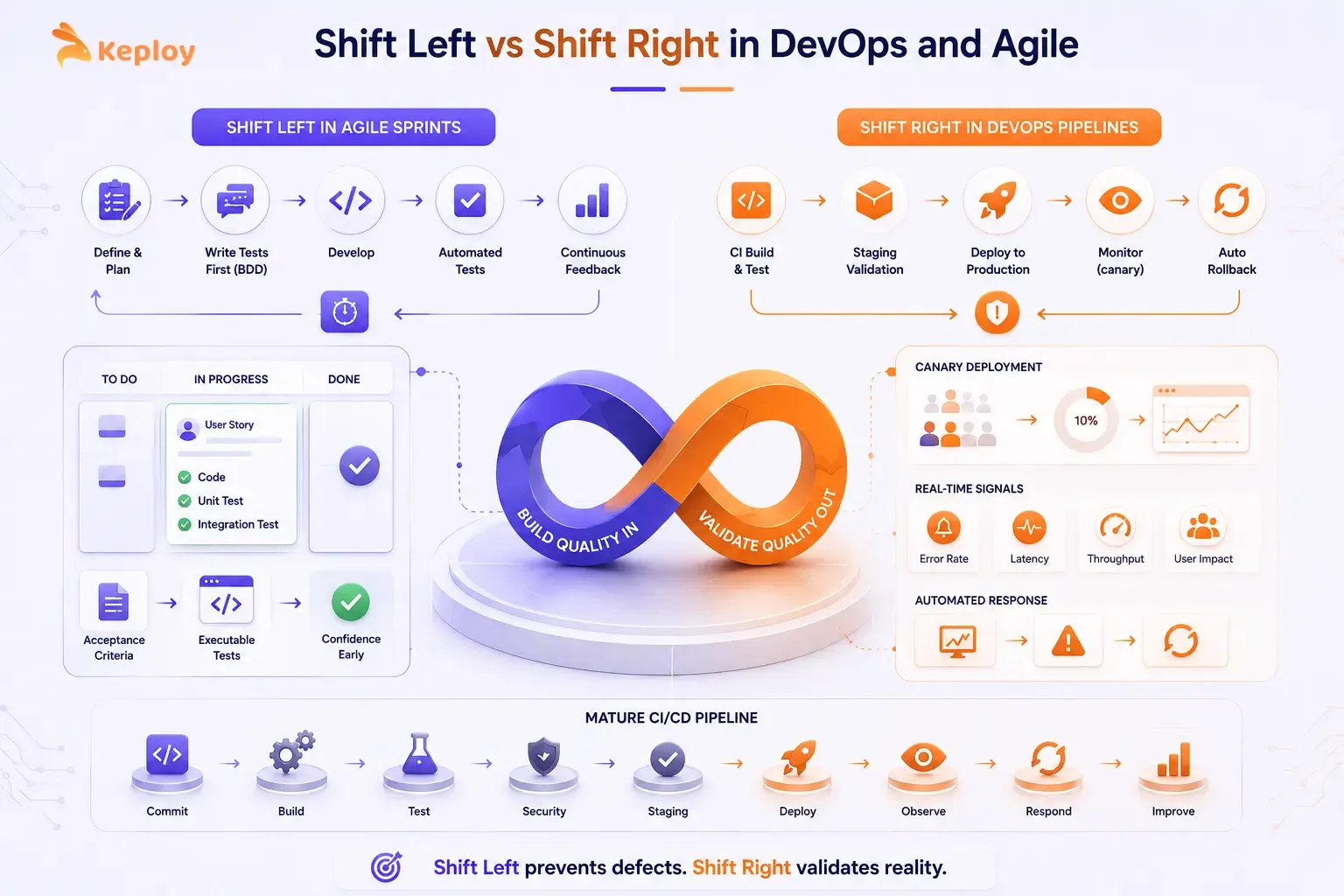
Shift Left in Agile Sprints
In Agile development, shift left shows up as a "definition of done" that includes automated tests. A story isn’t complete when the feature works. It’s complete when the tests prove the feature works and will continue to work.
BDD (Behaviour-Driven Development) bridges the gap between requirements and tests. Acceptance criteria get written as executable specifications before development begins. By the time code is written, the tests that validate it already exist. This is shift left at the requirements stage, not just the code stage.
The sprint feedback loop is tight. A failing test on day two of a sprint is cheap to fix. A failing test found in a regression run the day before release is expensive. Shift left compresses the feedback cycle to hours, not weeks.
Shift Right in DevOps Pipelines
In DevOps, shift right becomes a standard stage in the deployment pipeline. After a successful CI run and staging validation, the pipeline doesn’t end at deployment. It continues with canary traffic monitoring, error rate comparison, and automated rollback triggers.
Spotify’s deployment model includes production validation as a standard phase. Feature flags are the norm rather than the exception. A feature that isn’t behind a flag is unusual, not the default.
The "you build it, you run it" model that Amazon pioneered and Google’s SRE framework formalised puts production responsibility on the same team that built the feature. That accountability changes how teams design for shift right. You’re more likely to build in observability, rollback, and canary support when you’re also the one getting paged at 2am.
In a mature CI/CD pipeline, shift left and shift right aren’t alternatives. They’re sequential stages. What breaks in CI never reaches production. What reaches production is observed continuously. The deployment stage connects these two sides of the quality loop. Read our guide to the software deployment strategy and process for a detailed breakdown of deployment environments, execution models, validation, and post-deployment monitoring.
The Feedback Loop: How Shift Right Feeds Back Into Shift Left
Why Each Approach Alone Leaves Gaps
Shift left alone produces test suites that cover what engineers anticipated. The tests are only as good as the scenarios they represent. Teams write tests for the flows they know about and the edge cases they thought to consider. Real users find the ones they didn’t.
Shift right alone catches problems after users experience them. That’s valuable, but reactive. The same failure mode can recur because there’s no mechanism ensuring it gets codified as a pre-deployment gate.
The gap both approaches leave individually: shift left doesn’t know what it doesn’t know, and shift right learns but doesn’t prevent.
How the Feedback Loop Works Step by Step
The closed-loop model connects them:
-
Deploy with shift right observability in place. Traffic flows. Monitoring watches.
-
A real user triggers a behaviour nobody tested for. An error surfaces. Or performance degrades on a specific endpoint. Or an API response returns an unexpected field combination.
-
That production signal gets captured. Not just logged, captured as a test case. The request that caused the problem, the response that was returned, the state of the system when it happened.
-
That captured interaction becomes a regression test in CI. It runs on every future commit.
-
The same failure can’t reach production again without being caught first.
Strengthen Your Pre-Deployment Test Suite with Real Traffic
This is exactly the pattern Keploy is built for. When Keploy captures real API traffic from production or staging, it converts those request-response pairs into regression tests that run in CI. The test suite doesn’t just cover anticipated scenarios. It covers the actual scenarios real users triggered, including the ones no engineer thought to write a test for.
Teams using this approach find that the regressions most likely to cause production incidents are the edge cases real users hit first. Basing regression tests on real traffic rather than authored scenarios means coverage grows with actual usage, not with the imagination of whoever wrote the test cases.
When an API changes and a previously captured test fails, the failure surfaces in CI before deployment. That’s the shift right feedback closing the shift left loop.
DORA Metrics Impact of Running Both
Running both approaches in a feedback loop produces compounding DORA metric improvements:
-
Change Failure Rate drops because shift left catches more defects before deployment, and the regression suite grows with every production signal shift right captures.
-
Mean Time to Recovery drops because shift right observability detects problems faster and automated rollback responds before manual intervention is needed.
-
Deployment Frequency increases because teams trust the pipeline. Strong shift left coverage plus shift right observability means deployment becomes routine rather than high-risk.
The DORA 2024 data shows elite teams achieve all three simultaneously. The common factor across elite teams is not choosing between shift left and shift right. It’s building the feedback loop that connects them.
Tools for Shift Left and Shift Right Testing
Shift Left Testing Tools
The shift left tooling stack covers four categories: testing frameworks, static analysis, contract testing, and CI orchestration.
-
Testing frameworks: pytest and unittest for Python, JUnit and TestNG for Java, Jest and Mocha for JavaScript.
-
Static analysis: SonarQube, Semgrep, Checkmarx.
-
Contract testing: Pact.
-
CI orchestration: GitHub Actions, GitLab CI, CircleCI.
Shift Right Testing Tools
Shift right tooling covers observability, progressive delivery, and resilience validation.
-
Observability: Datadog, New Relic, Grafana with Prometheus.
-
Progressive delivery: LaunchDarkly, Unleash.
-
Chaos engineering: Chaos Monkey, LitmusChaos.
-
Incident management: PagerDuty, OpsGenie.
Tools That Bridge Both
The most useful tools are the ones that connect shift right observation to shift left prevention.
Keploy sits explicitly in this category. It captures real API traffic from production and staging environments and converts those interactions into regression test cases that run in CI. The shift right signal (what real users did) becomes a shift left gate (what the next deployment must not break). The test suite grows with actual usage patterns, not just with what engineers anticipated.
How Keploy Closes the Gap Between Shift Left and Shift Right Testing
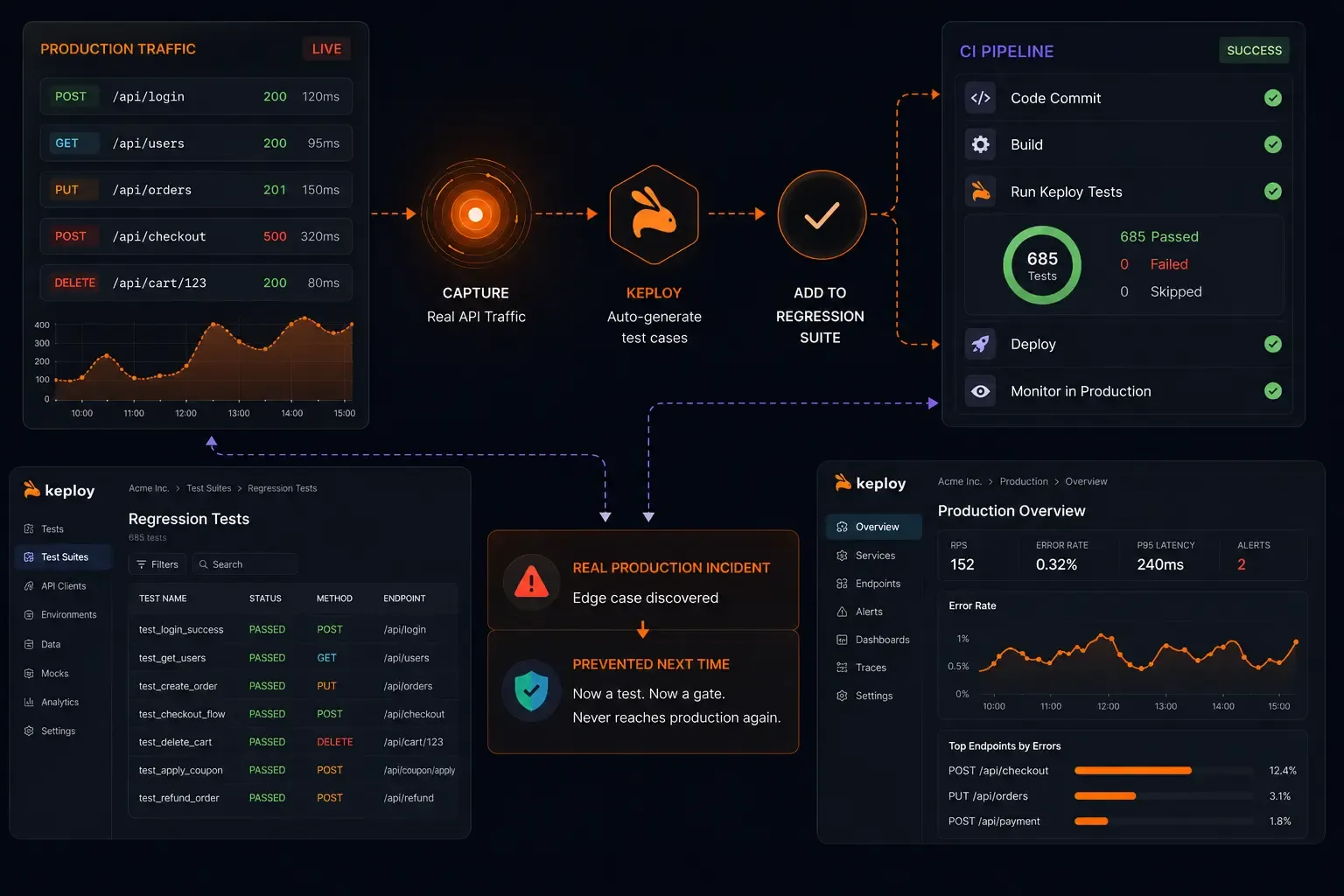
Most teams run shift left and shift right as separate activities with no connection between them. The shift left test suite grows through manual authoring. Engineers write test cases for the scenarios they anticipate. The shift right observability stack catches incidents in production. But those incidents rarely feed back into pre-deployment coverage. The same edge case can surface in production twice because nothing turned the first occurrence into a CI gate.
Keploy addresses this directly. It captures real API traffic from production and staging environments and converts those request-response pairs into regression tests that run in CI. The shift right signal becomes the shift left gate automatically, with no manual test authoring required. When a production incident exposes an untested edge case, that interaction becomes a test case that blocks the same failure on every future deployment.
The result is a test suite that grows with actual user behaviour rather than anticipated scenarios. The regressions most likely to cause production incidents are precisely the ones real users trigger first. Keploy’s approach ensures those interactions get codified as pre-deployment gates rather than incident reports.
Conclusion
Shift left and shift right aren’t strategies to choose between. They’re two halves of a quality loop that only works when both are running.
Shift left is how you prevent the failures you can see coming. Shift right is how you learn about the ones you couldn’t. The feedback mechanism that connects them (production signal becoming pre-deployment gate) is what separates teams that keep getting surprised by production incidents from teams that don’t.
Start with shift left if your test coverage is thin. Add shift right when your deployment process is stable enough to observe. Build the feedback loop once both are in place. That sequence is what the DORA data shows high-performing teams doing consistently across engineering organisations of every size.
Frequently Asked Questions
What is the difference between shift left and shift right testing?
Shift left moves testing earlier in the development cycle, before deployment, to catch defects when they’re cheapest to fix. Shift right extends testing into production to validate real user behaviour and system reliability after deployment. They target different failure modes and are most effective when used together.
Where does the term "shift left" actually come from?
Larry Smith coined it in 2001. It refers to the classic V-model project timeline, where testing traditionally happened on the right side (late in the cycle). Shifting left means moving those activities to the left, earlier. The name stuck because it’s intuitive on a timeline diagram even if nobody draws the diagram anymore.
We already have 80% code coverage: should we still do shift right?
Yes. Code coverage measures which lines ran during tests, not whether the tests reflect real user behaviour. An 80% coverage score says nothing about performance under real load, third-party API behaviour in production, or the edge cases real users trigger. Shift right exists precisely because coverage doesn’t equal quality.
Is shift right testing the same as testing in production?
Partly. Testing in production is one shift right practice, but shift right also includes staging-level approaches like shadow traffic testing and performance testing in production-like conditions. The defining characteristic of shift right isn’t where it happens. It’s that it validates real or realistic behaviour rather than anticipated scenarios.
What types of bugs does shift left consistently miss?
Performance degradation under real traffic volumes, third-party API behaviour that differs between sandbox and production, user behaviour combinations nobody anticipated, and cascading failures in distributed systems that only appear at scale. These aren’t failures of shift left. They’re the reason shift right exists alongside it.
Do you need chaos engineering to start with shift right?
No. Chaos engineering is advanced shift right. Start with canary releases and basic observability: error rates, latency, and log monitoring on new deployments. That alone catches the majority of production issues most teams miss. Add chaos engineering when your baseline observability and recovery processes are already solid.
How do you know if your shift left coverage is good enough to trust a release?
Track your Change Failure Rate: the percentage of deployments that cause a production incident. DORA research shows elite teams achieve rates below 5%. If yours is consistently higher, shift left coverage isn’t catching enough before deployment. The metric gives you a signal that’s more honest than test count or coverage percentage.
Do you need separate teams for shift left and shift right?
No, and in most high-performing organisations they’re intentionally owned by the same team. The "you build it, you run it" model means the developers who write the shift left tests are also responsible for production monitoring. Shared ownership creates the right incentives. Teams invest in shift right observability when they’re also the ones who get paged.