



The spiral model is a risk-driven software development approach that combines iterative prototyping with the structured phases of the waterfall model. Work progresses through repeating loops of planning, risk analysis, engineering, and evaluation, with each cycle producing a more refined version of the product. It suits large, high-risk projects where requirements evolve over time.
Would you believe there is a development methodology that treats changing requirements and technical risks as part of the process? That’s exactly what I thought about the Spiral Model until I explored it further.
The Spiral Model is a risk-driven software development lifecycle approach that combines iterative development with systematic risk analysis, making it ideal for large, complex, and evolving projects.
In this blog, we explore how it helps teams deliver high-quality software while managing risks effectively.
What is the Spiral Model?
The Spiral Model is an SDLC model that combines iterative development with elements of the waterfall approach. Introduced by Barry Boehm in 1986, it moves through repeated development cycles called "spirals," refining the product a little more with each pass.
Unlike rigid models, it puts risk front and center. Every cycle starts by identifying and evaluating risks, then picking the approach that best moves the project toward the final product. That makes it a strong fit for large, complex, and long-term projects where requirements evolve over time.
Uses of the Spiral Model
Some common uses of the Spiral Model include:
-
Dividing work into manageable iterations
Teams break the project into multiple development cycles, which lets them work toward smaller, achievable targets instead of one large delivery. -
Systematic risk evaluation and mitigation
At the start of each cycle, the team identifies technical, business, and user risks, then builds mitigation plans before development continues. -
Prototyping to validate ideas
Early software builds are created and improved with each cycle, which sharpens requirement understanding and guides development decisions. -
Continuous stakeholder feedback
Stakeholders review the output after every cycle, keeping the product aligned with user expectations as it grows. -
Documenting progress and decisions
Each cycle produces documentation covering what was achieved, what problems came up, and what comes next, which keeps the project transparent and under control.
Phases of the Spiral Model
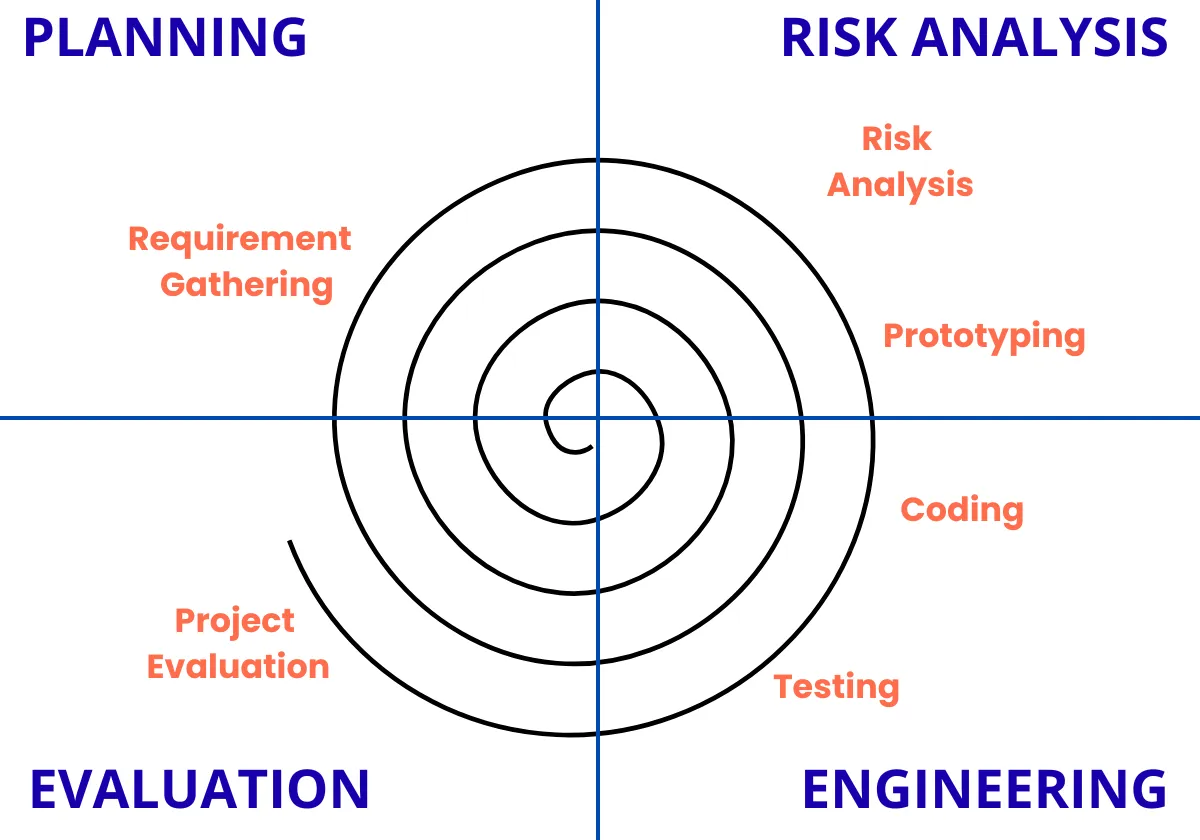
The Spiral Model undergoes four core phases in every cycle, blending planning, risk analysis, engineering, and evaluation.
-
Planning Phase
In the planning phase, system objectives, functionality, constraints, and key requirements are defined. The team also considers alternative solutions for the problem space, so that each iteration begins with a clear, goal-driven direction.
-
Risk Analysis Phase
In this stage, the team conducts a detailed risk analysis. Each alternative solution from the planning phase is checked against possible risk scenarios: technical, financial, schedule, or usability issues. To reduce uncertainties, proof-of-concept prototypes may be created at this stage. Teams also use sandbox testing environments at this stage to validate behavior in isolated conditions without affecting other systems or shared infrastructure.
-
Engineering Phase
Based on the selected approach, the product (or part of it) is designed, developed, and tested. This may include building the prototype, coding modules, unit testing, or integrating components. The focus of this phase changes as the project advances, with early spirals concentrating on mockups while the later ones shape the production-ready builds. Since each cycle targets different risks, teams typically adapt their software testing strategy from spiral to spiral, testing the highest-risk elements first. This includes regression testing in later spirals to verify that previously developed functionality remains intact as new components are integrated.
-
Evaluation Phase
The output is shared with the stakeholders for their feedback and validation, often through alpha and beta testing in the later spirals. The team determines whether objectives and risks were addressed effectively. Based on this, they decide whether to proceed to the next cycle, repeat the current one, or go with an alternative approach. This keeps the system user-oriented and iterative in nature.
Steps of the Spiral Model
Although the Spiral Model involves four main phases along each loop, these phases are further subdivided into steps.
-
The team collects detailed requirements from stakeholders, users, and domain experts. This step ensures that all internal and external expectations are captured.
-
After considering the initial requirements, a rough architectural design is prepared. It defines key modules, data flows, and interfaces.
-
A small-scale prototype is then built from the preliminary design. The prototype helps in demonstrating core functionalities and the UX flow.
-
After the first prototype is reviewed, the following steps are involved:
-
Evaluating strengths, weaknesses, and risks
-
Refining the requirements
-
Redesigning the system
-
Building and testing the next prototype
-
This cycle may repeat numerous times.
-
The project may be cancelled at this point, for instance, if the risk of cost overrun is very high, technical feasibility is doubtful, or the user is unsatisfied with the product being developed. This serves as a checkpoint for making cost-effective decisions.
-
Prototypes are evaluated and improved through several spirals. With these evaluations, the product becomes progressively closer to the system the user expects.
-
Once the prototype has been validated against user needs, the design of the final production-quality system is produced, taking into account all changes from previous iterations.
-
The system is rigorously tested for reliability before deployment, often combining API testing with performance monitoring, so that issues are detected and resolved proactively once the system is live.
Advantages of the Spiral Model
-
Enhanced Quality Control: Iterative software testing and evaluation in every phase results in fewer bugs and a more stable system.
-
Constant Customer Involvement: Stakeholders are engaged at every spiral to make sure the produced system meets expectations and stays relevant.
-
Improved Cost Estimation: Each spiral cycle provides better insights on budget and resources, aiding in accurate forecasting.
-
Supports Complex Systems: Well-suited for enterprise-level or multi-team projects where dependencies and priorities are constantly shifting.
-
Proactive Risk Management: Risks are identified and mitigated at each phase, thereby minimizing the chances of unforeseen troubles during deployment.
-
Flexibility in Requirements: Allows for iterative refinement of features based on user feedback and evolving business needs. It works well in environments where change is the norm.
Disadvantages of the Spiral Model
Consider these significant disadvantages before implementing the Spiral Model:
-
Not Ideal for Short Projects: Smaller applications often do not justify the layered approach of the Spiral Model.
-
Dependency on Risk Analysis: Without competent risk evaluators, the benefits offered by this model are significantly reduced.
-
Management Overhead: Coordination among various teams, reviews, and approvals is required for every cycle.
-
Complex Implementation: It needs a structured and disciplined team to handle the iterations and the risk evaluation.
-
Costly: Repeated planning, risk analysis, and prototyping add to the overall cost.
-
Time-Consuming: Each spiral cycle may take a lot of time, especially when dealing with risky elements.
-
Heavy Documentation: Constant documentation consumes significant effort and sometimes slows down development.
Risk Handling in the Spiral Model
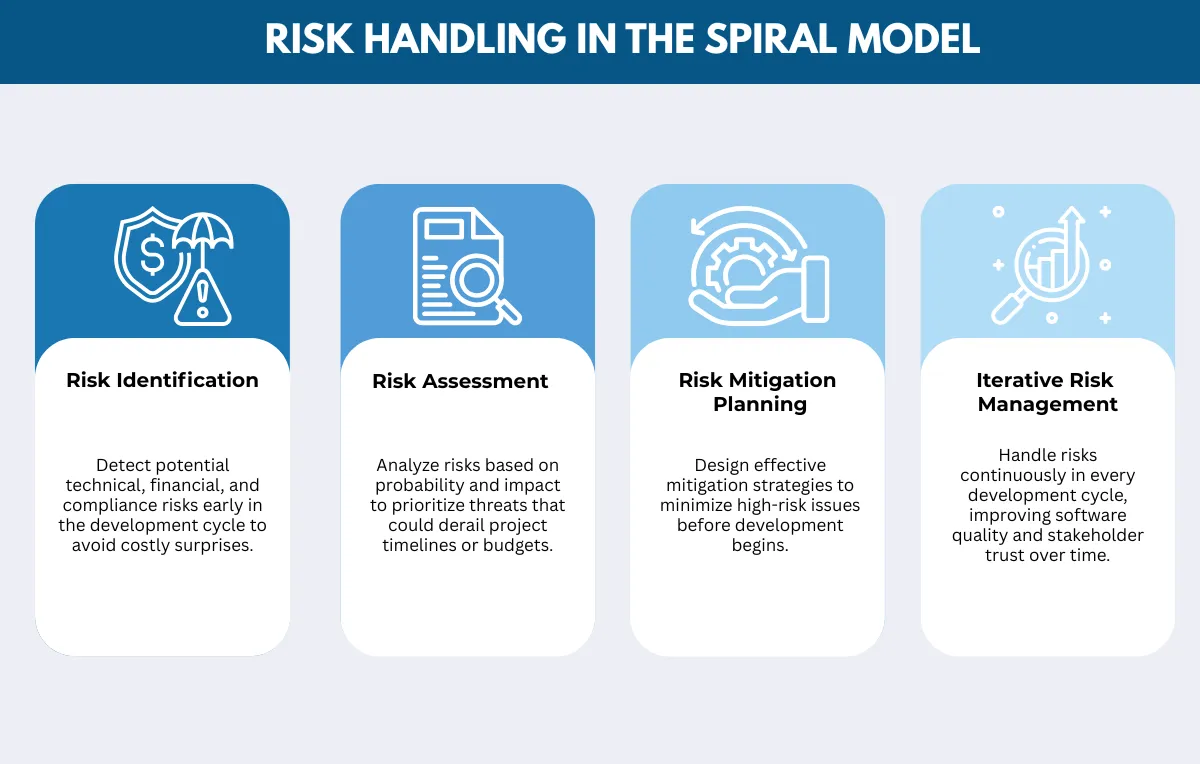
Risk handling lies at the core of the Spiral Model. It allows teams to address uncertainty at every step, before it becomes expensive or unmanageable.
How It Works
Each spiral cycle has a focused phase for:
-
Identifying risks (technical, budget, legal, etc.)
-
Analyzing risks in terms of severity and likelihood
-
Planning mitigation before development takes place
This repeats in every loop, making the process stronger over time.
Why It’s Important
-
Late-stage project failures are avoided
-
Expensive rework is reduced
-
Confidence grows in risky or evolving projects
-
Planning improves and stakeholder trust builds
-
Decisions come faster with fewer surprises
-
Software quality improves with each iteration
Example of the Spiral Model
Smart Agriculture Monitoring System
Consider the example of developing a system that helps farmers monitor soil moisture, temperature, and weather data using IoT sensors and a mobile app.
-
First Spiral Cycle
The team identified the basic needs: farmers have to monitor soil moisture and view results in real time in a mobile app. Some risks were identified, such as poor internet connectivity, exposure of sensors to weather conditions, and delayed data transmission.
A basic prototype was built with one moisture sensor and a simple app interface. The prototype was tested in a controlled environment for connectivity and real-time updates. -
Second Spiral Cycle
New functionality was added, including a temperature sensor and alerts for low soil moisture to help plan irrigation better.
This version was tested on a medium-sized farm to see how it performed in the field and how much power it consumed. -
Third Spiral Cycle
The system was expanded to include multiple farm zones and local weather data for planning purposes.
Multilingual features were added to help users overcome language barriers. User testing revealed problems with sensor pairing and a complicated onboarding process. To fix this, the onboarding was simplified, and the app interface was redesigned with accessible elements to improve the overall experience. -
Fourth Spiral Cycle
The team shifted focus to improving battery life, saving data in offline mode, and speeding up the app. Usage analytics were introduced to refine user-oriented features based on real behavior. Data privacy protections were also put in place, and supporting videos and guides were added for farmers who are new to technology.
Why is the Spiral Model Called a Meta Model?
The Spiral Model is called a meta-model because it does not mandate one software development methodology. Rather, it acts as a general framework within which different methodologies can be selected and applied according to the nature of the project and its risk profile.
In each spiral cycle, teams may follow Waterfall, Incremental, Evolutionary, or Agile, depending on what fits best at that time. The Spiral Model is a higher-level structure that guides these choices through continuous risk analysis and planning.
This flexible, meta-level design makes the Spiral Model adaptable to different project types, team cultures, and technical requirements. Rather than prescribing one particular approach, it provides a way to select and apply the most appropriate technique for the situation at hand.
The meta nature of the model allows it to integrate the best practices from other models, while retaining its own focus on iterative development and risk management.
When to Use the Spiral Model
The Spiral Model is particularly useful in the following scenarios:
-
Projects where requirements are unclear or expected to change, and detailed specifications are not available in advance.
-
High-risk projects involving cutting-edge or complex technologies that need validation through prototyping.
-
Projects that require frequent stakeholder reviews and feedback loops to stay aligned with business goals.
-
Systems with long development timelines where changes are inevitable.
-
Large systems where incremental delivery helps manage complexity.
It is commonly used in sectors like aerospace, defense, healthcare technology, and enterprise software, all of which require reliability and adaptability.
The Spiral Model for Software Development
The Spiral Model combines iterative development with effective risk management. To employ it successfully, consider the following key practices:
-
Create Simple Prototypes:
Build quick, functional models to test assumptions as early as possible. -
Engage Risk Experts Early:
Identify potential risks and deal with them before they grow. -
Engage Stakeholders Regularly:
Get feedback after each cycle to confirm requirements have not changed and you are on track. -
Keep Documentation Minimal:
Document only what is needed to aid progress and clarity. -
Be Flexible with Your Methods:
Change your approach depending on what suits the current stage best: Agile, Waterfall, or a combination. -
Plan for Change:
Requirements and risks are bound to evolve during the project. Identify how much time and budget you need to set aside for them. -
Train the Team:
Ensure that everyone understands the model and its emphasis on iteration and risk. -
Automate Where Possible:
Use test automation and integration testing to speed up the engineering and evaluation phases.
If teams follow these practices, they can manage complexity, limit risk, and achieve better outcomes with the Spiral Model.
How Keploy Helps You Automate the Testing Process
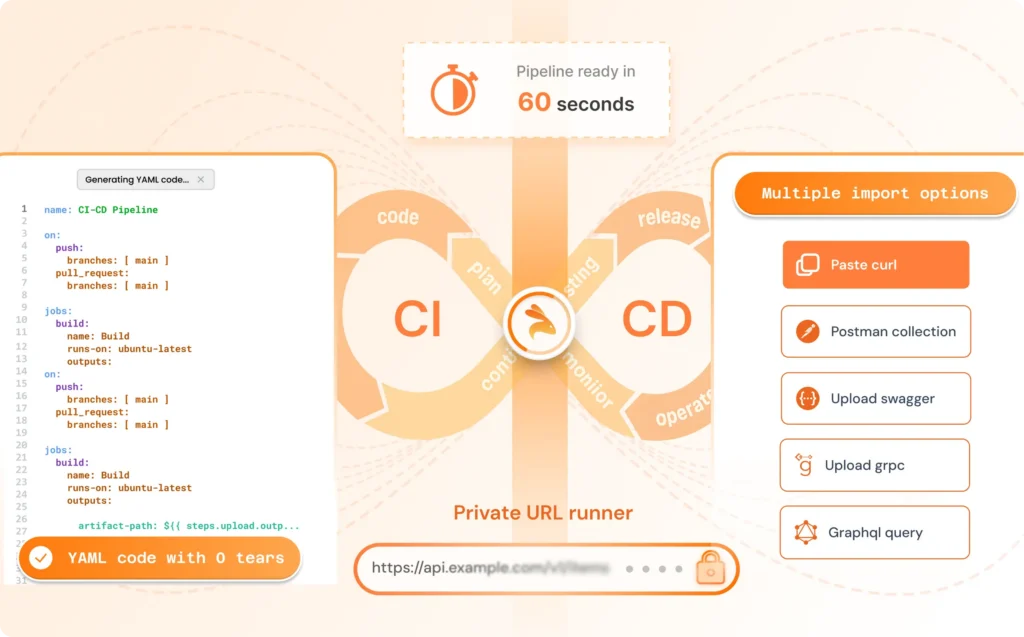
In the Engineering phase of the Spiral Model, testing plays a crucial role in minimizing technical risks and validating each iteration. Since development happens in repeated cycles, manual testing can quickly become time-consuming and inconsistent.
Keploy is an open-source testing platform that helps teams automate API testing, E2E, and integration testing by generating test cases from real application interactions. This lets teams validate every spiral cycle faster while maintaining high software quality.
By bringing automated testing into each iteration, teams can detect defects early, reduce rework, and ensure that every release aligns with user expectations and risk mitigation goals.
Conclusion
The Spiral Model demands structured planning, thorough documentation, and skilled risk analysis, but in return it delivers high-quality, reliable software.
Its ability to balance flexibility with control makes it ideal for complex and evolving systems. By combining iterative development with continuous risk management, the Spiral Model gives teams confidence in long-term software delivery.
For teams working on high-risk or large-scale projects, it remains one of the most practical SDLC models available today.
Some of the Other Useful Blogs for Your Reference:
FAQs
Q1. How does the Spiral Model compare to Agile methodologies?
Both are iterative, but the Spiral Model focuses on risk analysis and documentation, whereas Agile focuses on rapid delivery and close customer collaboration with minimal documentation.
Q2. How long are the iterations of each spiral?
It depends on the project. Iterations usually run from a few weeks to a couple of months, depending on the project’s complexity, scope, and level of risk.
Q3. What skills do I need to successfully implement the Spiral Model?
You need skills in risk management, prototyping, stakeholder management, and working in iterative cycles.
Q4. How do I measure success using the Spiral Model?
Look for reduced risks, satisfied stakeholders, high quality, and whether you achieved the objectives set at the beginning of each spiral.
Q5. Can the Spiral Model be combined with other development methodologies?
Absolutely. As a meta-model, the Spiral Model can incorporate multiple development processes depending on the project or organization’s needs.