AI Test Automation
What Is AI Test Automation?
AI test automation uses artificial intelligence and machine learning to generate, execute, maintain, and optimize software tests. It encompasses AI-powered test generation, self-healing tests, and autonomous testing agents — reducing manual effort while improving coverage and defect detection.
Traditional test automation requires engineers to manually write, maintain, and debug test scripts. AI shifts this burden by generating tests from code analysis, real traffic, or specifications, and automatically maintaining tests when the application evolves.
The market has matured significantly since 2024. What was experimental is now production-ready. Keploy's traffic-based generation is used by thousands of developers, and the question for engineering teams is no longer "should we use AI for testing?" but "which AI testing approach fits our stack?"
Types of AI Test Automation
Three categories of AI testing, each solving a different part of the testing problem.
AI Test Generation
Create test cases automatically from traffic patterns, code analysis, or API specifications. Eliminate manual test authoring.
- Traffic-based (Keploy)
- Code analysis (LLM-powered)
- Spec-based (OpenAPI)
Self-Healing Tests
ML models automatically update test scripts when the application changes. Reduce maintenance burden by 30-50%.
- UI selector healing
- API noise detection
- Schema migration handling
Autonomous Testing Agents
AI explores applications without predefined scripts. Computer vision, LLM reasoning, and reinforcement learning discover bugs autonomously.
- Exploratory testing AI
- Visual regression agents
- Fuzz testing with ML
How Keploy Uses AI for Testing
AI where it adds concrete value: eliminating false positives, generating tests from code changes, and reducing test suite bloat.
AI Noise Detection
When Keploy captures multiple recordings of the same endpoint, it uses statistical analysis and ML classification to identify non-deterministic fields. Timestamps, UUIDs, session tokens, and random values are automatically flagged and excluded from strict equality assertions.
This eliminates the primary cause of flaky tests without manual configuration. The model improves with more recordings, becoming increasingly accurate at distinguishing signal from noise.
Multi-LLM Test Agent
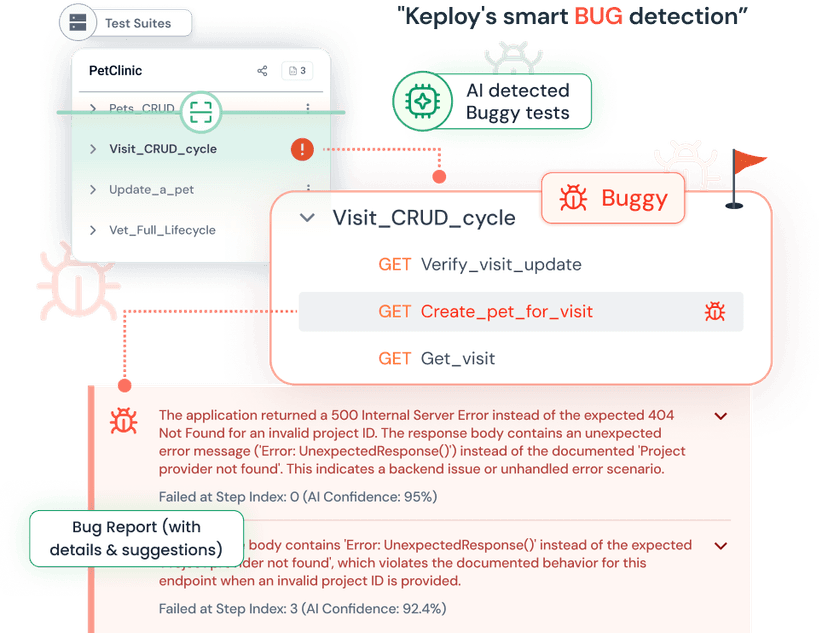
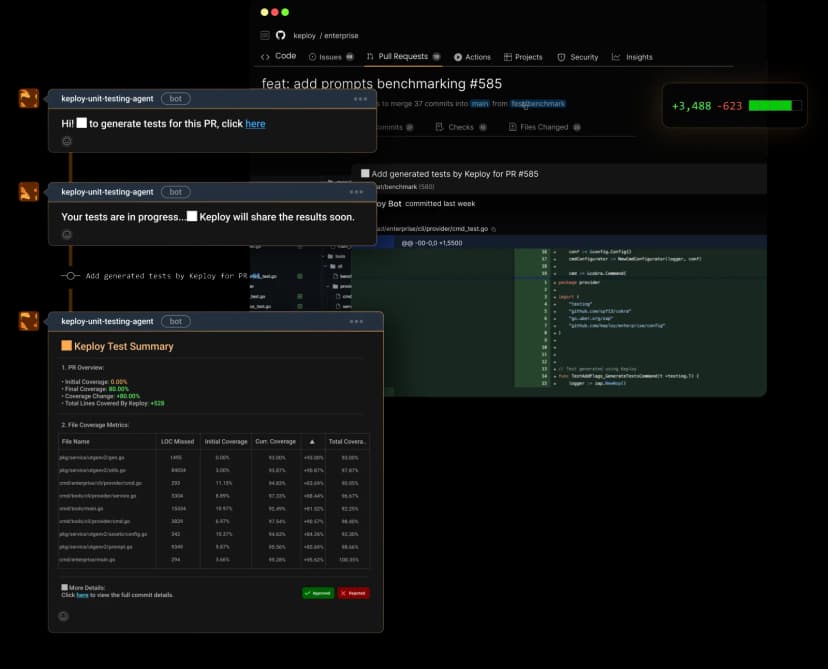
Keploy's Test Agent analyzes PR diffs using multi-LLM reasoning to generate targeted unit tests for changed code. Rather than generating tests for the entire codebase, it focuses on specific functions modified in a PR.
The Agent uses multiple LLM calls to: understand code change intent, identify testable behaviors, generate test cases covering happy paths, error paths, and edge cases, and validate that generated tests compile and pass.
AI-Powered Deduplication
When recording traffic from high-volume endpoints, Keploy may capture hundreds of similar requests. AI identifies functionally equivalent test cases — same code path, same assertion outcomes — and retains only the unique ones. This keeps the test suite lean and fast without sacrificing coverage.
ROI of AI Test Automation
Measurable impact for a 10-engineer team adopting AI testing tools.
Time on Testing
Code Coverage
Flakiness Rate
Prod Incidents/mo
Time Savings
Engineering teams spend 20-40% of development time on testing activities. AI test generation targets the largest cost center: authoring (40-60% of testing time).
Teams report 40-70% reduction in authoring time. Self-healing tests reduce maintenance time by 30-50%. Combined, this recovers 15-30% of total engineering capacity.
Defect Prevention Value
Each production incident costs 4-16 engineer-hours to investigate, fix, and deploy a hotfix. High-severity incidents include customer impact and SLA penalties.
Reducing production incidents by 50-60% through better test coverage translates to significant cost savings beyond direct time savings on testing activities.
Implementation Roadmap
A phased approach designed for measurable results within the first quarter.
Baseline and Quick Wins
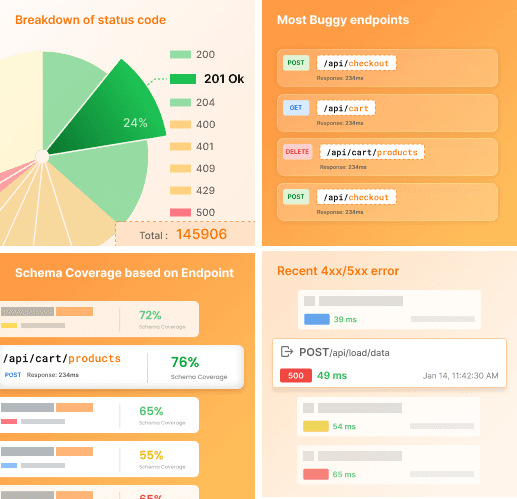
Measure current coverage, flakiness rate, and test execution time. Deploy Keploy in record mode on one service in staging. Capture traffic and generate your first tests. This takes 1-2 days per service.
Expand Coverage
Roll out traffic-based test generation to additional services prioritized by incident rate. Enable the Test Agent on repositories to generate unit tests on PRs. Integrate AI-generated tests into your CI gate.
Optimize and Measure
Track key metrics and compare to baseline. Fine-tune noise detection thresholds. Set up periodic traffic re-recording to keep tests current. Evaluate E2E self-healing for UI testing.

Scale and Iterate
Extend to all services. Establish flakiness SLAs. Automate traffic re-recording on a schedule. Report ROI to engineering leadership monthly. Evaluate new AI testing capabilities as they mature.
Evaluating AI Testing Tools
What to look for when selecting AI testing tools for your engineering team.
Test Quality
Do generated tests catch real bugs, or just inflate coverage numbers? Assess assertion depth, not just line coverage.
Maintenance Burden
Do tests break with every code change? Self-healing and noise detection reduce ongoing maintenance costs.
CI/CD Integration
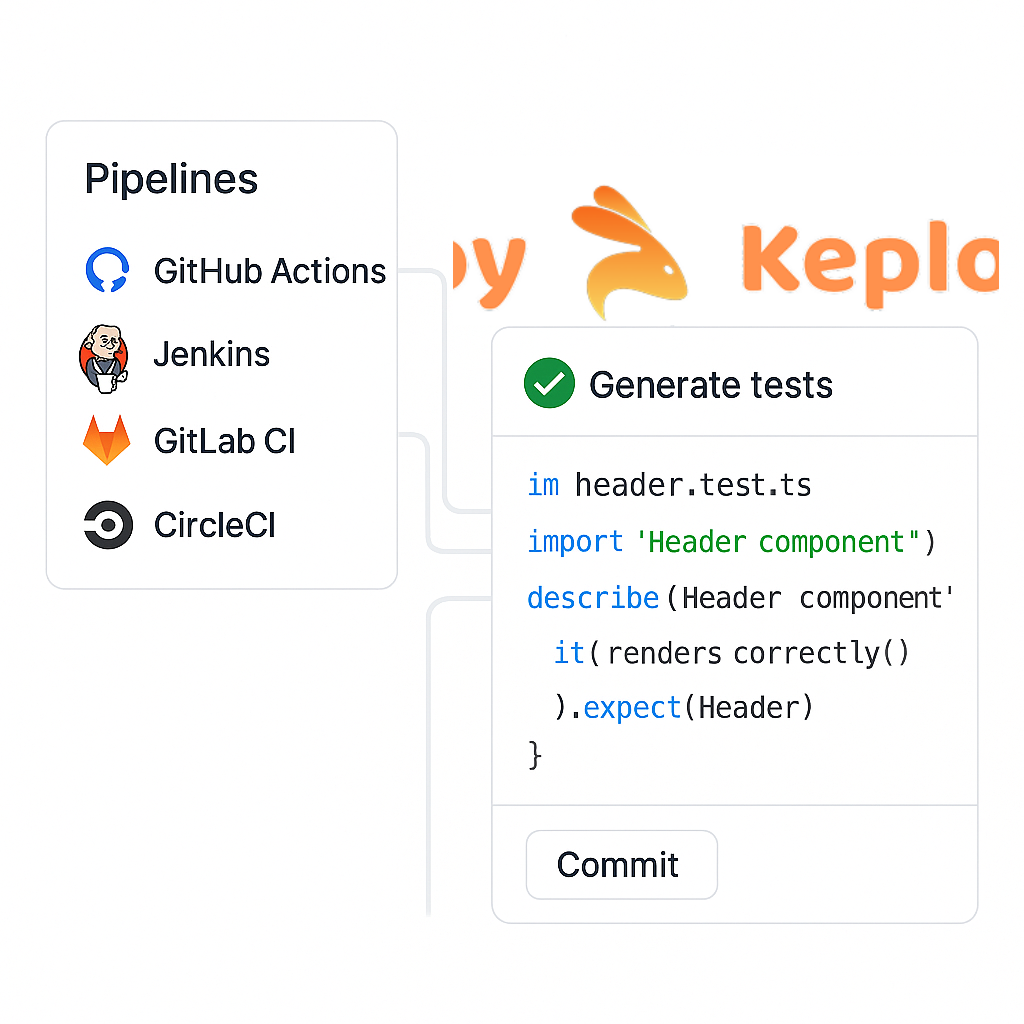
Does the tool integrate natively with your pipeline? Evaluate setup time, execution speed, and reporting quality.
False Positive Rate
Tests that fail incorrectly waste more time than missing tests. Measure the false positive rate before committing.
Non-Determinism Handling
How does the tool handle timestamps, UUIDs, and random values? Manual configuration vs automatic detection matters.
Total Cost of Ownership
Include license fees, engineering time for setup, ongoing maintenance, and training. OSS-core tools lower vendor risk.
Limitations and Risks
AI testing is powerful but not a silver bullet. Clear-eyed expectations help teams succeed.
Coverage does not equal quality
AI-generated tests can inflate coverage without catching real bugs. Always evaluate assertion quality, not just coverage impact. Keploy mitigates this by generating tests from real traffic with real response assertions.
AI cannot replace exploratory testing
AI excels at regression testing but struggles with discovering unknown behaviors. Human testers bring domain knowledge and adversarial thinking that AI cannot replicate. Use AI for repetitive work.
Tool lock-in risk
Proprietary tools create platform dependency. Prefer tools that store tests in standard formats (YAML, JSON) and can run without the vendor's cloud. Keploy stores tests as YAML files in your repository.
False positives in generated tests
AI-generated tests may produce false positives or false negatives. Review generated tests before trusting them blindly. Start with AI-generated tests as a baseline and refine over time.
See AI Testing in Action
How Keploy captures traffic, generates mocks, and eliminates flaky tests — all powered by AI.
FAQs
Join our GlobalCommunity
Connect with developers worldwide. Follow updates, ask questions, share feedback, and ship faster with other Keploy builders.


“Best report of integration and API tests I've seen — which we don't get from RestAssured.”
G2“Future of microservices testing. I don't write tests now!”
Mahfooz A. · G2 · 5/5“An amazing product that simplifies the automation.”
Gartner · 4.0