High Quality CodeHigh Velocity Business
Keploy improves code quality by converting real production traffic into regression tests that gate every pull request. It automatically surfaces defect density, test pass-rate, and coverage delta metrics, blocking flaky or defective code before it reaches the main branch so teams ship faster with fewer escaped bugs.
Your codebase isn't just logic—it's a promise to users for reliability, performance, and security.
Keploy embeds itself into your development lifecycle to ensure that promise never breaks—even as your app scales.
We help you record reality, automate validations, and continuously maintain quality—so your team can ship faster, smarter, and safer.
The Hidden Tax of Poor Code
Developer toil drains productivity and slows delivery
Keploy helps you reclaim your time and focus on what matters most.

$2.41T
annual cost of bad code
in the US alone
CISQ 2024
Poor-quality code costs companies over $7.72 mn/year in production-defect fire-fighting once they cross $100 mn ARR.
Defects siphon 4–6 % of total operating margin when downtime, escalations, and reputation loss are included.
54% of senior engineers consider quitting after 9 months of intense maintenance work—costing ~$122K per exit.
Low-quality teams experience 1.8× higher platform-team attrition than their high-quality peers.
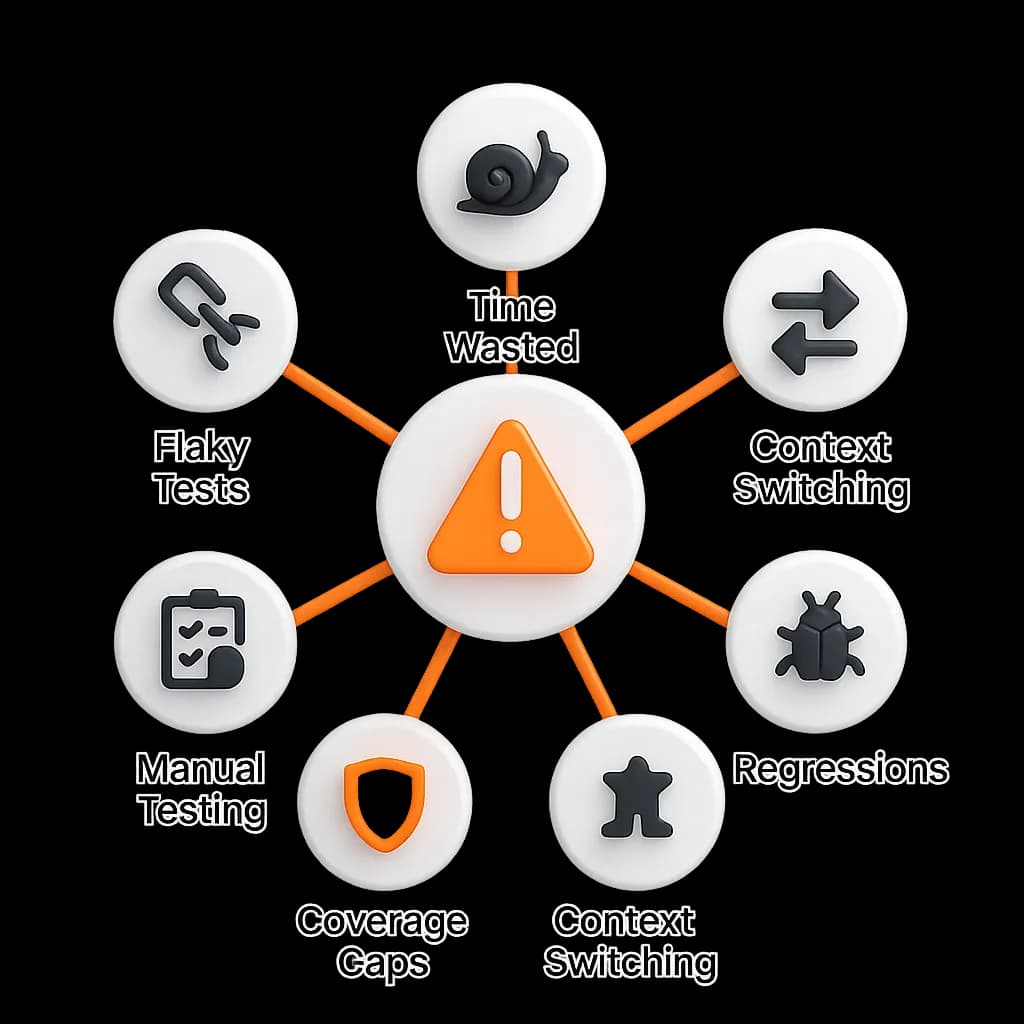
Code‑Quality Pitfalls
Holding Teams Back
Where developers lose momentum
- Flaky Tests – unreliable results drain confidence
- Manual Testing Grind – repetitive checks slow delivery
- Coverage Gaps – blind spots hide critical bugs
- Context Switching – constant task shifts erode focus
In our 2025 State of Code Quality Pulse Survey (n = 100 engineering leaders), a clear pattern emerged: teams that allow these four failure modes to persist sacrifice an average 23 % of sprint capacity to fire‑fighting and rework. That lost momentum shows up directly on the balance sheet—shipping delays, customer churn, and regulatory exposure add up fast.
The impact isn’t limited to velocity. When flaky tests and manual QA dominate the workflow, senior engineers spend their most expensive hours doing detective work instead of building features. Participants estimated that every week spent in a defect “war‑room” burns roughly $42 k in opportunity cost for a 20‑developer squad. Multiply that by a typical SaaS release cadence and you quickly cross the $7.7 million annual drag we see in companies breaking the $100 million ARR mark.
The human toll is just as real: 54 % of staff‑plus engineers said they would consider leaving after nine months of “hair‑on‑fire” bug duty. Attrition at that level costs roughly $122 k per regrettable departure once you factor recruiting, onboarding, and lost domain knowledge.
By contrast, organizations that invest 5 % of engineering bandwidth into automated, production‑mirrored testing report a 2.3 × faster time‑to‑market and a 46 % reduction in defect density within two quarters. Those gains compound into higher market share and—most importantly for CXOs—an operating‑margin lift of up to 6 percentage points.
Transform Your Development Excellence
Navigate your journey from reactive quality management to predictive excellence

Reactive Quality Management
Organizations at this stage address quality issues as they arise, often after deployment.
Key Characteristics:
- Manual testing processes dominate
- Quality issues discovered post-deployment
- High cost of defect resolution
Business Impact:
High technical debt, increased operational costs

Proactive Quality Practices
Teams begin implementing structured testing and quality gates in their development process.
Key Characteristics:
- Automated unit testing adoption
- Code review processes established
- Basic CI/CD pipeline implementation
Business Impact:
Reduced defect leakage, improved team productivity

Integrated Quality Culture
Quality becomes embedded in every aspect of the development lifecycle with comprehensive automation.
Key Characteristics:
- Comprehensive test automation strategy
- Quality metrics drive decision making
- Cross-functional quality ownership
Business Impact:
Faster time-to-market, enhanced customer satisfaction

Predictive Quality Excellence
Advanced analytics and AI-driven insights enable predictive quality management and continuous optimization.
Key Characteristics:
- AI-powered quality predictions
- Real-time quality monitoring
- Continuous optimization loops
Business Impact:
Market leadership, innovation acceleration
Metrics That Matter
A year ago, every release felt like a gamble. Hot-fixes crowded the sprint board, QA cycles dragged, and customer support lived on standby for rollback alerts. The team worked hard, but the code worked against them—bug reports kept outpacing features, and launch dates served more as wishful thinking than reliable milestones.
That changed the moment quality moved upstream. Production traffic became a living test suite; pull requests arrived with auto-generated test cases and instant coverage reports. A failing check now blocks defects at the branch, not in production. Suddenly, developers merge with confidence, product managers plan aggressive roadmaps, and on-call rotations feel almost—dare we say—boring.
The ripple effects are tangible: releases ship twice as often, outages shrink from hours to minutes, and long-postponed migrations finish a third faster. Nearly $3 million in defect costs stay off the ledger, while the equivalent of five engineers is redirected from firefighting to building the next big thing. The metrics below capture the journey—proof that when quality leads, velocity follows.
2×
deployment frequency
67%
reduction in MTTR
25%
faster time to market
33%
faster migrations
$2.9 M
cost saved
5
engineers reallocated
FAQs
Built for Developers
Ready to Upgrade Your
Code Quality?
Turn real traffic into regression tests in minutes—no rewrites, no friction. Start for free, ship with confidence, and watch your quality metrics soar.
Try Keploy Free →